


Many hunters may initially find home processing daunting, especially when it comes to skinning a deer. However, the right tools and a bit of practice can make the job more manageable.
How We Earn Your Trust
Hands-On Testing
Where a knife was tested, we say who tested it, and partner footage is labelled. How We Test →
Specs You Can Check
Figures come from the manufacturer’s product page. Where a figure comes from a retailer or differs from the knife we tested, we say so.
How We Make Money
We earn a commission when you buy through our links. Commissions do not decide which knives we pick. How We Make Money →
Top Picks
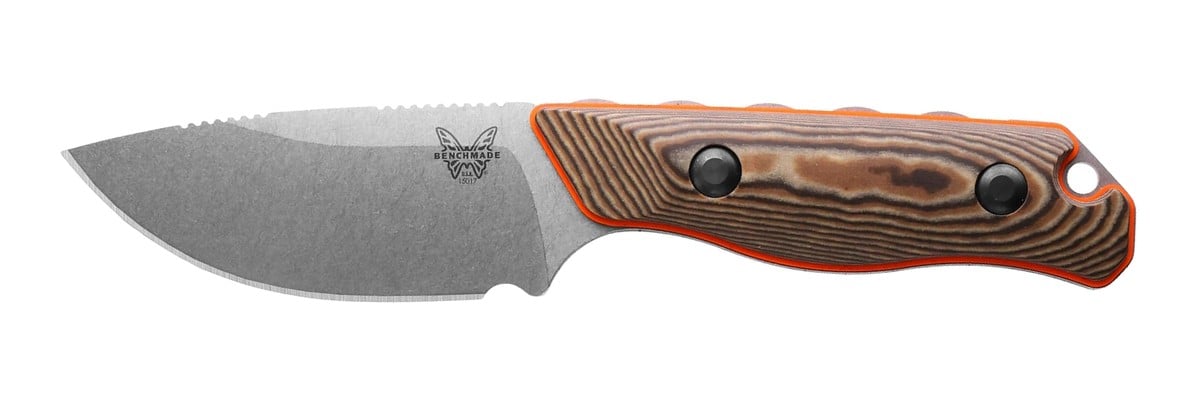
The Benchmade Hidden Canyon Hunter is my pick for the best skinning knife for deer because its short, deep-bellied blade gives you control around the tight spots and holds an edge through the whole job. If you’d rather swap to a fresh edge than sharpen, the Outdoor Edge Razor-Pro adds a gutting blade too.
Deer Skinning Knife Comparison
Figures come from the maker or the retailer listing for the exact version recommended. Weights are for the knife without a sheath or spare blades.
| Knife | Best For | Blade | Overall | Thickness | Weight | Steel | Main Trade-off |
|---|---|---|---|---|---|---|---|
| Hidden Canyon | Precise, compact skinning | 2.79 in71 mm | 6.42 in163 mm | 0.12 in3.0 mm | 3.11 oz88 g | CPM S90V → | Premium price |
| Tellus FX | Skinning plus camp chores | 4.2 in107 mm | 9.0 in229 mm | Not published | 6.7 oz190 g | CRYO 440C → | Long and heavy for skinning |
| Razor-Pro | Fresh edge on demand | 3.5 in89 mm | 8.0 in203 mm | Not published | 5.67 oz161 g | 420J2 replaceable blades → | Thin blades, more to clean |
| Soldotna | Skinning and quartering | 3.48 in88 mm | 7.63 in194 mm | 0.12 in3.0 mm | 3.3 oz94 g | 1095 → | Pricey for 1095 |
| Izula | Lightest pack weight | 2.88 in73 mm | 6.25 in159 mm | 0.16 in4.1 mm | 1.9 oz54 g | 1095 → | Small grip |
| Buck 103 | Long sweeping cuts | 4.0 in102 mm | 8.25 in210 mm | Not published | 4.3 oz122 g | 420HC → | Less nimble |
| Quick Skin | Dedicated hide removal | 3.5 in89 mm | 7.13 in181 mm | 0.19 in4.8 mm | 6.6 oz187 g | 1095 → | Heavy, specialized |
Best Overall: Benchmade Hidden Canyon Hunter
The compact skinner I trust most: a short, controllable blade with a deep belly and an edge that lasts through a whole deer.
What We Like about Hidden Canyon
- +Deep belly with two sets of jimping for precise control
- +CPM S90V holds an edge a long time
- +Short blade is easy to steer around the legs and tail
Good to Know about Hidden Canyon
- Smooth Richlite scales can feel slick when dry
- Costs the most on this list
Full Specs
- Model
- 15017-1, Richlite
- Blade Length
- 2.79 in71 mm
- Overall Length
- 6.42 in163 mm
- Blade Thickness
- 0.12 in3.0 mm
- Blade Shape
- Drop point
- Grind
- Flat
- Steel
- CPM S90V →
- Handle
- Richlite
- Tang
- Full
- Weight (Listed)
- 3.11 oz88 g
- Sheath
- Boltaron
- Origin
- USA
The Hidden Canyon Hunter is also my top pick among the best hunting knives, and it was an easy choice for the best deer skinning knife. I found that the factory edge was hair-popping sharp in my testing. This knife will take the skin off a deer like butter. The drop point blade is very thoughtfully designed. It has a deep belly with two sets of jimping. The first is in a standard location in the usual spot ahead of the handle. However, the second set further down the blade makes this knife stand out. It helps give this knife some unbelievable control.
I’m not a massive fan of the smooth scales on this knife. They are beautiful, but they feel a bit slick. However, during testing, they performed better during a wet hands test than when dry. I was surprised but couldn’t argue with the result. The sheath isn’t my favorite, but it has a low profile. I don’t consider either of these deal-breakers because the rest of the blade is so great.
The model pictured and linked here is the 15017-1, with CPM-S90V steel, Richlite/G-10 handles and a Boltaron sheath. The 15017 uses CPM-S30V, stabilized wood handles and a leather sheath. Both have the same blade, and the 15017-1 weighs 3.11 ounces versus 2.81 ounces for the wood model. The S90V version holds an edge longer and is harder to sharpen, while the S30V model costs less and is easier to touch up. Neither has the reach of the Soldotna, but that short blade is the reason to choose it for close, controlled work.

Best Budget: SOG Tellus FX Blaze
The least expensive pick, and a fixed blade that keeps working as a camp and everyday knife after the season.
What We Like about Tellus FX
- +Costs the least of any knife here
- +Blaze orange handle is easy to find on the ground
- +Finger groove and jimping give a secure grip
Good to Know about Tellus FX
- 4.2 inch blade is longer than you need for skinning
- Adjustable sheath clip is hit-or-miss
Full Specs
- Model
- Tellus FX, Blaze orange
- Blade Length
- 4.2 in107 mm
- Overall Length
- 9.0 in229 mm
- Blade Shape
- Drop point
- Grind
- Flat
- Steel
- CRYO 440C →
- Handle
- GRN
- Tang
- Full
- Weight (Listed)
- 6.7 oz190 g
- Origin
- Taiwan
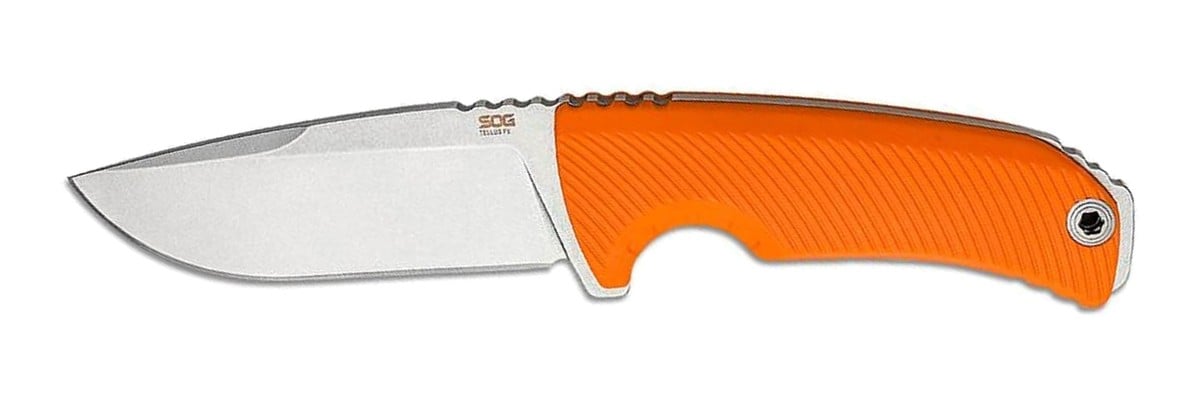
The Tellus FX Blaze is a solid knife. The finger groove and jimping combine for some solid ergonomics. An orange handle makes it easy to relocate if set down while skinning in the dark. This knife has extra value because it can double as an EDC in the offseason. Meanwhile, the 4.2-inch drop point blade is slightly longer than the range I generally recommend for skinning. It has a decently deep belly for optimal cutting.
SOG packages this knife with a sheath that utilizes its universal mounting system. Loosen a few screws to change the height and configuration of the clip. Depending on the user’s knife-carrying preferences, the system is a bit hit-or-miss. This is one situation in which going simpler might have been a better idea. For hunters planning to carry their skinning tool in a pack, it’s a non-factor for this affordable knife.
The Tellus is the budget choice for someone who also wants a general outdoor fixed blade. Its 4.2-inch blade and 6.7-ounce weight are more knife than you need just to separate a deer’s hide. Choose the Hidden Canyon for tighter work or the Izula for a lighter pack. Choose the Tellus for a fuller grip and more reach without the premium price tier.
Best Replaceable Blade: Outdoor Edge Razor-Pro
A fresh, razor-sharp skinning blade at the push of a button, plus a separate gutting blade for opening the deer.
What We Like about Razor-Pro
- +Push-button blade change, no tool or pliers needed
- +Second, non-replaceable gutting blade folds out for opening the body cavity
- +Comes with spare 3.5 inch skinning blades
Good to Know about Razor-Pro
- Thin replaceable blades won't take twisting or bone work
- Hair, fat and blood collect around the blade holder
Full Specs
- Model
- RO-10, black (folding, lockback)
- Blade Length
- 3.5 in89 mm
- Overall Length
- 8.0 in203 mm
- Blade Shape
- Drop point + gutting blade
- Grind
- Flat
- Handle
- Rubberized TPR
- Weight (Listed)
- 5.67 oz161 g
- Sheath
- Nylon belt sheath
- Origin
- China
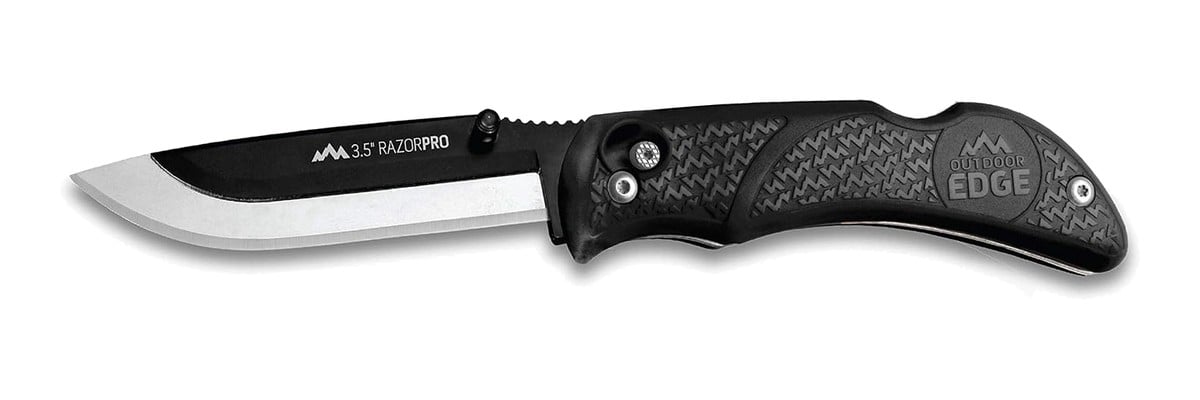
I like the convenience of swapping to a fresh blade instead of stopping for a touch-up with a whetstone. The Razor-Pro changes blades with a push button, so there is no scalpel-style blade to wrestle on or off with cold fingers, and the rubberized handle gives you far more to hold than a bare scalpel.
What sets it apart from a single-blade replaceable knife is the second blade. The fold-out gutting blade has a blunt tip, so you can open the belly with less risk of cutting into the stomach or intestines, then switch to the 3.5 inch skinning blade for the hide. So one tool covers both the deer gutting knife job and the skinning.
The replaceable blades are thin, which suits hide removal and small-game work, not twisting through a joint or levering against bone. Bring spares rather than counting on one edge to finish every job. Pack used blades in a rigid, closed container, not loose in a pocket or game bag.
The folding mechanism and blade-swap system can trap dirt, hair and blood. That is the compromise for avoiding field sharpening, and it is why the Hidden Canyon remains the better all-round choice for hunters who prefer one reusable blade. For knives aimed at the broader job of gutting and breaking down game, see the field dressing knife guide.
Best Backcountry: CRKT Soldotna
One knife for skinning and quartering on a backcountry hunt, with a balanced Micarta handle and almost no weight in the pack.
What We Like about Soldotna
- +3.48 inch blade handles both skinning and quartering
- +Micarta handle feels balanced and secure
- +Made in the USA, built with TOPS Knives
Good to Know about Soldotna
- 1095 steel rusts if you leave it wet
- Expensive for a 1095 blade
Full Specs
- Model
- 3029, Micarta
- Blade Length
- 3.48 in88 mm
- Overall Length
- 7.63 in194 mm
- Blade Thickness
- 0.12 in3.0 mm
- Blade Shape
- Drop point
- Grind
- Flat
- Steel
- 1095 →
- Handle
- Micarta
- Tang
- Full
- Weight (Listed)
- 3.3 oz94 g
- Sheath
- Leather
- Origin
- USA
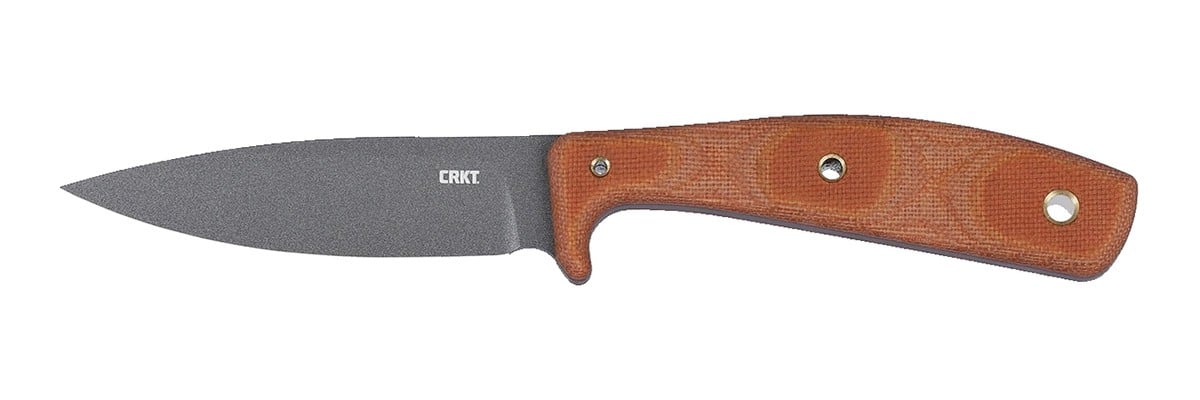
Backcountry hunts present an extra challenge for skinning. A knife will also probably be needed to quarter the animal in the field. The Soldotna’s blade is a good size for both. I love how this knife’s Micarta handle feels in the hand. It was extremely well-balanced during my testing. At the same time, I wasn’t afraid to put a little leverage on it, either. It’s a surprisingly robust knife, considering that it weighs only slightly more than 3 ounces. This is a knife that most hunters won’t even notice in their heavy backcountry pack. CRKT designed this knife with TOPS knives, and the quality of both companies shows. Some hunters might think it overkill, but I love the Cerakote finish here.
This knife is expensive for a blade made from 1095 steel. However, I suspect that some of the price comes from that Cerakote finish I mentioned earlier. I look at this one as more of an investment piece. The construction is excellent. The longer blade and full handle make more sense than the compact Hidden Canyon when one knife has to handle both skinning and the larger cuts involved in quartering. Work through joints rather than using the edge to chop or pry through bone.
Best Lightweight: ESEE Izula
The lightest fixed blade here, small enough for a whitetail and simple to wash in one piece.
What We Like about Izula
- +About 2 ounces, the lightest fixed blade here
- +One-piece steel is easy to clean
- +Tough enough to take some leverage
Good to Know about Izula
- Bare skeleton handle is small for big hands
- Short blade means more strokes on a big-bodied deer
Full Specs
- Model
- Izula, black
- Blade Length
- 2.875 in73 mm
- Overall Length
- 6.25 in159 mm
- Blade Thickness
- 0.16 in4.1 mm
- Blade Shape
- Drop point
- Grind
- Flat
- Steel
- 1095 →
- Handle
- Bare steel
- Tang
- One-piece steel
- Weight (Listed)
- 1.9 oz54 g
- Sheath
- Molded polymer
- Origin
- USA
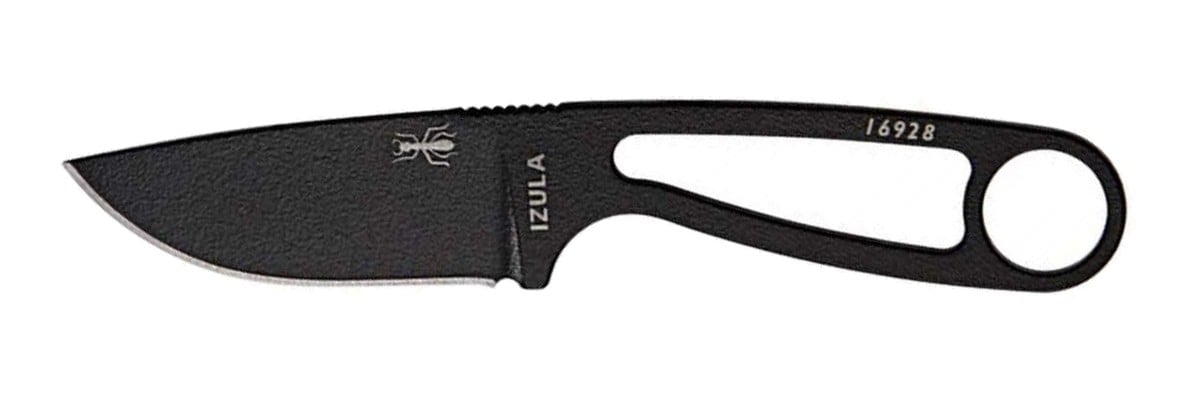
The ESEE Izula is an incredibly versatile knife that can do a little bit of everything. The compact blade is the perfect size for whitetails. This is a highly rugged knife thanks to a one-piece construction. I was never afraid to put any leverage on this blade for more strenuous tasks. Although, I doubt that most hunters will need to work the blade hard. The knife I tested came with an excellent factory edge. At about 2 ounces, this knife is hardly noticeable in a pocket or hunting pack. Its low weight and easy-cleaning, one-piece construction make it my lightweight fixed blade pick.
The skeletonized handle might not be to everyone’s liking. A paracord wrap or removable scales can fill out the grip, but they add weight and need more attention during cleaning. The bare handle is the simpler option if minimum weight and easy washing matter most. I also found the sheath retention to be tight during my testing. It remains to be seen whether it will loosen with time. Otherwise, I love this knife for skinning. Clean and dry the 1095 steel after use and keep it protected against rust. The coating protects covered surfaces, but it doesn’t make the steel stainless. Read the full ESEE Izula review →
Best Traditional: Buck 103 Skinner
The classic American skinner: a wide, deep-bellied blade for long sweeping cuts and a handle that fills a big hand.
What We Like about Buck 103
- +Wide blade with a deep skinning belly
- +Comfortable handle for larger hands
- +Made in the USA with Buck's lifetime warranty
Good to Know about Buck 103
- Broad blade is less nimble in tight spots
- Basic leather sheath
Full Specs
- Model
- 0103BKS-B
- Blade Length
- 4.0 in102 mm
- Overall Length
- 8.25 in210 mm
- Blade Shape
- Skinner
- Grind
- Hollow
- Steel
- 420HC →
- Handle
- Phenolic
- Weight (Listed)
- 4.3 oz122 g
- Sheath
- Leather
- Origin
- USA
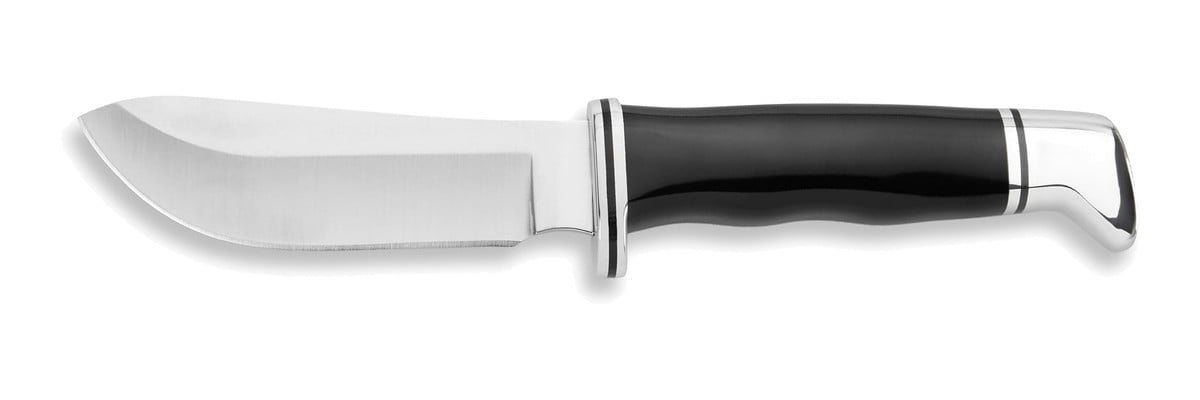
I love how, as much as times change, Buck Knives stay mostly the same. The 103 Skinner is the definition of a classic hunting knife. It has a signature black handle and metal bolster with a satin finish. It’s almost too pretty to skin with. Buck gave this knife a wide blade with a deep belly. It has a subdued tip, but care is still needed to avoid puncturing or catching the hide in tight areas. The ergonomics here are excellent. This knife is a great choice for hunters with larger hands. It would also be a good choice for anyone who wants more control during skinning.
The included sheath is functional but nothing special. It’s not a horrible one, but it’s nothing special, either. Still, it’s an acceptable trade-off since there are aftermarket options. The Skinner is a beautiful, functional knife perfect for the traditional hunter.
The Buck is the more traditional choice for long, sweeping cuts on an already field-dressed deer. Its broad blade is less nimble than the Hidden Canyon around small, awkward areas, but the longer handle gives larger hands more room. If you want a dedicated hide-removal knife rather than the lightest all-purpose hunting tool, that trade-off makes sense.
Best Dedicated Skinner: TOPS Quick Skin
An all-belly blade built for one job: taking the hide off with fewer, longer strokes.
What We Like about Quick Skin
- +All-belly blade covers more hide per stroke
- +Two sets of jimping for several grip positions
- +Made in the USA with a Kydex sheath
Good to Know about Quick Skin
- One of the heavier knives here
- Too specialized to be your only hunting knife
Full Specs
- Model
- QSK-02, Tungsten Cerakote
- Blade Length
- 3.5 in89 mm
- Overall Length
- 7.13 in181 mm
- Blade Thickness
- 0.19 in4.8 mm
- Blade Shape
- All-belly skinner
- Grind
- Flat
- Steel
- 1095 →
- Handle
- G-10
- Tang
- Full
- Weight (Listed)
- 6.6 oz187 g
- Sheath
- Kydex with Beta loops
- Origin
- USA
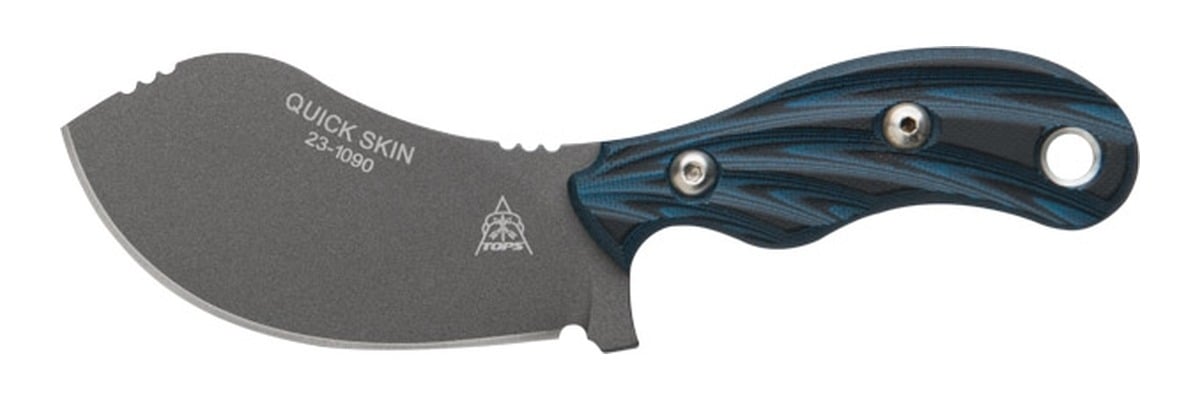
A deep belly can help with the long, sweeping cuts used in skinning. TOPS’ Quick Skin knife offers just that. There are two sets of jimping on this blade. The second set near the front of the blade helps with leverage where precision is needed. It wasn’t necessary, but I appreciate that TOPS gave this knife a Cerakote finish.
That finish, combined with the fact that TOPS knives are made in the USA, does drive the price up a little. This knife is also one of the heavier options out there. I like this knife best for anyone who values a broad skinning blade and several grip positions over minimum pack weight. The Hidden Canyon is easier to carry for mixed tasks, and the Quick Skin is the more specialized choice when hide removal is the priority.
How To Choose A Deer Skinning Knife
Quick Checklist
- Job: Skinning only, or gutting and quartering too
- Blade: 2 to 4 inches with a deep belly and a controllable point
- Edge: Sharpenable steel or replaceable blades
- Grip: Texture that holds with wet, cold hands
Most quality hunting knives can also skin a deer. The useful distinction is how much other work you expect that knife to do. An expensive blade will not replace practice, and a larger knife is not automatically a better skinner.
Skinning
Skinning means separating the hide from the carcass. A curved belly and a point you can control are useful here. Much of the hide can be pulled away, with the knife cutting the connective tissue that resists. The Buck 103 and TOPS Quick Skin put that broad cutting belly first. The Hidden Canyon gives up reach for easier control around tight areas.
Gutting and Quartering
Gutting, or field dressing, means removing the internal organs. A controllable tip and a secure wet grip matter more than a very broad blade, which is why the Razor-Pro’s guarded gutting blade is useful here. Quartering adds longer cuts through meat and connective tissue, plus work around joints. The Soldotna’s extra reach and full handle suit that mixed workload. None of these knives is a substitute for a saw when you need to cut bone. Back at the processing table, a boning knife can be more useful for trimming and separating meat from bone.
Blade Shape
Skinning a deer with a classic Bowie knife or other clip point blade is possible. However, the finer point is also prone to snagging on the deer’s hide. It’s not the best choice for hunters planning to tan the hide. A curved belly with a controllable, less aggressive point is preferable. You do not need to dull the tip to get it. Drop points are by far the most popular these days. The deep belly helps control and separate the hide from the meat.
Handle and Grip
If the skinning is done correctly, then hunters don’t need to work the blade of their knife too hard. However, having a decent texture for more control and leverage is nice. Comfortable handles are especially important in cold conditions. They also help when the deer has been dead for a long time. The more the animal has stiffened, the harder the skinning job.
Steel
Picking a steel type for a skinning knife goes together with deciding on a budget. Technically, any low-grade steel, even 8Cr13MoV, can skin a deer. The main difference is in performance. Steels like S30V or S90V can offer good edge retention, but don’t assume a knife will process multiple deer without a touch-up. This is usually a trade-off decision because the better steels result in a higher price point.
Fixed Blade or Replaceable Blade
Choose a fixed blade if you want one knife for skinning, field dressing and other light outdoor cutting. It is easier to wash thoroughly, and there are no loose replacement blades to manage. You do need a way to maintain the edge, so a compact hunting knife sharpener is worth packing even with a premium steel. Choose a replaceable-blade folder if a fresh edge on demand matters more than all-round versatility. The Razor-Pro is particularly useful when you want a gutting blade and a fresh skinning edge in one tool. Bring compatible spares and a closed container for used blades, and keep lateral pressure off the thin blade. A replaceable edge does not eliminate cleaning. The holder, pivot and lock still collect hair, fat and blood.
How I Picked These Knives
In addition to hunting whitetails for the last 23 years, I’ve covered knives professionally for the last decade. I’ve used my share of knives, both sharp and dull, on deer. Subsequently, I’ve learned what types of knives work best for these chores and what don’t. I ensured that this piece didn’t include knives that hadn’t previously stacked up for me.
You might expect the Havalon Piranta here. It’s a fine skinner, but its scalpel-style blades need careful handling or a separate removal tool, and I prefer a push-button change with cold hands.
Final Thoughts
For compact control, the Benchmade Hidden Canyon Hunter blew me away with its edge retention and control. It is my pick for hunters who want a compact fixed blade that can handle more than hide removal. If one knife has to skin and quarter on a backcountry hunt, get the CRKT Soldotna. If you’d rather never sharpen in the field, get the Outdoor Edge Razor-Pro.
Deer Skinning Knife FAQs
What is the best length for a skinning knife?
Skinning knives don’t need to be huge. For deer, a blade in the 2-to-4-inch range is a good starting point. Although skinning a deer with a longer knife is possible, shorter knives are easier to control in tight areas. This is especially true around tendons and when separating the tail from the carcass.
What is the best shape for a deer skinning knife?
Drop point and skinning blades are ideal because they feature a deep belly that is better suited for long, sweeping cuts. These blades usually have a more subdued point, but careful technique still matters when protecting the hide.
Should a skinning knife be sharp?
Absolutely. Sharp knives make the job easier. When a knife cuts cleanly, there is less need for excessive pressure that could cause a hand to slip. A sharp edge still requires careful handling and doesn’t guarantee an undamaged hide.
Do I need a deer skinning knife set?
Not usually. A set adds a gut hook, a saw and sometimes a boning knife, which helps if you quarter in the field and process at home. For most whitetail hunters, one good skinner plus a small saw for the pelvis and joints covers the job, and a boning knife at the processing table does the rest.
Still Not Sure?
Take our 60-second quiz and get matched with the right knife.

