


We independently evaluate all recommended products and services. Any products or services put forward appear in no particular order. If you click on links we provide, we may receive compensation.

The best bushcraft knife is one you can control comfortably for carving, preparing kindling and everyday camp chores. The TOPS BOB Fieldcraft is my overall pick, while the lighter Morakniv Kansbol is my budget favorite. These knives cover different needs, from fine woodwork to heavier wilderness survival tasks.
A bushcraft knife needs a dependable edge, a secure handle and a steel you are willing to maintain. Stainless steel is convenient in wet conditions; carbon steel needs more care to prevent rust. We’ve been testing knives designed with bushcraft in mind for years. Thus, I’ve come up with several favorites that I return to repeatedly. These are my picks for the best bushcraft knives.
Key Considerations
The term “bushcraft knife” is somewhat nebulous. However, most people use it to refer to full-tang fixed-blade knives with a flat or Scandi grind. Some folding knives can also be used for lighter tasks. These are some of the key factors we considered when making our decisions:
- Steel Type: Knives used for bushcraft spend a lot of time outdoors, especially in survival situations. We considered edge retention, ease of sharpening and rust resistance as trade-offs. The picks include both carbon steels, such as 1095, and stainless options, such as 12C27 and CPM-S30V.
- Tang and Blade Thickness: We favored sturdy fixed blades, while allowing lighter options such as the partial-tang Kansbol. A thicker blade can help with splitting but adds weight and can make slicing harder. Tang construction, heat treatment and edge geometry matter alongside thickness.
- Handles: Good weather is a rarity in a survival situation. Therefore, we looked for comfortable handles with scaling that’s easy to grip when wet or cold. Everyone’s handle preference will differ, so we’re trying to include as many as possible.
- Cost and Availability: We wanted high-end and budget options on this list because not everyone can afford to spend $300+ on a knife. Availability and prices vary by retailer, steel and sheath package, so check the linked configuration before buying. Although I’m sure that your favorite brand makes a great knife, don’t take it as a slight if it didn’t make the cut here.
Top Picks
- Overall pick: TOPS BOB Fieldcraft
- Best Budget: Morakniv Kansbol
- Best Large: Ka-Bar Fighter
- Best Small: Benchmade Mini Bushcrafter
- Best Serrated: Uncharted Supply Co Empire
- Best Flat Grind: Esee 6

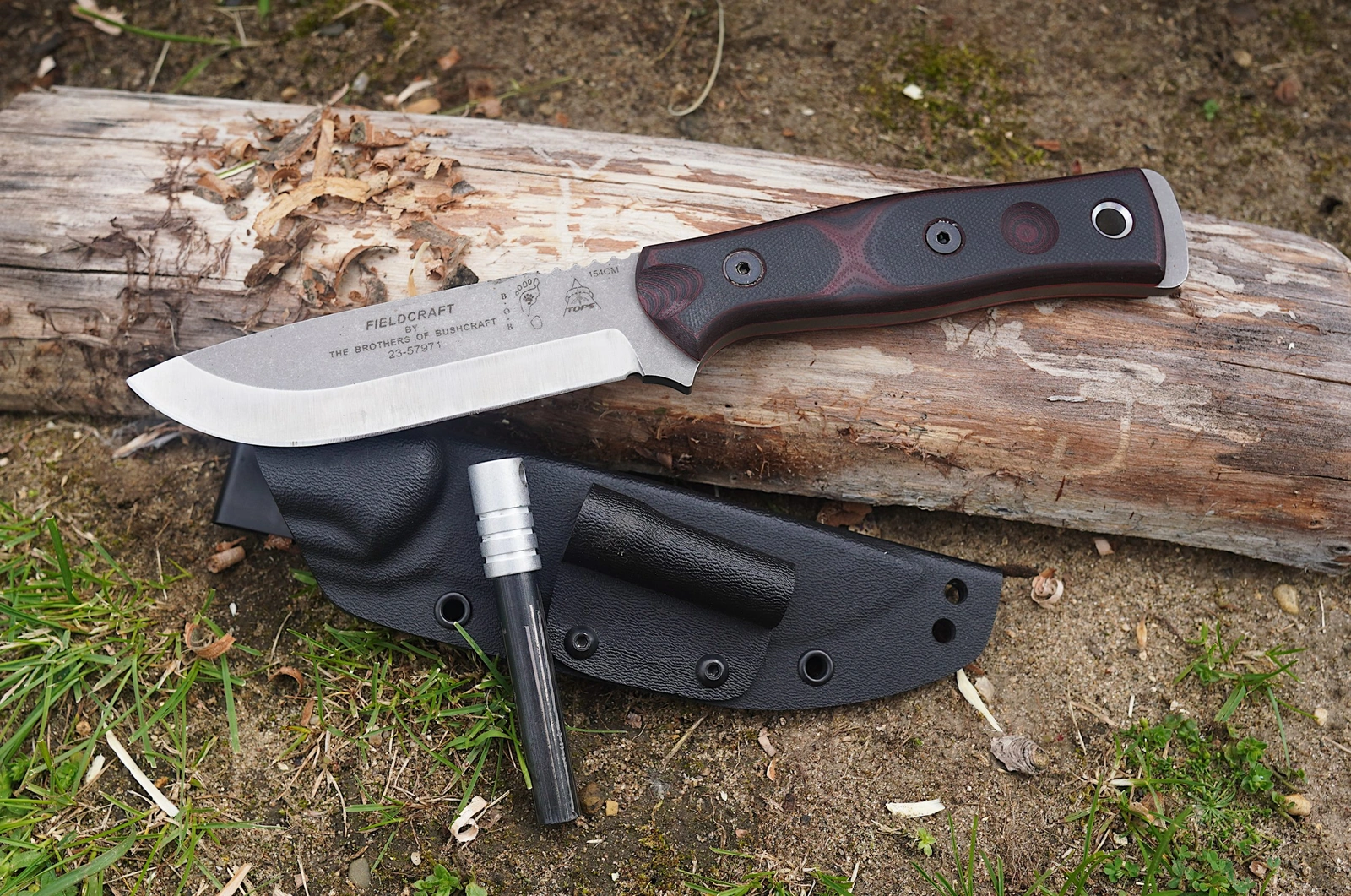
Best Overall: TOPS Bob Fieldcraft
| Pros | Cons |
|---|---|
|
|
Version note: The specifications and hands-on comments here refer to the 154CM/G10 model linked at Amazon. The Blade HQ option uses 1095 carbon steel, which needs more rust prevention and has slightly different listed dimensions and weight.
Incredible balance and edge retention make the TOPS Bob Fieldcraft one of the most impressive knives I’ve ever used. This one has a couple of variants; I own the 154CM stainless steel/G10 handle version. I usually like a handle with more texture to the grip, but this one has excellent contours. Combined with the superb jimping on the spine, it feels like this knife’s handle was custom-made for my hands.
I’ve subjected this knife to plenty of abuse since I got it. The Fieldcraft effortlessly splits and feathersticks wood. The blade is super beefy, and I was never afraid to put leverage on it. I even used this blade to field dress a Wisconsin whitetail last season. I was pleased by the control during the delicate task of opening the chest cavity.
The TOPS is noticeably heavier than other knives of this size that I own. The sheath also has a tight retention that hasn’t entirely loosened up yet. However, this is one of the nicer sheaths to come stock with a knife. As a nice bonus, it came with a good ferro rod. In short, this is an incredible bushcraft knife that is versatile for many outdoor scenarios.
Best Budget: Morakniv Kansbol

| Pros | Cons |
|---|---|
|
|
The Mora Kansbol’s incredible versatility completely contradicts the adage, “You get what you pay for.” It remains one of the most affordable knives in this group. The polymer grip has a nice, rubbery, rounded feel. I’ve never felt my hand strain using it. Nor have I had this knife slip once in my hands.
The Sandvik 12C27 stainless steel blade has impressed me with its edge retention for an affordable knife. This knife came razor sharp out of the box and cuts cord and cardboard like butter. The 90-degree spine is one of the best I’ve ever seen on this style of knife. It’s an excellent scraping tool but shines best for fire starting. The Kansbol throws a huge spark.
The Kansbol combines a Scandi grind with a thinner, profile-ground tip, making it useful for both woodwork and slicing. My only real complaint is that the knife is not a full tang, which takes some heavier bushcraft tasks out of the equation.
This is a worthy knife for bushcrafters of all skill levels. However, I especially like this one for youngsters just learning wilderness survival.
Best Large: Ka-Bar Fighter 1269

| Pros | Cons |
|---|---|
|
|
The Ka-Bar Fighter fits the bill for anyone who wants a “Rambo” size bushcraft knife without the ridiculous serrations. Seriously, this knife has an enormous 8-inch blade with a 7.25-inch cutting edge. I found it to be a wood-splitting machine in my tests. The 1095 Cro-Van steel holds a surprising edge despite this extreme abuse.
I’m most impressed by the handle of this knife. It’s a Kraton G copolymer material with a hefty and slightly rubberized feel. This might be the most solid handle I’ve ever felt. When a blade is this long, it requires a good handle, and Ka-Bar delivers it in a big way here.
There is a vast disparity between the knife and the sheath I tested, which isn’t made in the States like the knife. I don’t trust any rivets, and the loop snaps are cheap. Retention is also spotty. Sometimes, I could easily remove the knife; other times, it required extra elbow grease. I don’t think it’s a deal-breaker; I would pick up an aftermarket sheath option. Current packages may include KA-BAR’s newer hard-plastic sheath, so check the retailer’s description. The Fighter isn’t for everyone. It’s a serious knife for serious bush crafter enthusiasts who want to tackle extreme projects like extended-stay shelter construction.
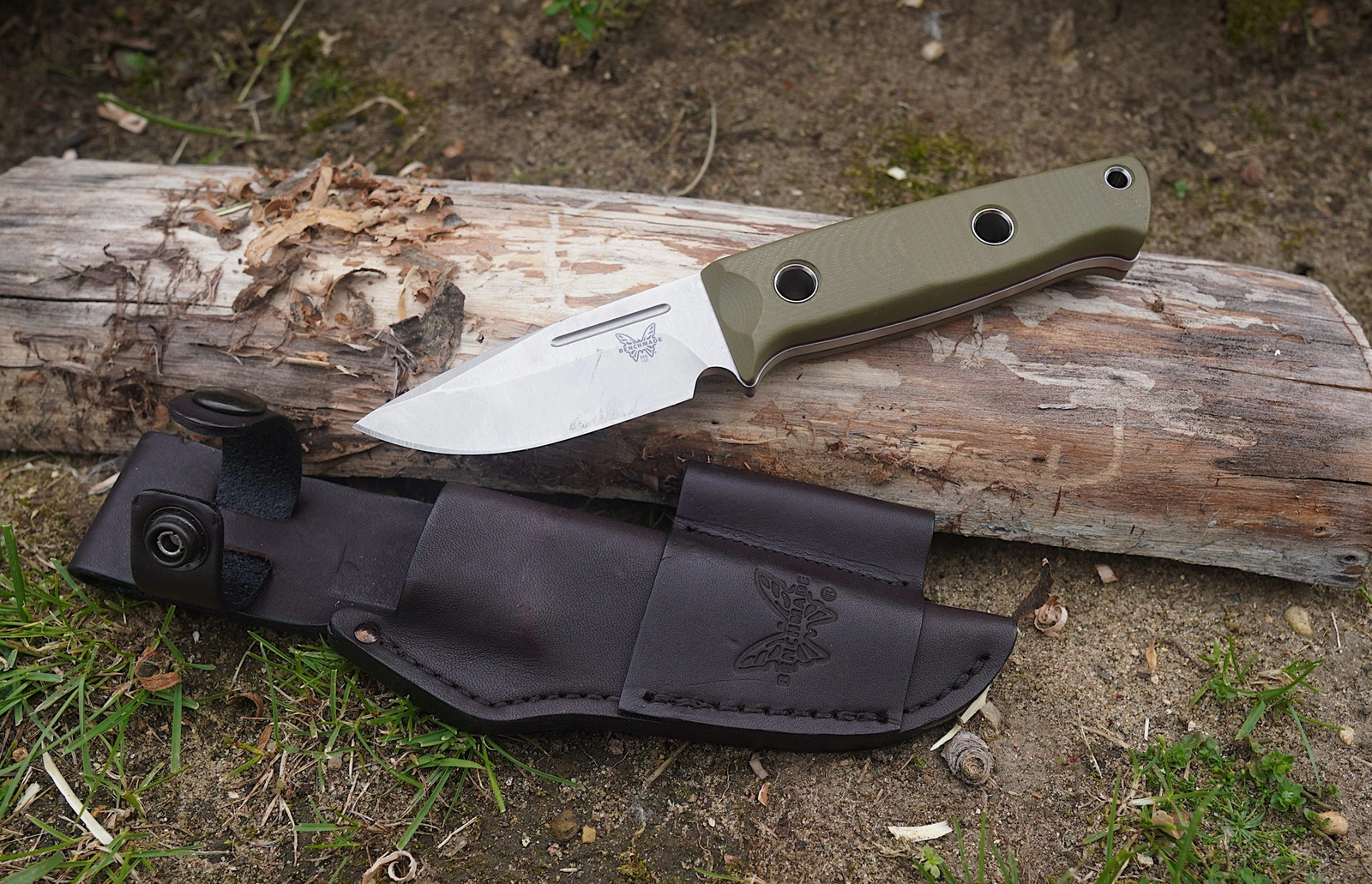
Best Small: Benchmade Mini Bushcrafter
| Pros | Cons |
|---|---|
|
|
The original Bushcrafter is an excellent knife, and the Mini is essentially a scaled-down version of that. The CPM-S30V stainless steel stands out here, providing incredible edge retention. I’ve cut everything from wood and cardboard to heavy braided fishing lines with it. It slices through them all with minimal effort.
The blade size is a little short for batoning, but it handles almost any other bushcraft task effortlessly. I like the spine here, too. It throws off a big spark with a Ferro rod for firestarting. The G10 handle does have a very smooth texture. Usually, I’m not a massive fan of that, but it works with this knife, mainly because the curves on the belly conform nicely to my fingers. This is also the rare knife for which I don’t mind the lack of jimping.
It doesn’t bother me, but plenty complain about branding on Benchmade’s blades. There is a little billboarding here, but it’s nothing too egregious. The CPM-S30V steel, compact full-tang build and US manufacturing put it in the premium price bracket. I don’t think this is a knife for beginners. It’s a high-end option for anyone wanting a smaller, reliable knife with a decent heft.
Best Serrated: Uncharted Supply Co Empire

| Pros | Cons |
|---|---|
|
|
Many outdoor enthusiasts won’t consider a serrated knife for bushcraft knives. However, I still wanted to offer an option for anyone who works with cordage frequently. Don’t let the fact that this knife was manufactured in China scare you away. The serrations here are also somewhat subdued compared with other affordable “survival” knives. I found they rip cardboard and slice paracord and fiber materials nicely.
The rest of the blade is a nicely honed flat grind. The 15-ounce weight makes it a little heavy for the belt loop. The sheath is also relatively cheap. However, it also gives a lot of confidence during wood splitting. It batoned wood like a champ during my testing without getting marred like other knives.
My favorite part of this knife is the ergonomics. The finger groove on the handle belly is perfect, and I love the thumb rise and jimping. The rubberized grip is the icing on the cake. All those features combined make for a knife that’s a true joy to use. I’ve never had this knife slip once in my hands. The included sharpener and ferro rod add to its value.
Best Flat Grind: Esee 6

| Pros | Cons |
|---|---|
|
|
The Esee 6 has garnered a legendary reputation in bushcraft circles. Its 1095 steel blade has one of the best flat grinds available today. The thick blade makes firesticking and batoning wood for a fire simple. Although, the place where the Esee shines best is on any kind of fine woodwork. This knife is an excellent choice for anyone who spends a lot of time carving, especially when cutting V-notches. The jimping on the top of the blade helps offer exceptional control for more precise work. The 1095 carbon steel is straightforward to touch up, but the exposed edge needs drying and oiling even with the coating on the rest of the blade.
Unfortunately, this is another knife for which the sheath is the weak point. Like the other knives on this list, we give it a pass because that part can be replaced. Another reason we like Esee is that they have one of the best warranties around. Its transferable lifetime warranty covers repair or replacement if the knife breaks. Rust, normal wear, loss and cosmetic damage are excluded, and owners pay shipping; see ESEE’s full terms. That kind of customer service is hard to find these days.

Bushcraft Knives Compared
Compare the main trade-offs below. Blade lengths include the full blade rather than just the sharpened edge; the TOPS figures are for the tested 154CM model.
| Knife | Best fit | Blade / steel | Main trade-off |
|---|---|---|---|
| TOPS BOB Fieldcraft | All-round bushcraft | 4.75 in / 154CM tested | Heavier carry; the 1095 option needs more rust care |
| Morakniv Kansbol | Budget camp chores and carving | Approx. 4.25 in / 12C27 | Partial tang limits heavier splitting |
| Ka-Bar Fighter 1269 | A larger plain-edge blade | 8 in / 1095 Cro-Van | Less nimble for fine work; check the sheath package |
| Benchmade Mini Bushcrafter | Compact, controlled cutting | 3.38 in / CPM-S30V | Premium price; short blade for batoning |
| Uncharted Supply Co Empire | Cordage and mixed camp tasks | 5 in listed / stainless steel | Heavy; serrations reduce the continuous plain edge |
| ESEE-6 | Larger full-flat-ground option | 6.5 in / 1095 | More blade to control; carbon steel needs care |
How To Choose The Best Bushcraft Knife
Size and Construction
For carving and routine camp chores, a blade around 3.5–5 inches is a useful starting point. The longer Ka-Bar and ESEE offer more reach for larger work, but take more care to control during fine cuts. A secure sheath and a handle that fits your hand matter more than maximum blade size. Keep splitting within the knife maker’s guidance; use a saw or hatchet for large or knotty wood, and avoid twisting or prying with the blade.
Steel Type
There is no one-size-fits-all knife steel that will cover every situation. There is almost always a trade-off in the decision. For instance, CPM-S30V offers good wear resistance but takes more effort to sharpen than simpler steels. Carbon steels such as 1095 are straightforward to touch up, but need drying and a light protective oil to prevent rust. Heat treatment and edge geometry also affect how a knife performs.
Then, there are the use-case scenarios. Something like CPM-MagnaCut offers superior corrosion resistance for wet environments. Stainless steel is lower-maintenance for food preparation, although carbon steel can also do the job if it is cleaned and dried promptly. Consider how the knife will be used to determine the best steel type.
Grind
A wide-beveled Scandi grind is useful for controlled wood carving and provides a broad bevel to follow when sharpening. I prefer a Scandi for wood batoning, but the grind alone does not tell you how well a knife will split wood. Blade thickness, edge angle, tang construction and the size of the wood all matter.
A full flat grind is a versatile choice for slicing, food preparation and general camp work, and it can carve well too. A thin edge usually cuts more easily, while a thicker edge tolerates rougher use at the expense of cutting efficiency. Choose the whole blade geometry for your tasks rather than assuming one grind is always best.
Handles
The truth is that everyone’s hand is different. Finding the handle that offers the best control is a good idea but can require some trial and error. For instance, I seem to have a perpetual case of butterfingers. Thus, I like anything with texture or tact that helps me grip it. I prefer rubber or polymer handles. I’m not usually a fan of smoother Micarta or G10 unless there are additional lines or contours to help with grip.
Spines
The 90-degree or “squared-off” spine has almost become a standard for bushcraft knives. This is mainly due to the popularity of Ferro rods for fire starting. The sharp edge creates a large spark when struck. Other users like this spine style for scraping tasks, especially when cleaning animal hides. However, the sharp edges can become uncomfortable when using a thumb for leverage on top of the blade. This mainly becomes a problem for users who spend a ton of time wood carving. In that scenario, it might be best to consider a rounded spine and an alternative fire starting method.
Jimping
Not every bushcraft knife has these notches on the spine or the blade handle. It’s another personal preference feature that can be determined only once someone has a blade in their hand. I like them because they give me more control with my thumb on the spine instead of the side of the handle.
Serrated vs Plain Edge
Most bushcraft enthusiasts will probably want to stick with a plain edge. It is better for precision tasks like feathersticking and fashioning snares. Additionally, serrated edges are difficult to sharpen. With that said, I don’t want to dismiss them entirely. I’ve read more than one survival story in which someone’s life was saved with a serrated edge. These are mainly when a heavy rope gets wrapped around someone’s leg, or a vehicle goes through the ice. In a situation like that, precision doesn’t matter as much as speed. Serrations can help with rope and other fibrous materials, although cutting speed also depends on sharpness and the material. That’s the main reason that many emergency responders carry them. Ultimately, it’s up to each person whether that peace of mind is worth the trade-off of usefulness for other tasks.

Why Trust Us
I have covered knives for several major publications for the last decade and developed rigid standards for knives. During this time, I’ve tested everything from the $5 options in the local hardware bargain bin to the latest $500 offerings. I test knives in real-world scenarios and frequently subject them to additional tests. Running a brand-new knife through cardboard until it dulls is one way that I test factory edges. I also take the time to cut as many materials as possible. This helps me test the knife’s capability and find any flaws.
Final Thoughts
Match the knife to the bushcraft tasks you do most often. The TOPS BOB Fieldcraft was an easy choice for best bushcraft knife because it excels at all the basic tasks. It’s an excellent knife for wood splitting, carving, and fire starting. My second favorite is easily the Morakniv Kansbol for its versatility and incredible price point.
FAQs
Q: What is bushcraft?
A: Bushcraft is essentially a blanket term for wilderness survival skills. Its broad definition includes everything from wood splitting (batoning) to crafting snares and traps for small animals. Other aspects of bushcraft include fire starting, woodcraft, and survival shelter construction. Hunting and fishing also sometimes fall under this umbrella, especially when using hand-crafted tools.
Q: What is the best steel for bushcraft knives?
A: The truth is that just about any steel will work for bushcraft, although some more popular steels are used more than others. Primarily 1095, CPM-S30V, 420 stainless, and CPM-3V. MagnaCut is a new option that is rapidly gaining popularity for its incredible corrosion-resistant qualities.
Q: Should you bring a knife sharpener in the field?
A: Bringing a small sharpener is not a bad idea if there is space in your pack. This is true even if it is needed only for a quick touch-up to the edge. The Kansbol’s standard sheath does not include a sharpener; Morakniv’s separate Survival Kit adds one, along with a ferro rod. Otherwise, something small like the Work Sharp Guided Field Sharpener will get the job done.
Q: How do I know if I have a good bushcraft knife?
A: Look for a secure, comfortable handle, a dependable sheath and an edge that makes your regular carving and cutting tasks easy to control. Heavy batoning is not a requirement for every bushcraft knife. The key is finding a blade that works for the type of bushcraft you practice most often.

