

An onion should not need a wrestling match, and a carrot should not crack apart before the blade reaches the board. A chef’s knife can feel effortless on parsley yet clumsy on a sweet potato. More money does not automatically fix either problem.
I’ve spent years evaluating knives, and the Knife Informer team’s experience spans thousands of knives of every type and style. For dinner prep, I put blade design ahead of decoration. Match the blade’s curve to your chopping motion, then choose the heft and reach you can control through a whole meal’s worth of work.
How We Earn Your Trust
Hands-On Testing
Where a knife was tested, we say who tested it, and partner footage is labelled. How We Test →
Specs You Can Check
Figures come from the manufacturer’s product page. Where a figure comes from a retailer or differs from the knife we tested, we say so.
How We Make Money
We earn a commission when you buy through our links. Commissions do not decide which knives we pick. How We Make Money →
Top Picks
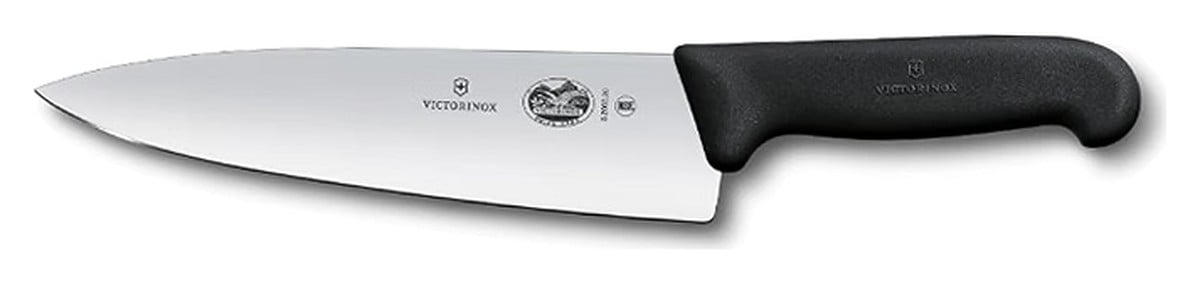
My choice is the Victorinox Fibrox for an inexpensive everyday knife that is easy to steer. Choose the MAC Professional MTH-80 when precise dice and thin vegetable slices justify a much bigger spend.



Chef Knife Comparison
Compare cutting role and heft first, then blade length and grip.
| Knife | Best For | Blade | Overall | Weight | Edge | Construction | Steel | Handle | Main Trade-off |
|---|---|---|---|---|---|---|---|---|---|
| Victorinox Fibrox | Everyday prep | 7.9 in201 mm | 13.4 in340 mm | 6.4 oz181 g | Straight | Stamped | Stainless steel | Thermoplastic elastomer (TPE) | Bulky molded handle |
| Mercer Renaissance | Weighty, affordable chopping | 8 in203 mm | 13 in330 mm | 8.8 oz249 g | Straight | Forged | X50CrMoV15 | Delrin | More weight to lift between cuts |
| MAC MTH-80 | Thin vegetable slices | 7.88 in200 mm | 12.63 in321 mm | 6.5 oz184 g | Straight | Stamped | High-carbon molybdenum vanadium stainless | Pakkawood | Large price jump from the everyday picks |
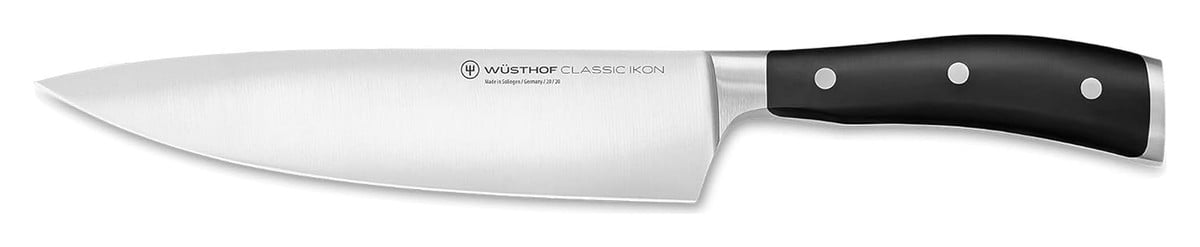
| Wüsthof Classic Ikon | Rock chopping | 8 in203 mm | 13.25 in337 mm | 9.1 oz258 g | Straight | Forged | X50CrMoV15 | Polyoxymethylene (POM) | Heavy and expensive |
| Tojiro F-809 | Wide produce and batch prep | 9.45 in240 mm | 14.37 in365 mm | 8.47 oz240 g | Straight | Not published | VG10 core with 13-chrome stainless cladding | Laminated reinforced material | Needs more room and steering |
Best Overall: Victorinox Fibrox
Buy the Fibrox for weeknight vegetables and boneless chicken without spending your sharpening budget on the knife.
What We Like about Victorinox Fibrox
- +Easy to steer from onion dice to chicken strips
- +Textured grip stays secure when your hands are wet
- +Leaves room in the budget for a sharpener
Good to Know about Victorinox Fibrox
- The chunky molded handle can crowd a small hand.
- The plain molded finish lacks the refinement of the pricier picks.
Full Specs
- Model
- 5.2063.20 / 5.2063.20BK, black
- Blade Length
- 7.9 in201 mm
- Overall Length
- 13.4 in340 mm
- Edge
- Straight
- Construction
- Stamped
- Blade Shape
- Chef's knife
- Steel
- Stainless steel
- Hardness
- 56 HRC
- Handle
- Thermoplastic elastomer (TPE)
- Weight (Listed)
- 6.4 oz181 g
- Origin
- Switzerland
Specs source: victorinox.com · Hardness from Knives and Tools.
The Fibrox is my default for a first serious cooking knife. Its broad blade gives your guiding knuckles room, while the pointed front starts a fine dice. The gently curved edge also handles a small pile of parsley without demanding a high rocking stroke. For chicken strips, I favor the modest mass over a knife that makes every change of direction feel like work.
It slices carrots, onions and herbs cleanly. Yams and sweet potatoes are its weak spot: in the same outside test the heavier Mercer scored higher on yams. The two sell at a similar price. I still favor the Fibrox for preparing a whole meal because it is easier to lift and redirect, especially when moving between vegetables and trimming boneless chicken. Buy the Mercer instead if a heavier knife steadies your chopping.
Best for Cooks Who Like Heft: Mercer Renaissance M23510
Buy the Renaissance for a weighty chopping workhorse that costs about a third as much as the Ikon.
What We Like about Mercer Renaissance
- +Traditional heft at a fraction of the Ikon’s price
- +Rounded spine eases pressure in a pinch grip
- +Top marks on onions and yams in an outside cutting test
Good to Know about Mercer Renaissance
- Repeated lifting takes more effort than with the Fibrox.
- The plain riveted handle lacks the Ikon’s sculpted grip.
Full Specs
- Model
- M23510, black
- Blade Length
- 8 in203 mm
- Overall Length
- 13 in330 mm
- Edge
- Straight
- Construction
- Forged
- Blade Shape
- Chef's knife
- Grind
- Taper ground
- Steel
- X50CrMoV15
- Hardness
- 56 ± 1 HRC
- Handle
- Delrin
- Weight (Listed)
- 8.8 oz249 g
- Origin
- Taiwan
Specs source: mercerculinary.com · Overall length, steel and weight from KnifeCenter.
Heft does not have to mean a blade that splits food apart. The Renaissance has a taper-ground edge, and Daniel Jackson’s comparison found it particularly good on onions and yams. It is my choice for cooks who want a planted feel while dicing soup vegetables, without paying for the Ikon’s sculpted handle. The lighter Fibrox is easier to redirect around chicken breasts or lift repeatedly during a long session.
The rounded spine gives a pinch grip a less abrupt surface to rest against. Against the Fibrox, the extra mass carries the taper-ground edge through a yam with less push from you, and that is the job I buy it for. Its curved belly also handles herb mincing.
Best for Fine Vegetable Work: MAC Professional MTH-80
Spend more on the MAC when precise dice and uniform vegetable slices matter most at your board.
What We Like about MAC MTH-80
- +Thin blade reduces resistance in fine vegetable work
- +Low mass suits long sessions of precise chopping
- +Pointed tip suits detailed slicing
Good to Know about MAC MTH-80
- Costs a little over three times the Mercer.
- Potato slices can still cling to the dimpled blade.
Full Specs
- Model
- MTH-80 Professional, dimpled
- Blade Length
- 7.88 in200 mm
- Overall Length
- 12.63 in321 mm
- Edge
- Straight
- Construction
- Stamped
- Blade Thickness
- 2.5 mm2.5 mm
- Blade Shape
- Chef's knife
- Steel
- High-carbon molybdenum vanadium stainless
- Hardness
- 61 HRC
- Handle
- Pakkawood
- Weight (Listed)
- 6.5 oz184 g
- Origin
- Japan
Specs source: macknife.com · Steel, hardness and handle from Cutlery and More.
The MAC earns its place through the cut. Its thin blade and modest belly suit a forward stroke into carrots and close, controlled dicing. I favor it over the German-style rocker when uniform small pieces matter more than a rolling chop over a mound of herbs. There is little extra mass to lift between strokes, so the upgrade does not come with a heavy-knife penalty.
The extra money buys a finer cross-section and harder steel. For a cook refining onion dice and carrot matchsticks, that is where I would spend the extra money. Wet potato slices can still stick despite the hollows.
Best Premium: Wüsthof Classic Ikon
Buy the Classic Ikon for rocking through herbs and coarse chopping, not for the cleanest carrot matchsticks.
What We Like about Wüsthof Classic Ikon
- +Curved belly follows a rolling herb mince
- +Contoured shape suits a firm full-fist hold
- +Mass gives a planted feel during coarse chopping
Good to Know about Wüsthof Classic Ikon
- The thick blade can split carrots before the cut finishes.
- Its heft is tiring if you lift the whole knife every stroke.
Full Specs
- Model
- 1040330120, black Classic Ikon
- Blade Length
- 8 in203 mm
- Overall Length
- 13.25 in337 mm
- Edge
- Straight
- Construction
- Forged
- Blade Thickness
- 3 mm3 mm
- Blade Shape
- Chef's knife
- Steel
- X50CrMoV15
- Hardness
- 58 HRC
- Handle
- Polyoxymethylene (POM)
- Weight (Listed)
- 9.1 oz258 g
- Origin
- Germany
Specs source: wusthof.com · Overall length, blade thickness, steel, handle and weight from Cutlery and More.
The Classic Ikon is the clearest choice here for someone who keeps the tip near the board and rolls the blade across parsley or garlic. The raised front accommodates that motion, and the contoured grip gives a full-handle hold more shape than the Mercer. For coarse onions and boneless chicken, I favor it when a heavier German knife already feels natural in your hand.
That preference has a real cost in dense vegetables. Its broad cross-section wedges carrots apart, so I reach for the MAC for julienne. The Ikon and the MAC are priced alike, at roughly three times the Mercer. Pay that premium for its rolling action and handle fit, and decide between it and the MAC by the cut you make most.
Best for Large-Batch Prep: Tojiro Classic F-809
Buy the longer Tojiro for cabbage, big onions and batch prep on a spacious board.
What We Like about Tojiro F-809
- +Reaches across wide produce without restarting the cut
- +Thin cutting geometry suits fine slices across a large batch
- +Hard cutting edge resists rounding during careful prep
Good to Know about Tojiro F-809
- Less nimble around small onions or a crowded board.
- The boxy grip is less sculpted than the Ikon’s handle.
Full Specs
- Model
- F-809 CLASSIC / DP, 240 mm
- Blade Length
- 9.45 in240 mm
- Overall Length
- 14.37 in365 mm
- Edge
- Straight
- Blade Shape
- Gyuto
- Grind
- Double bevel
- Steel
- VG10 core with 13-chrome stainless cladding
- Hardness
- 60 HRC
- Handle
- Laminated reinforced material
- Weight (Listed)
- 8.47 oz240 g
- Origin
- Japan
Specs source: store.tojiro.net · Edge from Amazon. Hardness from Chef Knives To Go.
The F-809 reaches across a cabbage half and leaves more travel for slicing boneless chicken breast in a single draw. The longer edge also lets you line up more food for each stroke. At over two and a half times the Fibrox’s price, I expect more than reach: the thin grind and harder VG10 core make it a more focused slicer for repeated vegetable slicing. Those are reasons to upgrade when you care about neat slices across a whole batch.
The trade-off appears when the job gets smaller. Detailed work around a shallot and trimming a single chicken portion are easier to steer with the MAC. The Tojiro needs more clear working space and attention to where its tip ends up. Buy it for sustained chopping on a roomy board.
How To Choose a Chef's Knife
Quick Checklist
- Your Motion: Rock the tip on the board? Pick a curved belly. Push forward through each cut? Pick a thinner, flatter blade.
- Your Food: Separate delicate slicing from coarse chopping when choosing an upgrade.
- Your Budget: Leave room for a board and sharpening rather than spending everything on the blade.
- Your Sessions: Prep for an hour at a time? A lighter knife tires your wrist less than a heavy one.
Eight inches or closer to ten? A standard eight-inch blade suits most home boards and lets you change direction around an onion without moving your whole arm. A longer knife reaches across cabbage and makes longer draw cuts through boneless meat. It also needs a larger clear working area. Put your current knife on the board beside the largest food you regularly prepare. If you keep running out of usable blade, add length. If you keep running out of space, do not.
Listen for a crack before the cut ends. A keen bevel can enter a carrot cleanly, then the steel behind it wedges the food apart. Sweet potatoes and squash expose this even more clearly. Thickness behind the edge matters more than total knife weight or thickness at the spine. That explains why the heavy Mercer still slices a yam well: its taper grind keeps the steel slim behind the edge. Andrew North found carrot splitting in his Classic Ikon review, along with resistance in fine onion work. A slim grind reduces resistance, but a hard blade is a poor lever when stuck. Stop and withdraw along the cut rather than twisting. No pick here is a dedicated hard-squash cleaver.
Soft German-style steel or hard Japanese steel? Softer blades generally tolerate everyday knocks better, but their edges can roll sooner. Harder steel resists that rounding and can support a fine bevel, yet a sideways load is more likely to leave a chip. The grind and heat treatment matter as much as the steel name. Choose the harder option for deliberate slicing, not because a higher hardness number makes it tougher.
Hold it as you cook. In a pinch grip, your thumb and bent index finger sit on opposite sides of the blade ahead of the handle. Curl your remaining fingers around it. Feel for pressure at the spine, then set the edge on the board and check knuckle clearance. A shape that forces your wrist into an awkward position is the wrong upgrade.
How I Picked These Knives
I chose Western chef’s knives and gyuto for vegetables, herbs and boneless meat. Each fills a separate role: an everyday lightweight, an affordable heavier knife, a fine-cutting upgrade, a dedicated rocker and a longer blade for batch prep. I weighed blade shape and comfort against current buying options rather than treating an alloy name as a verdict.
The shorter Tojiro F-808 overlaps the MAC too closely here, so the longer F-809 gets the place. Global’s G-2 has a distinctive all-metal grip, but I prefer the covered handles on these picks and it does not fill a missing cutting role. I left the Misono UX10 out because its asymmetric bevel adds a sharpening consideration that this general home-cook shortlist does not need. The Shun Classic adds a D-shaped Pakkawood option, but I chose the MAC for the precise vegetable work instead of another similar-length Japanese knife. A carbon-steel knife demands more prompt wiping and drying than I want to ask of an everyday first purchase.
Santoku, nakiri and bread knives are outside this chef-knife comparison. The broader kitchen knives guide covers the rest of a working collection.
Why Trust My Picks
I judge a recommendation by whether it solves a cooking problem, not whether the knife looks expensive. For a chef’s knife that means the grind behind the edge, a belly that suits your motion and a grip that stays put through a long prep session. Where an outside cutting test informs a verdict, I credit its author. These picks reflect that evidence and my judgment about the design.
Final Thoughts
Before upgrading, name the cut your current knife makes awkward even after sharpening. If you cannot, start with the everyday pick and spend the difference on maintaining it. Pay more when you can point to a specific improvement you will use at dinner, not a badge on the blade.
Chef Knife FAQs
Is a gyuto different from a Western chef’s knife?
A gyuto is the Japanese counterpart of a Western chef’s knife, designed for the same broad range of kitchen tasks. It is usually double-beveled, unlike a traditional single-bevel yanagiba. Some gyuto have unequal bevels, so check handedness and sharpening instructions rather than assuming every one is symmetrical.
Does forged always mean better than stamped?
No. Those terms describe manufacturing, not the final quality of the heat treatment or grind. A well-made stamped knife can cut more cleanly than a thick forged one. Judge the finished tool.
How often should I hone or sharpen a chef’s knife?
Use the cut as your signal. If it starts slipping on tomato skin or needs pressure where it once sliced easily, try a gentle touch-up on a honing rod suited to its steel. If it does not recover, sharpen it or use a professional service. For home use, MAC suggests its ceramic rod every few weeks and sharpening every couple of months, but frequency changes with use and the board. My kitchen knife sharpeners guide explains the tools.
Do I also need a santoku?
Not to cover ordinary cooking. Both handle vegetables and boneless meat. Add a santoku if you prefer its shorter, flatter shape, rather than buying one simply because it is a different knife style.
Still Not Sure?
Take our 60-second quiz and get matched with the right knife.

