


A good backpacking knife earns its place by handling food prep, cord, small repairs and other trail chores without adding unnecessary weight. The right choice depends on what else you carry: a slim folder may be all you need, while a compact fixed blade or multitool can make sense when it replaces other equipment.
In this buyer’s guide we’ll look at knives for hiking and backpacking, with weight, packed size and useful cutting performance taking priority over the size of the blade. These are different demands from a heavy camp knife intended for processing wood.
Our Top Picks
- Overall Pick: Spyderco Native 5 Salt
- Value Pick: ESEE Izula
- Splurge Pick: Benchmade Bugout
- Best Multitool: Leatherman Signal
- Best Minimalist Design: CRKT Folts Minimalist
- Best Assisted Opening: Kershaw Leek
- Best Longer Blade: Cold Steel Air Lite
- Best Lightweight Multitool: Victorinox One Hand Trekker
Key Considerations
So what do you look for in a knife for backpacking? Here are the main factors to consider:
- Weight – this seems like a no-brainer, but you want to get the functionality you need with as little weight as practical. Every ounce adds up when you’re hiking as you’re shuttling potentially a lot of gear with you and any additional weight is extra strain on your body. So, the lighter a knife is while still achieving its goal, the better.
- Size – seems obvious as you don’t want a knife that takes up a ton of room – whether it’s in your pocket or in your pack. This means in its closed or sheathed position, obviously – which tilts the scales towards folding knives since they inherently take up less room. That’s not to say there’s no use case for a fixed blade in backpacking – some of our choices on this list will be fixed blades, but in terms of utility provided versus space consumed, a folding knife usually wins.
- Safety – you want a knife that’s not going to fold closed on your finger when you’re out on the middle of the Appalachian trail. You also want a knife that has solid, confident ergonomics.
- One Hand Opening – This is a feature that’s useful in basically any situation and that’s also true for backpacking and hiking – not needing both hands to open and close a blade is much more convenient, especially if you need your other hand to hold something.
- Square Spine – Not strictly necessary, but it’s a bonus if your knife has a squared-off spine that can be used to strike a ferrocerium rod, and more so if the spine is exposed in the closed position since it’s safer to use that way.
- Folding vs Fixed – It’s up to you to decide if the extra strength of a fixed blade is worth the additional space it takes up as well as the added weight of a sheath. For wood-processing jobs beyond light carving, choose an appropriately sized fixed blade rather than forcing a lightweight folder to do the work.
- Consider a Multitool – think about your needs and what other tools you may be carrying – if you can reduce your loadout by combining several things into a single multitool you may be better off, and some multitools are specifically designed for camping or hiking.
Best Backpacking Knife: Recommended Models
Splurge Pick: Benchmade Bugout

The Bugout was purpose-built for this type of work: it was designed from the outset to be as slim, light, and compact as possible. The original Bugout features a 3.2” long drop point blade in CPM-S30V stainless powdered metallurgy steel, cut from extra-thin 0.09” blade stock, with a 3” cutting edge. It uses a shrunken-down version of the AXIS lock, the original spring-powered sliding bar lock that’s become more and more popular among other manufacturers lately.
It uses several tricks to cut weight, including titanium thumb studs, shrunken and nested stainless liners that only span the part of the handle with the lock, slim 0.42” wide Grivory (a trademarked name for a plastic made by EMS-Grivory) handles and even a shortened pocket clip. As a result, the Bugout – which stretches 7.46” long when fully opened – only weighs 1.85 ounces. That’s insane, considering most lightweight knives around that size are at least 50% heavier. It’s not without downsides – the handles flex noticeably when you grip them hard, and it’s a premium-priced knife. But Benchmade had a hit on their hands with this knife when it launched a few years back.

The line also includes the smaller Mini Bugout and versions with stiffer handle materials. Those are separate choices: the specifications and links here refer to the original blue Grivory, S30V Bugout 535. If low weight is your priority, its 1.85-ounce build remains the main attraction.
Check out our full review of the Benchmade Bugout.
| PROS | CONS |
|
|
Overall Pick: Spyderco Native 5 Salt
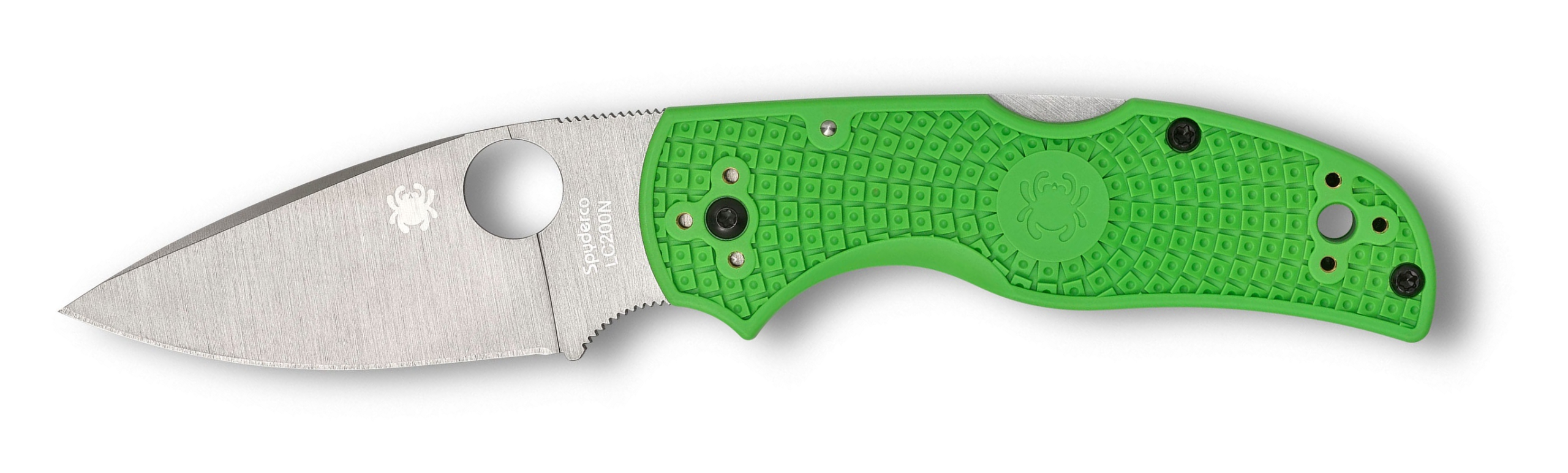
The Spyderco Native series has been a fan favorite for years, but the Salt version is especially well suited to backpacking. LC200N combines strong corrosion resistance with a practical cutting edge, making it useful on damp trips where cleaning and oiling gear is less convenient than at home.
The linked model is the green PlainEdge LC200N Native 5 Salt, C41PGR5. The yellow MagnaCut Native 5 Salt is a different steel version. The older yellow LC200N version appears in the original photo below; that pictured knife also has a serrated edge.
It doesn’t hurt that the basic Native is such a great design: a practical full-flat-ground blade with a thumb-hole opener, a solid forward finger choil and a reliable back lock. For camping, rafting or hiking in damp climates, the corrosion-resistant construction is one less thing to worry about.

Earlier serrated LC200N version pictured.
The lightweight handle is linerless FRN. Its bi-directional texture provides grip, and the four-position pocket clip lets you choose your carry orientation. It is an easy design to recommend for a damp trail, but the forward choil leaves less cutting edge than the blade length might suggest. The plain edge is the choice here for general food and camp chores; the fully serrated Salt is a different configuration.
| PROS | CONS |
|
|
Value Pick: ESEE Izula

The Esee Izula might be the definitive outdoor survival fixed blade. It’s at least the first thing that comes to mind in the category of fixed blades you’d want to take backpacking, thanks to its hyper-minimalist construction: a basic Izula is just a 2.875” drop point blade with the bare outline of a handle, made from one piece of coated 1095 high-carbon tool steel. If you want, there are optional Micarta handle scales that bolt together for a more comfortable grip, or you could also wrap the Izula’s handle with a layer of paracord – or even better, SurvivorCord. It looks like regular 550 Paracord but includes three additional strands inside – fishing line, utility wire, and waterproof tinder. It’s just an additional tool kit hidden in the handle of your knife. The bare Izula weighs 2 ounces before its sheath, cord or optional handle scales.

Speaking of handles, carrying a fixed blade means you must carry a sheath, so the downside of the Izula is the bulk of that sheath – the supplied molded sheath adds weight and takes up additional space. The sheath can accept different carry attachments. For neck carry, follow ESEE’s breakaway-lanyard instructions rather than using ordinary paracord around your neck. ESEE also sells a stainless version of the Izula with S35VN steel, which won’t be as tough as 1095 high-carbon but provides better corrosion resistance. If you’ve got bigger hands there’s the Izula II with 0.50” of length added to the handle, bringing the total length up to 6.75” from 6.25” (they share the same blade length) as well as pre-installed Micarta handle scales. The Izula is named after the most dangerous ant in the world, the Bullet Ant, but it won’t be as painful to add this to your gear loadout – I promise. Then again, nearly nothing else is that painful.
| PROS | CONS |
|
|
Best Multitool: Leatherman Signal
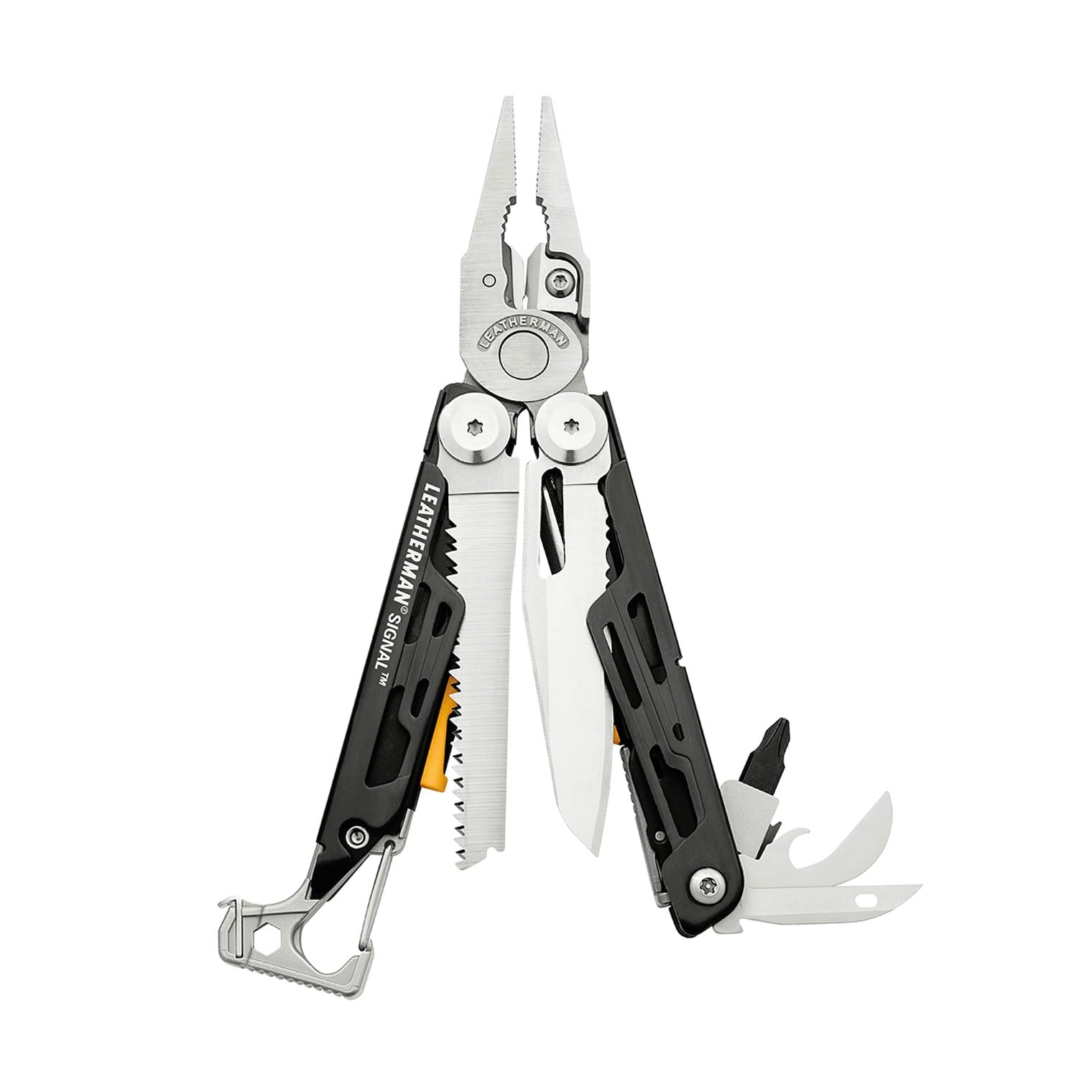
A multitool is generally heavier than most folding knives, and this is certainly true of the Leatherman Signal – which weighs in at a robust 7.5 ounces, or roughly 3 times that of the Spyderco Native 5 Salt mentioned earlier. Then again, it does a lot more than just cut things. The Signal is Leatherman’s version of an outdoor survival tool, based around the familiar framework of a folding pliers-based multitool but with some special adaptations for outdoor use. Most obvious of which are the removable tools on the sides: one contains a loud whistle and a ferrocerium firestarter rod, the other a tiny diamond-coated knife sharpener, both of which nest in the outer edges of the handles.

Also accessible from the outside is a 2.73” drop point blade in 420HC stainless steel, with a partially serrated edge, as well as a sharp pull-cut wood saw. Inside, there’s a sharpened awl with a thread loop for making rudimentary cloth repairs, a can/bottle opener with a wire stripper at its base, and Leatherman's proprietary 2D bit driver that accepts double-sided flat bits. The pliers don’t scrimp either, with replaceable hard-wire cutters at the base, needle nose pliers at the tip and a regular set of rounded pliers in the center. Finally, the far end of the handle functions as a hammer, ¼" box wrench and hex bit driver, a 3/16” box wrench and a sprung carabiner clip. You can do quite a lot with a Signal, from pounding in tent stakes to food prep to starting a fire.
So, while it’s heavy, it’s at least useful – and a compatible carry sheath is available if you prefer belt carry; check the selected package rather than assuming a sheath or bit kit is included. Leatherman has started making the Signal in some funky colors in addition to the original black and yellow variant, including a Crimson handle with black coated blades, Cobalt blue handles with satin blades, Aqua blue with black blades, and a silver handle with black blades model alongside the standard Signal. The main cutting compromise is its short, partly serrated 420HC blade; a dedicated plain-edge knife is more convenient for some food prep. It’s a purpose-built multitool for exploring the great outdoors.
| PROS | CONS |
|
|
Best Minimalist Design: CRKT Folts Minimalist

Besides the ubiquitous M16 folder, the Folts Minimalist is one of CRKT’s most popular model lines. With its eye-catching looks, light weight, wide variety of blade shapes, and affordable price tag, the Folts Minimalist is designed to be a neck knife for everyone. When I say variety of blade shapes, I mean it: the line includes several distinct blade shapes and steel options. If you want a practical blade shape, there’s the drop point, spear point, and bowie. If you want something funky, there’s the cleaver (of course), Persian, wharncliffe, tanto, double-ground Katana(!), or the sinister-looking Keramin karambit.

For backpacking, the compact drop point is the practical choice here. The linked black drop-point model is the 2384K, with G10 handles and a 5Cr15MoV blade. That steel is straightforward to sharpen, but does not offer the edge retention of the higher-end choices here. Other Minimalist versions use different steels and dimensions, so don’t treat the family name as one specification. The 2384K uses a molded thermoplastic sheath with mounting options, and all of them feature a distinctive scalloped handle design with three individual finger grooves for a solid grip. With its short blade and compact three-finger grip, the 2384K keeps the load small. It is best for controlled cutting, not heavy wood processing, and the sheath adds to the knife-only weight. The variety of blade shapes also means you can pick the Minimalist that suits your particular hiking needs the best.
| PROS | CONS |
|
|
Best Assisted Opening: Kershaw Leek

It’s not an exaggeration to say that the Kershaw Leek got me into knives in around 2007. The knife has been around even longer than that, debuting in limited numbers in 2000 and even winning Blade Magazine’s “Knife of the Year” award in 2002. Remember magazines? I digress, before I start feeling too old. The Leek is part of Ken Onion’s line of onion-related knives for Kershaw (including the Chive, Scallion, and Shallot) that helped to popularize SpeedSafe technology, the assisted-opening method Kershaw has used since 1998(!) to help make opening knives faster and easier. It uses a bent torsion spring concealed inside the handles to propel the blade open once the first couple degrees of travel have been accomplished manually; it’s the extremely fine line between an “assisted open” knife and a switchblade. I’ve often said it’s a distinction without a difference, but that’s fine – while assisted opening knives aren’t my choice for an EDC knife, they have an appeal when you’re out in the woods and need the convenience and the anti-social nature of AO knives is irrelevant.

Pressing the rounded flipper tab or ambidextrous thumb studs fires the Leek’s super-slim blade out, a 3” Wharncliffe (regular Leek) or reverse Tanto (Random Leek) that’s only 0.09” wide across the spine, giving it fantastic slicing performance. The Random Leek’s reverse tanto shape helps to minimize the big problem with Leeks, namely that it’s very easy to break that razor-sharp needle tip off if you use it wrong.
All Leeks come with a secondary safety, a tip lock that can be manually closed to prevent the knife accidentally opening in your pocket or pack, and at only 3 oz for the full stainless version or as low as 2.41 ounces for the carbon fiber/154CM variant it doesn’t add much weight. There are two basic variations (stainless handles with a framelock, or aluminum scales over stainless liners with a liner lock) with plenty of color choices and special models to choose from. The standard 1660 model uses 14C28N stainless steel, which is great for this application. The Leek has been a popular lightweight carry option for more than 20 years now, because it still makes a lot of sense.
Check out our full review of the Kershaw Leek.
| PROS | CONS |
|
|
Best Longer Blade: Cold Steel Air Lite

Cold Steel has a reputation as a brand that makes ridiculous knives designed to be sold at a shopping mall fantasy blades kiosk, which is... true. They do make some very silly knives, like the Espada XL with its 7.5” blade. But the other side of Cold Steel is arguably more interesting, producing some very slim, light, tough folders for reasonable money.

My pick of the litter is the Air Lite, a knife that puts a lot of strength and capability into a very slim, light package. The knife stretches out 8” when open, with a 3.5” long blade, but the handles themselves are only 0.35” wide. Like the American Lawman, the handles are made of G10 without liners, keeping the weight down to only 3.2 ounces. You have your choice of blade shapes, with either a drop point or a tanto, as well as an option of OD Green or Black G10 handles. The Tri-Ad lock keeps the blade open, a modified version of a lockback that uses a stop pin to distribute force between the lock bar and the face of the blade tang. All versions use AUS-10A steel, an upgrade to the older AUS-8 stainless steel Cold Steel used to frequently equip on their knives. The Air Lite is a good choice if you prefer a longer blade on your hiking knife but don’t want to take up a lot of space or add unnecessary weight.
| PROS | CONS |
|
|
Best Lightweight Multitool: Victorinox One Hand Trekker

We reviewed the One Hand Trekker a while back, and while it didn’t make a strong case for itself as an everyday-carry multitool, it makes more sense as a backpacking knife. At 4.6 ounces, it’s a good bit lighter than the other multitool on the list – the Leatherman Signal. At that sub five-ounce weight it includes a full-sized, partly serrated blade that locks and can be opened with one hand, a large wood saw, a locking bottle opener/screwdriver/wire stripper, a can opener, a sharpened awl, and a 3D Phillips screwdriver. It also includes a set of metal tweezers and a plastic toothpick inside the handle scales, both of which can be quite useful off the grid – a way to get splinters out of your fingers has a lot of value out in the woods.

As with almost all Victorinox SAK’s, if there’s a slightly different combination of tools you’d prefer, chances are that they make it. For instance, if you like the OH Trekker but prefer a corkscrew instead of a Phillips driver there’s the OH Forester which is otherwise identical other than the swapped out screwdriver. The Locksmith includes a plain-edged OH locking blade, and adds a metal file in another layer, while keeping the Phillips driver and awl. Swiss Army knives are a natural fit for outdoor activities, and the more modern 111mm body of the Trekker gives you a much more solid ergonomic grip in use and the benefit of locking tools for safety over earlier, smaller SAK’s. For the weight and price it adds a lot of utility to your carry.
| PROS | CONS |
|
|
Backpacking Knife Comparison
Swipe or scroll sideways to view the full comparison on smaller screens.
| Knife | Blade | Weight | Steel | Carry |
|---|---|---|---|---|
| Benchmade Bugout | 3.24 in | 1.85 oz | CPM S30V | 4.22 in closed |
| Spyderco Native 5 Salt | 2.95 in | 2.4 oz | LC200N | 4.00 in closed |
| ESEE Izula | 2.875 in | 2.0 oz, knife only | 1095 carbon | Sheath required |
| Leatherman Signal | 2.73 in | 7.5 oz, tool only | 420HC | 4.50 in closed |
| CRKT Folts Minimalist | 2.16 in | Approx. 1.8 oz, knife only | 5Cr15MoV | Sheath required |
| Kershaw Leek | 3.00 in | 3.0 oz | 14C28N | 4.00 in closed |
| Cold Steel Air Lite | 3.50 in | 3.2 oz | AUS-10A | 4.50 in closed |
| Victorinox One Hand Trekker | One-hand blade | 4.6 oz (130 g) | Stainless steel | 4.37 in (111 mm) closed |
Fixed-blade weights exclude the sheath; multitool weights exclude a separate pouch. The Izula’s 2.875-inch blade has about 2.63 inches of cutting edge. The Minimalist 2384K’s approximate weight follows CRKT’s manufacturer specifications; its sheath adds about 0.6 ounce.
Things to Avoid
Things to avoid for a backpacking knife are fairly simple.
- Excess weight that doesn’t at least serve a purpose – weight is fine if the tool provides lots of functions. But you don’t necessarily need a Becker BK9 when you go hiking; it’s going to take up a lot of space and weigh you down, leading to extra exertion and frustration over a long hike.
- Non-locking folding knives: while a slip joint pen knife is great for opening letters in the office, the potential consequences of a blade folding on your fingers when you’re out hiking in the woods are much higher. A solid, safe lock or a fixed blade is a good choice
- Carbon steel without a maintenance plan: coatings help, but the exposed edge still needs to be cleaned and dried.
- Odd blade shapes that aren’t useful for actually doing things: leave your Karambit at home. What are you doing with that?
- Rounded spines: not a big deal, but you might as well have a good ferro-striking surface built into the back of your knife.
Wrap-Up
Hopefully this guide helps you find the perfect knife to add to your backpacking carry, and if not, at least it points you in the right direction for finding the right type of knife for your next backpacking trip. Keep it light, keep it safe, and happy travels!
