


We independently evaluate all recommended products and services. Any products or services put forward appear in no particular order. If you click on links we provide, we may receive compensation.
A strop is a finishing tool, not a way around sharpening a dull knife properly. Used with too much pressure or the wrong angle, it can round the edge you just worked to create.
Working surface, support and abrasive matter more than a promise of a mirror finish. These choices include three leather paddles and a rigid diamond-resin alternative: a wide working surface, a defined diamond-emulsion kit, a budget paddle and a portable non-leather option. Pick the maintenance routine that suits your knives, rather than assuming every strop needs leather and paste.
Key Considerations
- Measure the leather, not the handle: The working surface determines how much room you have for a controlled pass. A long overall paddle is not necessarily a large strop, and width matters when working along a longer blade.
- Know what is on the leather: Bare leather and abrasive-loaded leather do different work. Green or gold compound does not establish a universal particle size. Choose specified grades when that distinction matters to your finishing routine.
- Use an edge-trailing stroke: The spine leads and the cutting edge follows. Driving the cutting edge into the leather can cut it. Keep the bevel controlled and the pressure very light rather than lifting the spine to chase a polished line.
- Keep finishing surfaces clean: Coarse grit carried onto a fine face defeats the purpose of the progression. Clean the blade, keep different compounds separate and protect the leather during storage.
Knife Strops: Top Picks
- Best Wide Paddle: Flexcut Dual-Sided Paddle Strop
- Best Defined Diamond Kit: Work Sharp Leather Strop and Diamond Emulsion Kit
- Best Budget Paddle: BeaverCraft Double-Sided Paddle Strop
- Best Non-Leather Option: Nano Hone Nano Truer
Best Wide Paddle: Flexcut Dual-Sided Paddle Strop
| PROS | CONS |
|
|
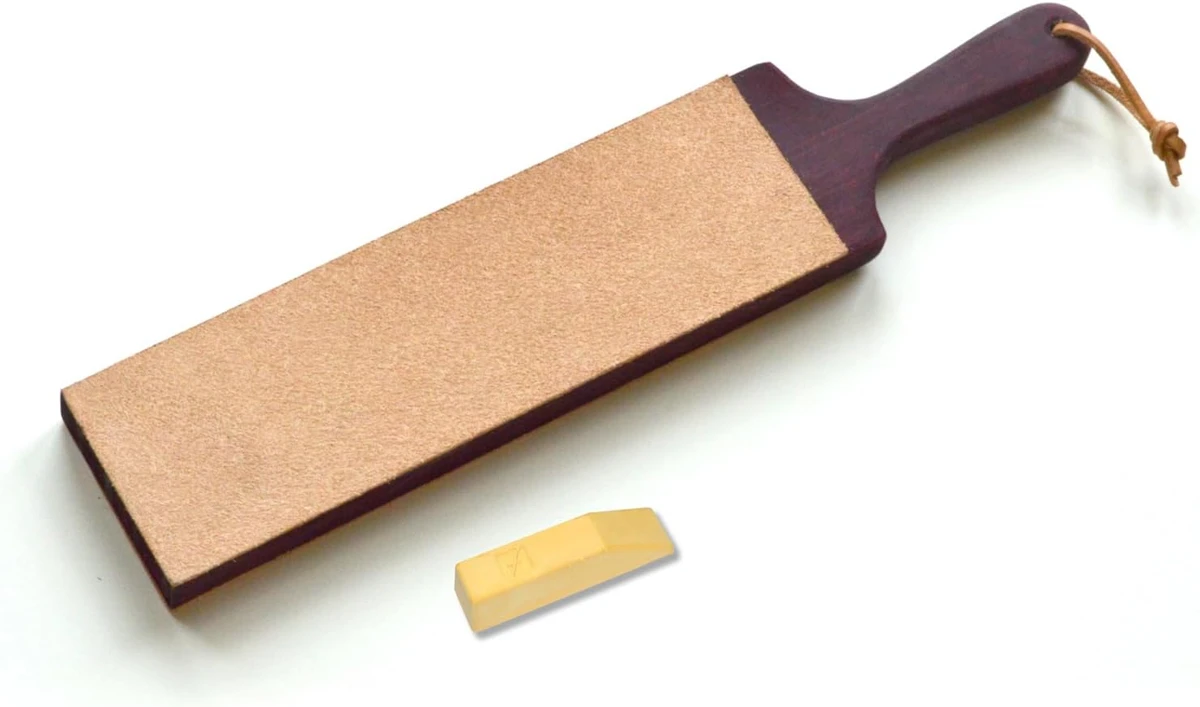
The PW16 is the paddle I’d choose when room for a controlled stroke matters most. Flexcut specifies a 10-by-3-inch stropping surface, which is useful working space rather than the length of the whole handle. The width gives a longer kitchen blade more room than the narrower budget paddle below, although you still need to follow the blade’s curve.
The rough leather face is intended for Flexcut Gold compound, with the smooth face available for finishing. A one-ounce compound bar is included. Flexcut identifies the compound’s abrasives as aluminum and titanium oxides, but does not give it a verified micron rating. I wouldn’t turn its gold color into a numerical grit claim or treat it as equivalent to a specified diamond emulsion.
I’d keep the faces dedicated to their jobs rather than load both indiscriminately. Clean the blade before moving to the finishing face, use an edge-trailing motion and let very light contact do the work. A wide leather surface makes the stroke less cramped; it does not prevent excessive pressure or a raised spine from rounding the apex.
Choose the Work Sharp kit if a defined two-grade diamond progression is the reason you’re buying. Choose the BeaverCraft if the lower price matters more than width. The Flexcut’s place is simpler: a generous rigid paddle, two leather surfaces and an included compound without needing to assemble a separate finishing station.
Best Defined Diamond Kit: Work Sharp Leather Strop and Diamond Emulsion Kit
| PROS | CONS |
|
|
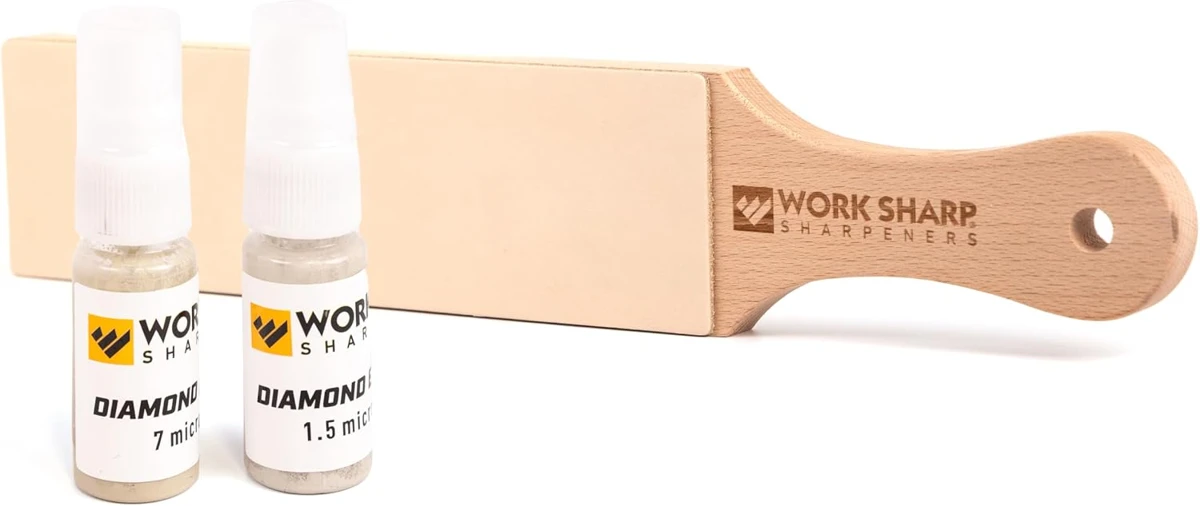
This is the Work Sharp kit I’d choose when I want to know the supplied abrasive sizes rather than infer them from a compound’s color. It pairs a standalone two-sided leather paddle with 15 ml each of 7-micron and 1.5-micron diamond emulsion. It is a complete paddle kit, not a stropping attachment that requires a Precision Adjust system.
Work Sharp gives the strop’s size as 8 by 2.375 inches. Keep one face dedicated to each emulsion and label them so the grades don’t get mixed. Apply a light coating, spread it and let it dry for a few minutes as Work Sharp directs. More liquid is not automatically a better working surface; residue buildup is a reason to clean the leather, not keep adding another layer.
The useful distinction from the Flexcut is the defined two-grade workflow. Start with the grade appropriate to the edge and finish finer only when that serves the cutting task. Neither bottle is a substitute for a sharpening abrasive when the bevel still needs shaping or a chip needs repair. I wouldn’t buy it on the assumption that a more polished edge always cuts better for everything.
Work Sharp calls for very light pressure and wiping buildup away with a cloth or paper towel. Keep the faces separate during cleaning and storage, and remove abrasive residue from the blade afterward. Choose this kit for its defined diamond grades; choose the Flexcut when a broad, explicitly specified leather working face matters more.
Best Budget Paddle: BeaverCraft Double-Sided Paddle Strop
| PROS | CONS |
|
|
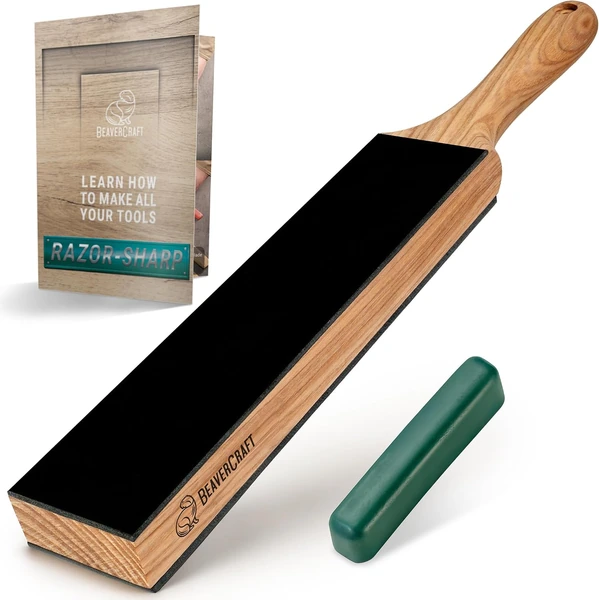
The LS6P1 is the lower-cost starting point for someone who wants a supported leather paddle and included compound. Its usable leather is 240 by 50 mm, about 9.45 by 1.97 inches. That is the dimension to compare, rather than the longer overall paddle including its handle.
I’d choose it for a modest setup where the narrower leather is an acceptable compromise. A longer knife can still be worked along its edge with controlled passes, but there is less width to work across than on the Flexcut. The lower price is the reason to consider it, not an unsupported promise that its leather produces a finer edge.
The selected LS6P1 includes BeaverCraft P1 green compound. Its color does not establish a micron grade or make it interchangeable with every other green bar. Keep a face dedicated to the compound and leave the other clean if you want an unloaded finishing surface. Don’t mix an unknown compound into a face you intend to use for a specified finer abrasive.
For an inexpensive first paddle, the BeaverCraft covers the basic hardware without a large outlay. Move to the Flexcut when you want more width, or to the Work Sharp when known diamond grades matter. Whichever you use, the same restraint applies: very light, edge-trailing strokes on a properly sharpened edge, not forceful rubbing to rescue a dull one.
Best Non-Leather Option: Nano Hone Nano Truer
| PROS | CONS |
|
|
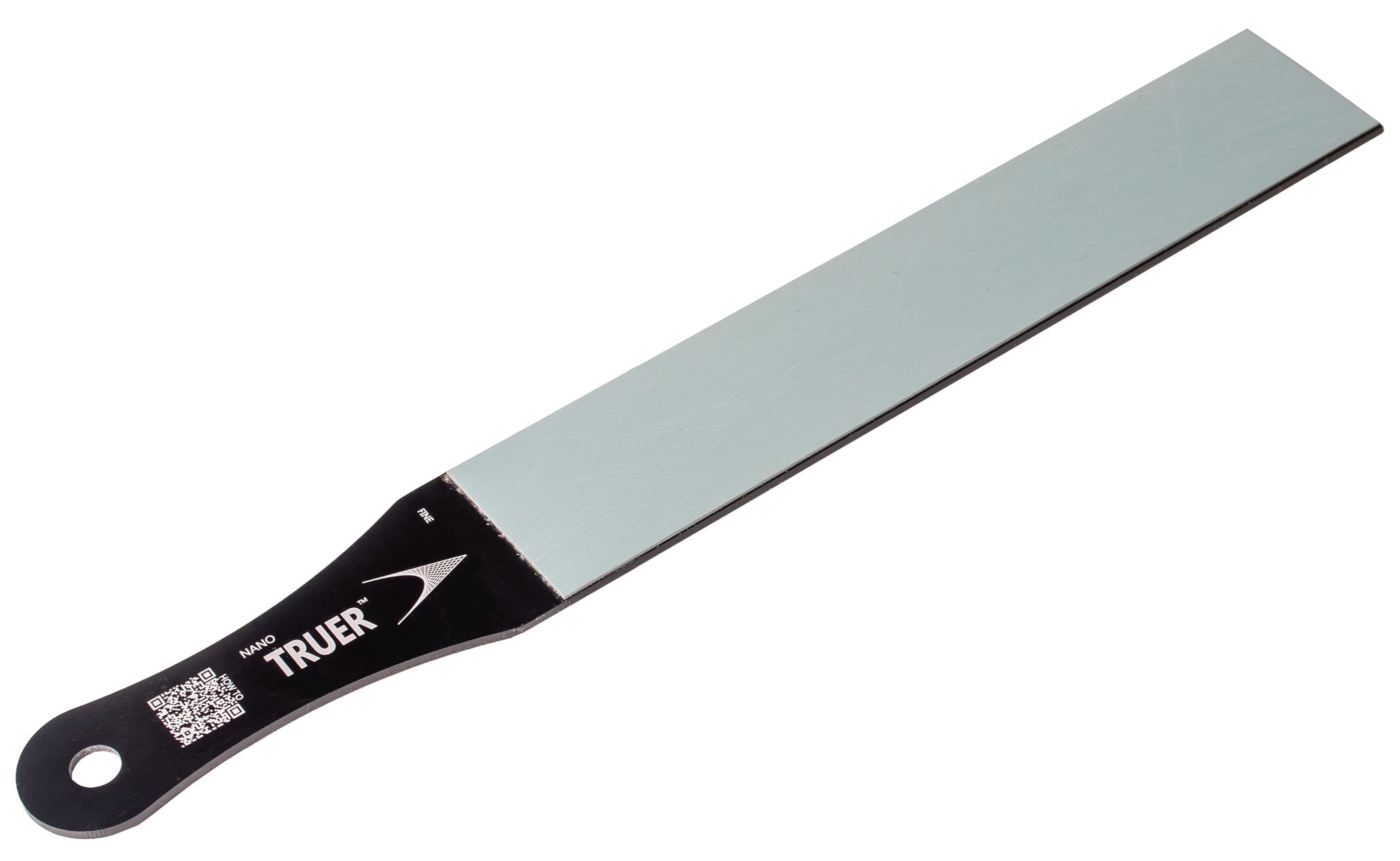
If you’d rather skip leather and rubbing compound into a paddle, the Nano Truer takes another approach. Its two diamond-resin faces provide 50- and 3-micron abrasives on a slim rigid paddle. This is the Truer 3/50 configuration, not the more aggressive 25/100 version.
I like its role as a portable edge-maintenance option: the abrasive is already in the surface, so there are no compound bottles to apply or leather faces to load. It is narrower than the paddles above, which helps it fit a knife roll but gives a broad blade less room. Follow Nano Hone’s edge-trailing method, with the spine leading and the cutting edge following, using gentle pressure.
Treat the two sides as different tools rather than assuming both are just a fine polish. The 50-micron side is a more substantial abrasive step; the 3-micron side provides finer maintenance. Nano Hone permits dry use, a little water or a suitable light oil, and recommends cleaning away metal residue afterward. There is no angle guide, and this knife-maintenance paddle should not be confused with a stone-flattening plate. Some retail listings describe it as a stone-truing tool; Nano Hone specifies this paddle for maintaining knife edges.
Compare Our Picks
Scroll sideways on smaller screens to compare all the details.
| Model | Best fit | Surface / size | Abrasive supplied | Main tradeoff |
|---|---|---|---|---|
| Flexcut Dual-Sided Paddle Strop | Best Wide Paddle | 10 x 3 in | 1 oz Gold compound bar included | Large paddle takes more storage space |
| Work Sharp Leather Strop and Diamond Emulsion Kit | Best Defined Diamond Kit | 8 x 2.375 in | 7 and 1.5 micron diamond emulsions included | Separate grades need dedicated faces and careful handling |
| BeaverCraft Double-Sided Paddle Strop | Best Budget Paddle | About 9.45 x 1.97 in | P1 green compound included | Narrower surface than the other two paddles |
| Nano Hone Nano Truer | Best Non-Leather Option | Rigid diamond resin; 10.75 in overall | Built-in 50 / 3 micron diamond resin | Narrow face; 50-micron side is more aggressive |
How to Choose a Knife Strop
Decide whether the edge needs sharpening first
A strop suits finishing and light maintenance. If the knife has a chip or the bevel has not reached a clean edge, return to an appropriate sharpening abrasive or a repair service. Stropping longer is not a reliable substitute for doing that work. The razor-sharp knife guide explains the wider sharpening sequence.
Consider the material and the complete setup
A supported leather paddle is my straightforward starting point for a home bench, but a strop does not have to be leather. Jende’s Nanocloth uses a synthetic surface on a rigid backing, while balsa is another way to carry abrasive. Check what you need to make the surface usable: Jende supplies its Nanocloth without emulsion, and CKTG’s magnetic balsa strop fits its separate Richmond base. If you already use a guided sharpener, a matching strop attachment may make more sense than another paddle. Check the exact holder and complete cost before buying. A different material is not automatically a complete kit or a better finish.
Choose enough usable leather
Compare the usable surface, not just the length of the handle. The Flexcut is the widest leather paddle here, Work Sharp supplies a shorter two-grade kit, and BeaverCraft offers a narrower leather face at a lower price. The slim Nano Truer saves space but leaves less room for a broad blade. Allow a stable working position and clearance for the whole cutting edge.
Distinguish bare leather from a loaded surface
Bare leather does not have one universal grit rating. Diamond emulsion and oxide compound add abrasives that remove material, and their color is not a reliable particle-size chart. Follow the selected kit’s instructions and keep different grades on dedicated, identifiable surfaces.
Control direction, angle and pressure together
Move with the spine leading and the cutting edge following. Maintain the intended bevel with very light pressure; avoid lifting the spine or pressing the edge deeply into the leather. Be deliberate when lifting and repositioning the blade so the next pass does not drive the edge into the strop.
Protect the finish from contamination
Clean the blade before stropping, keep coarse sharpening grit off the leather and remove compound residue from the knife before food preparation. Follow the kit’s cleaning method rather than applying a universal oil, solvent or soaking treatment. The knife care and maintenance guide covers cleaning, drying and storage beyond the sharpening session.
Leather is a choice, not a requirement
A firm leather paddle lets you choose or replenish compound. The Nano Truer instead has diamond abrasive built into rigid resin faces, so it needs no paste loading. Its 50-micron side is a more substantial abrasive step than a finishing strop, and the finer 3-micron side has a separate role. Keep the stroke edge-trailing and the pressure light with either approach.
Why Trust Us
These recommendations distinguish the surface from the abrasive doing the work. Manufacturer instructions establish the supplied compounds, stroke direction and care; specified particle sizes are kept separate from compound-color claims. The useful comparisons are working room, surface support and the maintenance step each kit can actually serve.
Final Thoughts
I’d choose Flexcut for a broad leather working face, Work Sharp for its defined diamond-emulsion progression, or BeaverCraft for a straightforward budget paddle. The Nano Truer is the alternative when you want a slim non-leather surface with abrasive already built in. Start with an edge that needs maintenance, use light edge-trailing strokes and keep coarse and fine work separate.
Frequently Asked Questions
Are all knife strops made from leather?
No. Strops can use leather, synthetic materials or wood such as balsa. Three of these picks use supported leather; the Nano Truer uses rigid diamond-resin faces with the abrasive built in. Match the backing, abrasive and maintenance method rather than assuming every surface needs a compound bar.
Do I need compound on a leather strop?
Not for every finishing routine. Bare leather and abrasive-loaded leather are different surfaces, so choose according to the selected kit and the job you want it to do. Adding compound changes the abrasive action; it is not automatically an upgrade to every clean finishing face.
Which way should I move the knife?
Use an edge-trailing motion: the spine leads and the cutting edge follows. An edge-leading stroke can cut the leather. Follow the kit’s handling instructions and reposition carefully between passes.
What grit is green stropping compound?
Color alone does not establish a reliable grit or micron rating. The selected BeaverCraft P1 has no verified numerical particle size in the maker’s specifications. Use a product with stated grades, such as the Work Sharp emulsions, if a defined abrasive size is important to your routine.
Can a strop fix chips or a very dull knife?
A leather strop is not the right primary tool for chip repair or substantial bevel shaping. Use a suitable sharpening abrasive or repair service first, then consider stropping as a finishing or light-maintenance step.
Does a mirror-polished edge always cut better?
No. The useful finish depends on what you cut and your preferences. A shiny bevel is not proof that the apex is sound, that the knife will slice every material better or that its edge will last longer.
