


We independently evaluate all recommended products and services. Any products or services put forward appear in no particular order. If you click on links we provide, we may receive compensation.
A drawer full of dull knives can make a powered sharpener look like an easy fix. It can help, but the motor won’t tell you whether you’ve chosen the right angle or when to stop removing steel.
For a kitchen-only routine, I’d start with the edge angle: the Chef’sChoice 15XV suits a dedicated 15° collection, the 1520 handles both 15° and 20°, and the compact E2 suits compatible 20° knives. The two Work Sharp belt machines trade the simplicity of those appliances for broader knife-and-tool use. Choose the approach before paying for extra settings.
Key Considerations
- Match the angle first: The angles here are per side. A fixed 15° or 20° sharpener changes an edge that was made at a different angle. Check the knife maker’s guidance, especially for asymmetric, single-bevel or unusually thin blades.
- Buy the right kind of control: Fixed guides simplify the setup. Adjustable angles and belt speeds give you more choices, but also more responsibility for pressure, blade position and the abrasive you use. More settings aren’t automatically better for a small kitchen collection.
- Protect the tip and heel: A guide only helps when the blade fits it. Bolsters, thumb studs and short blades can limit access to the edge. With a powered belt, following the tip off the abrasive can round it; learn the exact stopping sequence before starting on a favorite knife.
- Plan for maintenance: Belts and discs are consumables, and metal residue needs cleaning away. Check the correct replacement set, give the machine a stable workspace and use the least aggressive stage that will do the job.
Electric Knife Sharpeners: Top Picks
- Best Dedicated Kitchen Option: Chef’sChoice 15XV
- Best for Knives and Tools: Work Sharp Knife & Tool Sharpener Mk.2
- Best for Adjustable Angles: Work Sharp Ken Onion Mk.2
- Best Compact Kitchen Option: Work Sharp E2
- Best for Mixed 15° and 20° Kitchen Knives: Chef’sChoice AngleSelect 1520
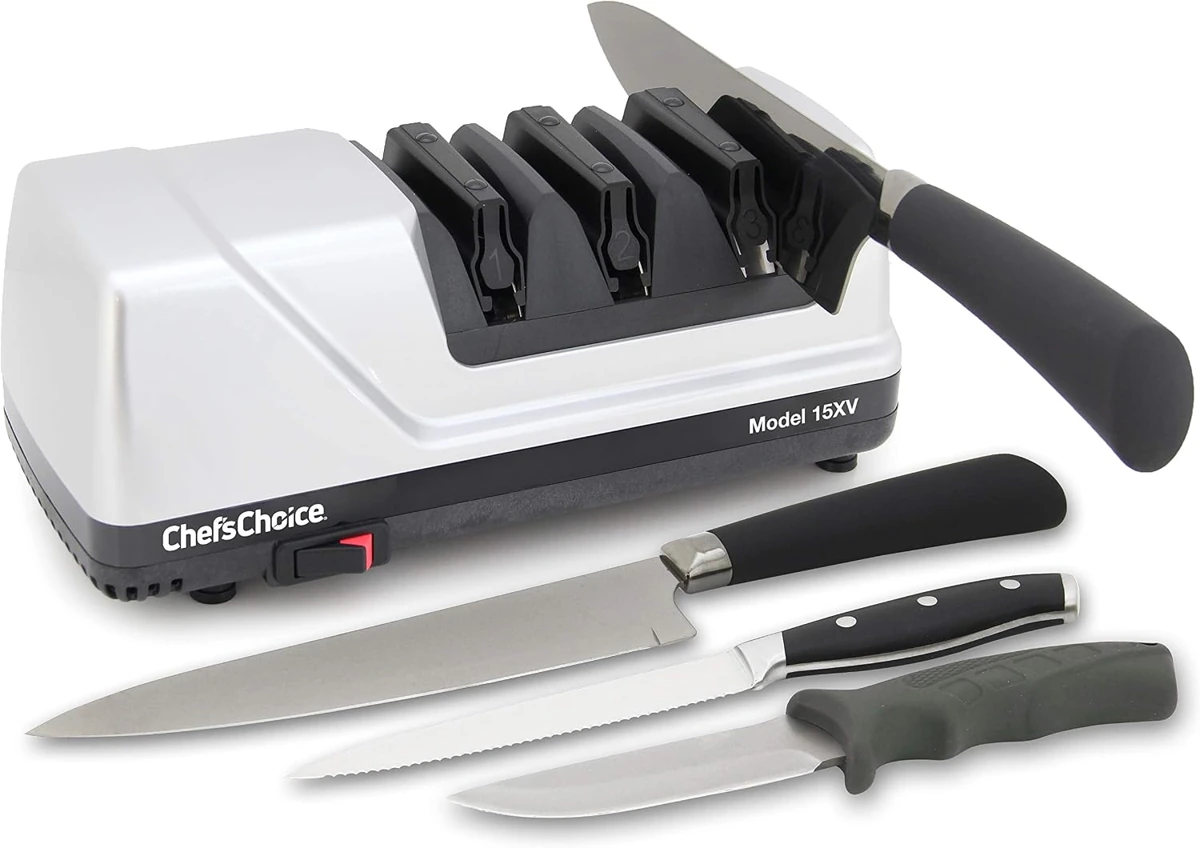
Best Dedicated Kitchen Option: Chef’sChoice 15XV
| PROS | CONS |
|
|
The 15XV is the one I’d consider first for a kitchen collection suited to its advertised 15° edge. The appeal is a defined sequence: diamond abrasives handle the first two stages, followed by flexible stropping and polishing discs in Stage 3. You don’t have to swap belts or choose a motor speed each time a chef’s knife needs attention.
That simplicity has a boundary. This is a 15° system, not a machine that detects and preserves any factory angle. Converting a 20° knife removes material to establish a different bevel, so decide whether you actually want that change. A suitable double-bevel kitchen knife is a more sensible starting point than an expensive specialty blade with geometry you haven’t identified.
The stages also have different jobs. After the initial sharpening, a lightly tired edge may need only the finishing procedure rather than another full trip through the coarse stage. Normal serrated maintenance uses Stage 3 under the manual’s directions. That treatment isn’t the same as individually restoring damaged scallops, and a badly damaged bread knife may need a specialist.
I’d choose the 15XV over the E2 for a compatible 15° kitchen collection. Choose the E2 if you need its fixed 20° setting instead, or a belt system if angle choice and work beyond kitchen knives justify the extra setup. Don’t confuse this model with the AngleSelect 1520: that machine offers separate 15° and 20° routes, while the 15XV is built around its 15° system.
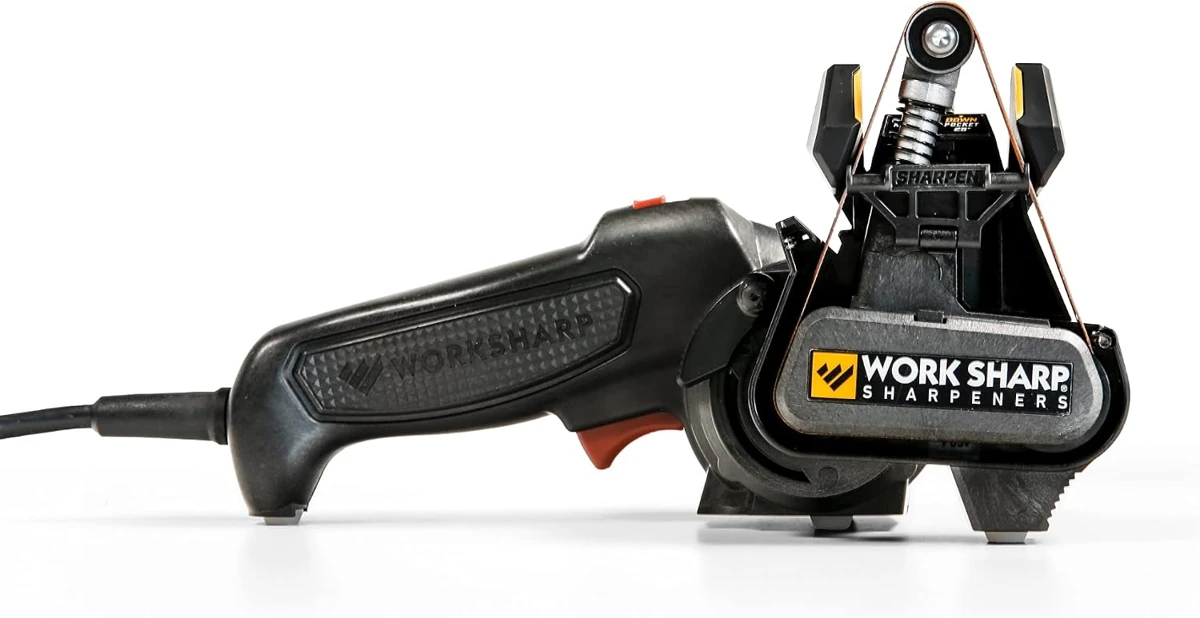
Best for Knives and Tools: Work Sharp Knife & Tool Sharpener Mk.2
| PROS | CONS |
|
|
In my Work Sharp Mk.2 review, I described why I appreciated having it in my work toolbox. That practical appeal is what earns it a place here: its flexible belts and removable guide handle knives, scissors and tools, with a separate procedure for each job. Don’t put everything through the same guide simply because one machine can sharpen it.
The WSKTS2 gives you 20° and 25° per-side presets and two motor speeds. The standard belt set includes P80, P220 and 6000 abrasives. The coarse belt belongs to appropriate repair or tool work, not every routine knife touch-up. A fine belt can maintain an edge without starting the whole shaping process again.
This is where I’d pay particular attention to the instructions. Work Sharp tells you to stop with the tip still supported by the belt, rather than drawing the point off a running abrasive. Light pressure and a steady stroke matter, too. A powered belt makes it easier to do unnecessary work quickly, so practice on an inexpensive blade before moving to a knife you care about.
The decision against the Ken Onion Mk.2 is straightforward: choose this model when its two angles cover your knives and you don’t need finer speed or angle adjustment. It won’t preserve a 15° edge with the guide installed. Its broader tool capability also doesn’t make it an industrial grinder; the manual limits use to 30 minutes in an hour. For someone maintaining a compatible kitchen and outdoor collection, it’s a useful middle ground.
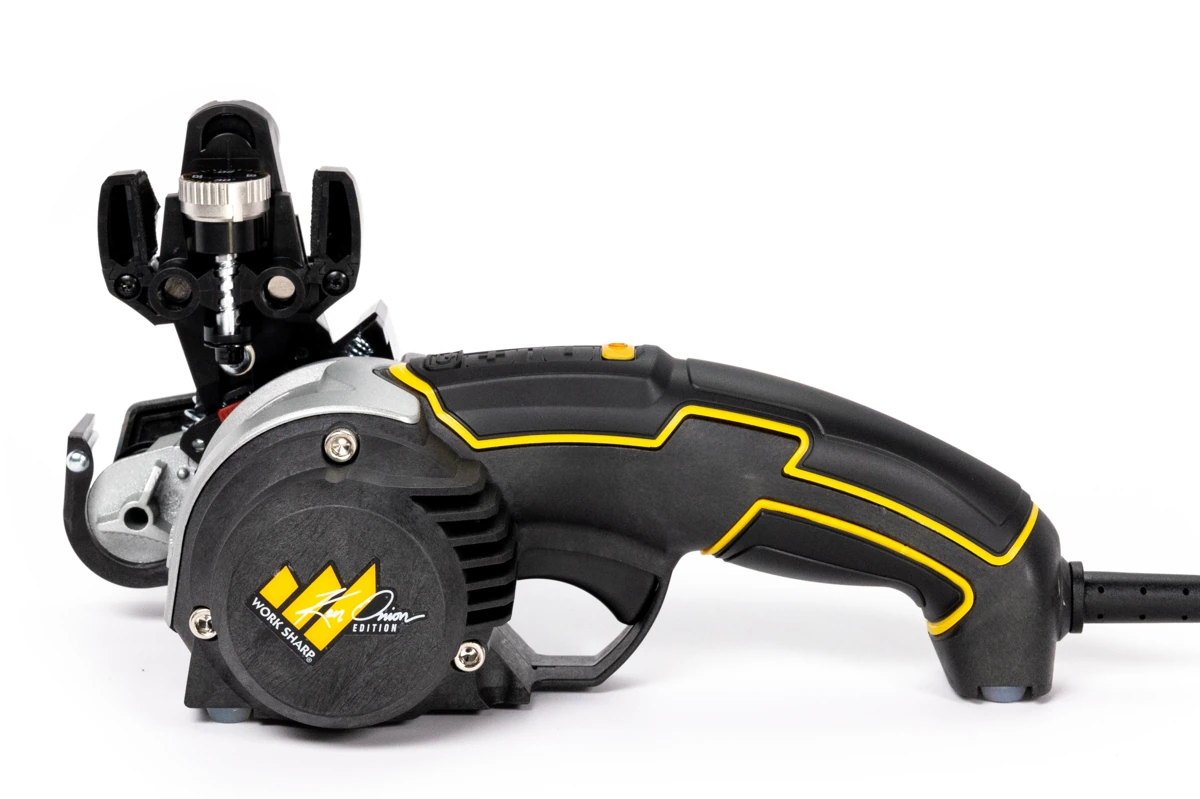
Best for Adjustable Angles: Work Sharp Ken Onion Mk.2
| PROS | CONS |
|
|
The Ken Onion Mk.2 earns its place when the standard Mk.2’s two angle presets are too restrictive. Its guide adjusts from 15° to 30° per side in half-degree increments, and seven speeds let you change how quickly the belt runs. I’d pay for that control when maintaining several compatible edge angles, rather than simply because the machine has more buttons.
The standard kit uses 3/4-by-12-inch belts, with P120, X65, X22, X4 and 6000 grades covering different stages of the work. Those labels aren’t five versions of the same finish. Start with the abrasive appropriate to the edge’s condition, then follow the maker’s progression and burr-removal instructions. The coarsest belt is a repair tool, not a compulsory first step.
KnifeInformer’s sharpening systems guide includes Travis Smola’s advice to begin with a practice blade on the Ken Onion Elite. That caution is useful here, too. The standard Ken Onion Mk.2 kit selected here has the guided cassette; the Elite package adds a separate Blade Grinding Attachment. I wouldn’t buy both as if they were two different sharpeners for the same job.
There are fit limits worth checking before you commit. Work Sharp notes that thumb studs or pocket clips can obstruct full blade insertion against the edge guide. Keep the tip supported through the stopping sequence, and don’t expect adjustable speed to compensate for excess pressure or poor positioning. If your knives all suit a 20° or 25° preset, the standard Mk.2 is the simpler purchase. If you need intermediate settings and are prepared to learn the controls, this is the more flexible option.
Best Compact Kitchen Option: Work Sharp E2
| PROS | CONS |
|
|
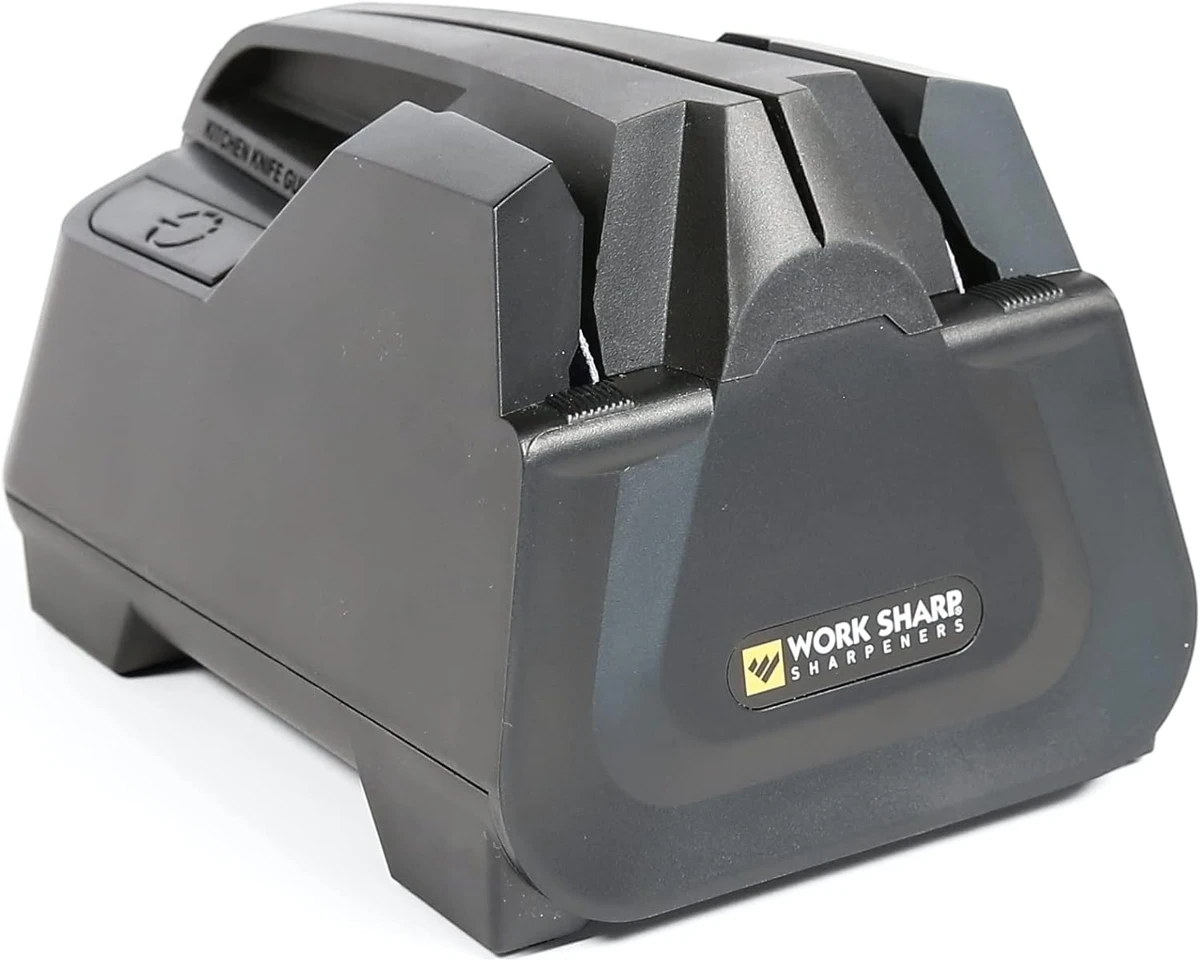
The E2 makes sense when you want a small kitchen machine rather than a sharpening hobby. It pairs powered flexible abrasive discs with fixed 20° guides and a separate manual ceramic honing wheel. There are no belts to thread or angle adjustments to make before a routine session.
Its CPE2 configuration uses replaceable P120 ceramic-abrasive discs. The ceramic honing wheel has a different role from those powered abrasives: it provides a maintenance step between sharpening sessions. The manual also permits serrated-edge maintenance at the appropriate ceramic slot, not a pass through every powered slot on the machine.
I’d choose this over the 15XV when the kitchen knives actually call for a 20° setting and compactness matters more than a wider finishing progression. Its simplicity also makes the limitation clear. It won’t preserve a 15° bevel, and it isn’t the right default for an unfamiliar single-bevel or asymmetric Japanese knife.
For a household that also sharpens pocket knives and garden tools, the standard Mk.2 offers a broader workflow. For compatible kitchen knives, the E2 avoids much of that extra setup. Give it enough counter space for a controlled full-length stroke, follow the manual’s pass sequence and clean the blade before it returns to food preparation.
Best for Mixed 15° and 20° Kitchen Knives: Chef’sChoice AngleSelect 1520
| PROS | CONS |
|
|
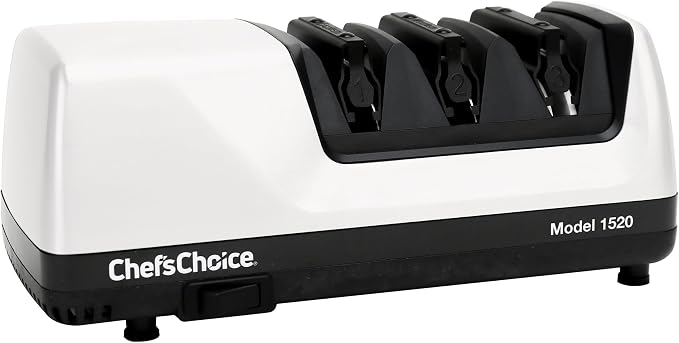
A kitchen drawer with both 15° and 20° knives is where the AngleSelect 1520 makes sense. Unlike the 15XV, it gives you a route for either angle. Stage 1 sharpens a 15° edge, Stage 2 sharpens a 20° edge, and Stage 3 finishes either one. You choose the appropriate route rather than sending every knife through all three stages.
I’d favor it over the E2 when keeping both angles matters and I still want a countertop appliance. It costs more and takes more space, but it avoids choosing between one fixed kitchen angle and the more involved Ken Onion belt system. Check each knife’s actual bevel guidance instead of deciding its angle from the country or brand name.
The first two stages use diamond abrasives; the shared third stage uses flexible stropping and polishing discs. Serrated blades have a separate Stage 3 procedure in the manual, and blades must fit freely in the slots. This is a kitchen sharpener, not a substitute for a scissors or axe sharpener. Specialty single-bevel knives need particular care and a procedure their maker supports.
Compare Our Picks
Scroll sideways on smaller screens to compare all the details.
| Model | Best fit | Angle control | Abrasives | Main tradeoff |
|---|---|---|---|---|
| Chef’sChoice 15XV | Best Dedicated Kitchen Option | 15° edge system | Diamond sharpening; flexible polishing/stropping | Doesn’t preserve a 20° bevel |
| Work Sharp Knife & Tool Sharpener Mk.2 | Best for Knives and Tools | 20° or 25° per side | P80, P220 and 6000 belts | Guides don’t offer a 15° setting |
| Work Sharp Ken Onion Mk.2 | Best for Adjustable Angles | 15–30° per side | P120, X65, X22, X4 and 6000 belts | More settings and belts to learn |
| Work Sharp E2 | Best Compact Kitchen Option | 20° per side | P120 ceramic-abrasive discs; fine ceramic | Fixed 20° setting limits compatibility |
| Chef’sChoice AngleSelect 1520 | Best for Mixed 15° and 20° Kitchen Knives | 15° or 20° per side | Diamond sharpening; flexible stropping/polishing discs | Choose the correct sharpening stage for each bevel |
How to Choose an Electric Knife Sharpener
Decide which edges the machine must preserve
Start with your most-used knife, then check the rest of the collection. A fixed-angle kitchen machine is convenient when the knives share a suitable bevel. Mixed edge angles favor an adjustable system, but single-bevel, asymmetric and ceramic blades need their maker’s specific approval and procedure. Don’t use the knife’s country of origin as a substitute for knowing its geometry.
Separate a cooking routine from a workshop routine
The 15XV, 1520 and E2 keep the task focused on kitchen knives. Work Sharp’s belt machines make more sense when tool sharpening is part of the purchase. They need room for belt changes and the full knife stroke, along with careful cleanup of sharpening dust. Check the selected U.S. machine’s electrical requirements before buying for another country. For a freehand alternative, compare our best sharpening stones.
Learn the stroke before chasing a finer finish
A consistent bevel and cleanly removed burr matter more than using every supplied abrasive. Follow the exact manual for pressure, speed and tip handling. Use a practice blade while learning. If a bolster prevents the heel reaching the abrasive, or a short blade cannot sit correctly in the guide, a different method may be more appropriate.
Keep repair work in perspective
A coarse abrasive has a purpose, but chipped edges, broken tips and substantial geometry changes deserve more care than a routine touch-up. A sharpening service may be the better answer for a valuable or unfamiliar knife. Unplug the machine for maintenance, follow its cleaning instructions and replace worn abrasives with the correct parts.
One kitchen angle or two?
The 15XV is a dedicated 15° system, while the 1520 has separate 15° and 20° sharpening routes. That is a useful distinction if the drawer holds knives with different recommended bevels. The E2 keeps a compatible 20° routine compact; a belt machine buys more versatility at the cost of more handling and abrasive choices.
Prefer a hand-powered kitchen routine?
If your knives fit a magnetic holder, the best rolling knife sharpeners offer another way to hold an angle without a motor. They still need compatible blade geometry and the right abrasive progression.
Why Trust Us
My earlier Mk.2 review informs the discussion of that machine, while Travis Smola’s advice on learning a Ken Onion system is credited in its section. For the other models, I compare the specified angles, abrasives and blade fit with the work each machine asks of you. That distinction matters more than simply buying the most powerful sharpener.
Final Thoughts
For a dedicated 15° kitchen collection, I’d choose the 15XV. The 1520 is the better fit when preserving both 15° and 20° edges matters, while the E2 saves space for compatible 20° knives. Choose the standard Mk.2 for broader knife-and-tool work at lower cost, or the Ken Onion Mk.2 for more angle and speed control. Keep the decision tied to the blades you actually sharpen.
Frequently Asked Questions
Can an electric sharpener damage a knife?
Yes. The wrong guide angle, excessive pressure, unnecessary coarse passes or poor tip handling can remove material you wanted to keep. A compatible machine and correct technique matter together. Start with the maker’s instructions and an inexpensive practice blade.
Should I use every sharpening stage each time?
No. Initial sharpening, routine maintenance and edge repair are different jobs. Follow the selected machine’s sequence for the condition of the edge. Repeating the most aggressive stage when a fine finishing step would suffice removes unnecessary metal.
Will an electric sharpener restore damaged serrations?
Not necessarily. A machine’s serrated setting or finishing procedure may maintain the teeth without reshaping each scallop. Use its exact instructions, and seek an appropriate tapered abrasive or professional service for damage it cannot address. Straight-edge slots are not a universal serrated-knife procedure.
Is a powered sharpener better than a stone?
It depends on the task. A motor supplies the abrasive motion; it doesn’t decide the angle, pressure or stopping point for you. A suitable guided machine reduces some of the setup, while a stone offers freehand control without a motor. Neither method compensates for an incompatible knife or an unlearned technique.
