

The Short Version
What I Like
- Thin, slicey blade and great jimping
- Perfect thumb studs, placement and tension
- Three-screw scale swaps and adjustable spring tension
- Some of the best crossbar-lock action, easily in my top three
What to Consider
- The fuller is pretty much unusable for flicking with my fingers
- Pay attention to the different screw lengths during scale swaps
- I'd like a bigger version with this improved crossbar lock
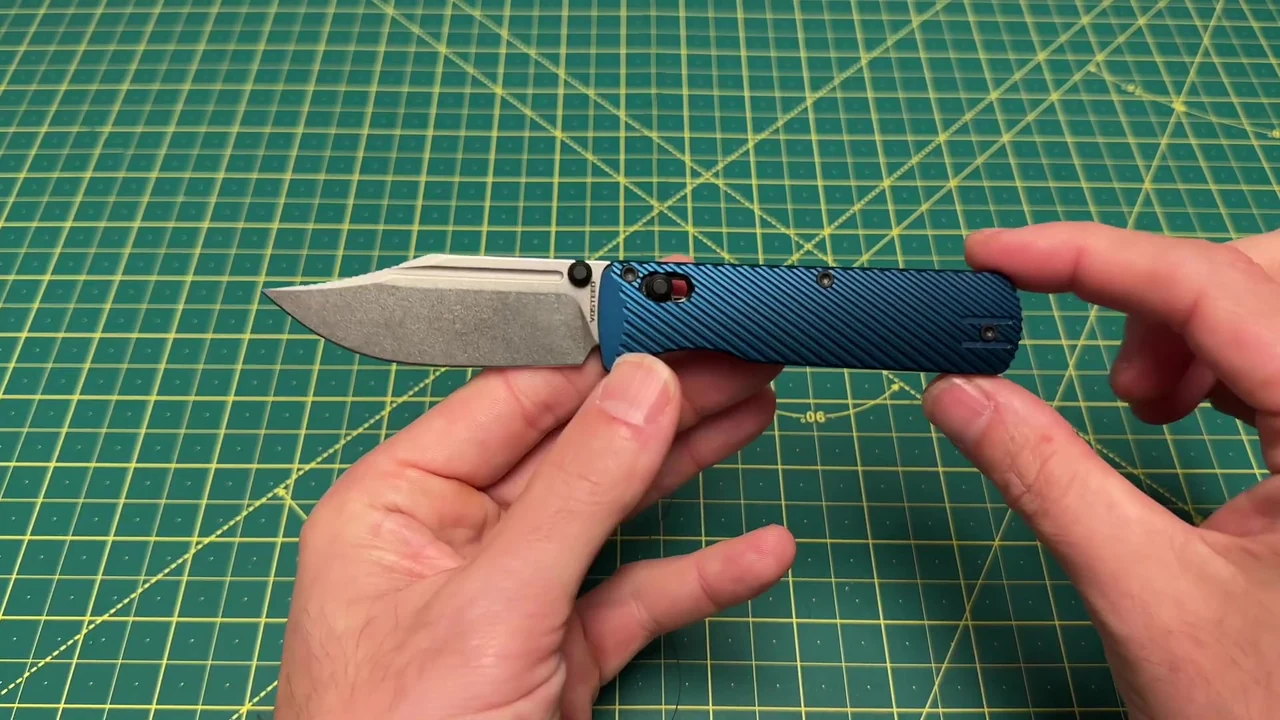
The Vosteed Vombat could very well end up being one of the most innovative knives I have handled. There are a few patents pending on this one.
Overall length is 6.72 inches, with a 2.92-inch blade and 0.118-inch blade thickness. It uses M390, a very, very premium steel. This has a Bowie-style blade, with a drop-point version available too. The flat grind is very nice, thin and slicey. Handle length is 3.81 inches and thickness is 0.490 inch.
This version has aluminum handles with really nice milling. It has a crossbar-style lock with a very unique, innovative design inside, left- or right-hand tip-up carry and a nice, light weight of 2.96 ounces. Yue Dong designed it. They did a really good job.
Full Specs
- Blade
- 2.92 inches, M390, flat grind
- Overall length
- 6.72 inches
- Blade stock
- 0.118 inch
- Handle length
- 3.81 inches
- Weight
- 2.96 ounces
- Handle
- Aluminum
- Lock
- Crossbar
- Carry
- Tip-up, left or right
Specifications: Manufacturer listing
Size Comparisons
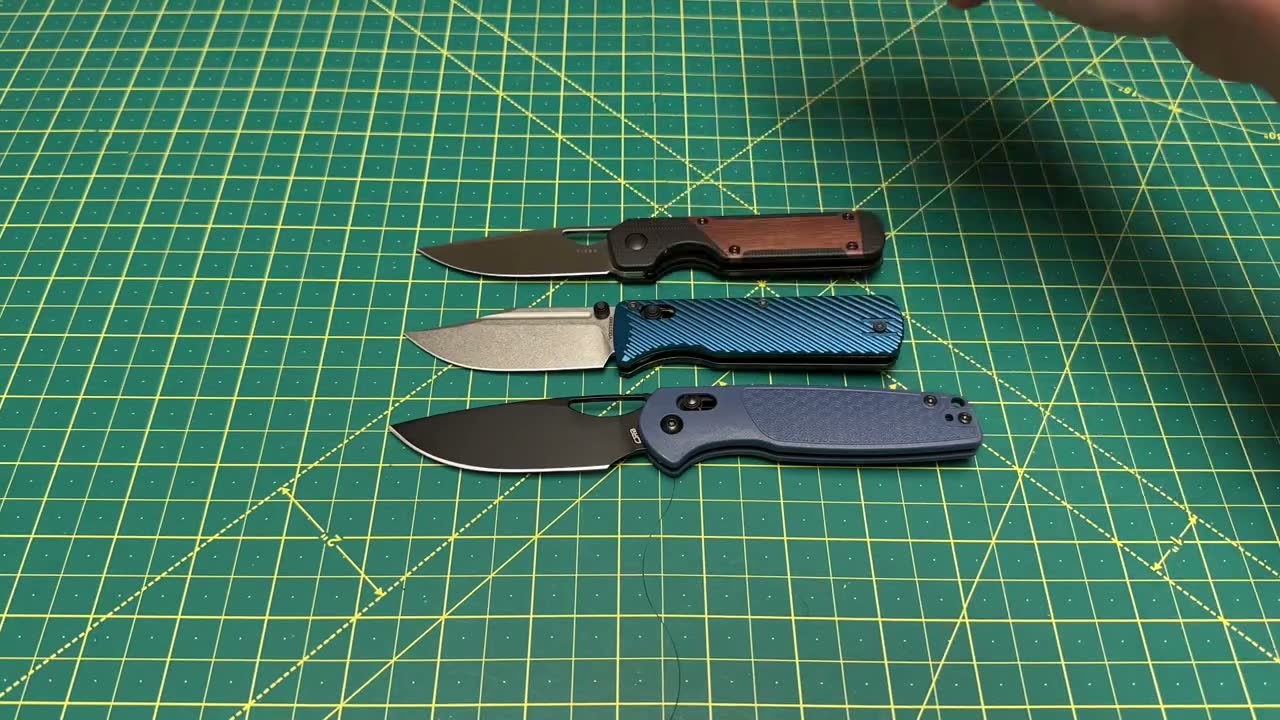
The Kizer Madrac is another of my favorite crossbar-lock knives of the year. I love its design, ergos and blade shape. The Hogue Deka also brings strong value. The Vombat is smaller than both. I'd personally consider it a small knife, though some would call it medium. I like a bigger knife, but there's nothing wrong with this being smaller.
The CJRB Acacia is an ultra-budget knife. The Kizer Mini Militaw is a really good size comparison: it's pretty much the same size as the Vombat.
Blade Details
The blade is good, nice and thin and slicey, about 0.016 to 0.017 inch behind the edge. The jimping is great, both toward the tip for little precision cuts and farther back where my thumb lands. It's really, really fun to have in the pocket.
I like the fuller, but for me it's pretty much unusable. Someone with skinny fingers and long fingernails may be able to flick it, but I simply can't. That's not the end of the world, because the thumb studs are perfect, perfectly placed, with perfect tension and very, very smooth operation.
Swappable Scale System
The Swappable Adjustable Scale system, or SAS, lets me quickly swap scales and adjust spring tension inside. There are T8 screws throughout, which is great. With the scale off, I can reach the spring adjustment. I really like the middle setting. Stronger is a little too strong for me on this size of knife, though I might strengthen it on a bigger blade.
With the scales off, there's still a nice, strong steel frame, and the knife remains functional. I like the internal milling from a design standpoint. The blue scale and its milling pattern look really nice. There are also downloadable files to 3D-print my own scales. That's not a first, but it's a really nice feature.
There are different aluminum scale options and really nice Ultem scales. For me, Ultem scales have to have black-coated hardware and liners; satin, uncoated parts just look weird. With extra scales, there are filler tabs, extra screws, Omega springs and thumb studs in different colors, plus another clip filler plate. I can really make it my own. I'm a big fan. The dark midnight-navy aluminum set looks really, really good.
I noticed the screws are different lengths, so pay attention when taking them out. I believe the longest goes into the post and the shortest in the middle. I think I had it right. It's simply three screws to swap the scale.
After the swap and a final tightening, blade centering is still perfect. There are more colors than the blues, too. I think I like the darker blue better, with nice lines at the top and a smooth bottom. Quickly swapping scales with three screws and adjusting spring tension inside is awesome.
Advanced Handle Features
The clip side has a service hole for fine-tuning action and blade centering with a T8 bit. I didn't adjust it because the blade was centered. I really like it so far. The screw is hidden and minimal, and the show side looks extra clean without a pivot. It also makes it easier to put the crossbar exactly where you want it, which they've nailed very well.
There's also a sandwich-inspired crossbar construction that makes reassembly easier. Disassembly isn't much longer or shorter; the time saving is in putting the knife back together.
Action and Lock Mechanism
The BRB system makes the crossbar itself smoother. The Madrac's clutch lock has a more mechanical sound and feel, with a second click when opening. The Deka has a quieter click too. Those are still great knives with really nice action, and I don't consider that a problem. The Vombat has no click. It's noticeably smoother when I kick the blade out.
I don't know everything causing this, but the inner workings feel a little more precise. There's less slap, and releasing the crossbar early catches the blade. Other locks do that too, but I notice it more here. It's not bad: it's very easy to use, smooth and intuitive. There's less friction. It's a very impressive lock.
Final Thoughts
This is some of the best crossbar-lock action available. I'd easily put it in my top three favorite crossbar-lock knives. I'd just like a bigger Vombat or another bigger knife using this improved system, ideally around a three-and-a-half-inch blade.
I really, really, really like the Vombat. For a smaller crossbar-lock knife, it doesn't get much better. I can't think of anything off the top of my head I'd enjoy more, especially with the favorable ergos and endless customization options. I think it's a phenomenal EDC given the innovation and creativity.
Where to Buy the Vosteed Vombat
Watch Wayne’s Full Review

