

The Short Version
What I Like
- Nice, bulbous, comfortable handle
- Heavy-duty, thick leather sheath
- Edge stayed sharp for two or three weeks with no chipping or rolling
What to Consider
- My finger gets close to the blade, creating a hot spot and eventually a tiny cut
- Balance is a tad handle-heavy
- I'd probably prefer the ESEE-CM6
I took the ESEE-6HM out to beat on wood and carve thin strips. ESEE knives probably aren't the lightest, and they're not for the gram counters.
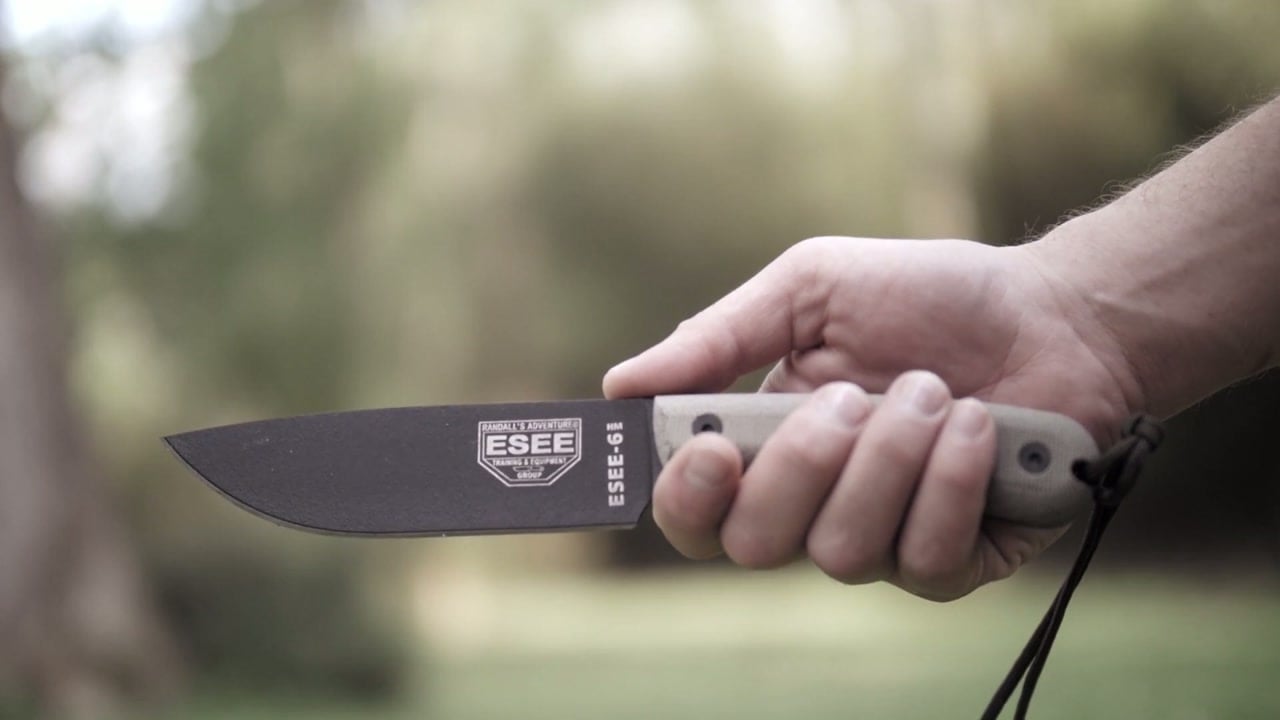
The 6HM is a revision of the ESEE-6 series with a changed handle shape and a blade modified for bushcraft. I don't own the other ESEE-6. The original had a longer blade with a choil but a shorter cutting edge. This version extends the cutting edge a bit and removes the choil. I'm not a fan of choils personally, but I don't know whether removing this one necessarily helps.
Full Specs
- Model
- ESEE 6HM
- Overall length
- 11.0 in
- Cutting edge
- 6.0 in
- Blade thickness
- 0.188 in
- Blade steel
- 1095 carbon steel
- Hardness
- 55–57 HRC
- Blade finish
- Black powder coat
- Handle
- Canvas Micarta
- Weight, knife only
- 10.8 oz
- Sheath reviewed
- Original leather pouch
- Made in
- USA
Specifications: Manufacturer listing
No finger guard for cutting
There's no finger guard for cutting. The choil is gone, but it still has a drop-point, flat-ground blade with a textured black powder coat. The coating is thicker than the Teflon-like coating on the Schrade SCHF51 and SCHF52 series.
The ESEE-CM6 also loses the choil but still has finger guards. It probably comes down to buying a knife for the way I hold it. While I'm making feather sticks, my pointer finger rests close to the blade and creates a hot spot for me.
Handle shape and Micarta
The handle is nice and bulbous. It's comfortable, and there's no jimping anywhere. It has nice Micarta on either side. I think Rowen makes the knives for both ESEE and DPx; they look like they could be made by the same company, though that DPx had hard jimping and weird edges everywhere.
This knife is minimalist. The only real sharp edge is the blade, and the grip and friction all have to come from me.
Balance, sheath and use
The balance is a tad handle-heavy, probably because the handle isn't skeletonized underneath. I appreciated the skeletonizing on the Benchmade Nimravus and Spyderco Temperance 2, though those are smaller blades overall. This still isn't quite as heavy as the Schrade 51 and 52, which are over 15 ounces at their lightest. Weight is relative, and I can't tell anyone what's too big.
The sheath is a throwback to leather. It has the logo emblazoned on it, like the billboard on the blade, but it's made from heavy-duty, thick leather. Like the knife, it's made in the USA. The knife fits down deep inside. Nothing other than tightness or friction keeps it in place, and mine isn't fully broken in, so I'll have to see how I like it over time.
I batoned a big piece of backyard wood with it. The wood was kind of rotten but still had a lot of knots. Afterward, I made feather sticks. My ferro rod was a bit used, and I couldn't get any really good sparks or shavings from it. I had another one I needed to find.
Striking a ferro rod with this coated blade peels the coating off. It strikes better with the coating removed. I don't know why I'd buy this knife if I weren't going to beat on it.
After spending a few weeks with it, I'd probably prefer the ESEE-CM6. I actually like the 6HM quite a bit, but my finger gets a bit too close to the blade when I'm making feather sticks. That caused a tiny cut after about half an hour working with wood in the backyard.
If you like light bushcraft knives, you'll want something a tad smaller and maybe with a skeletonized handle.
The edge stayed sharp
The edge stayed sharp for the two or three weeks I've had it, and it should be fine for a while longer before sharpening. I experienced no chipping or edge rolling, despite trying to shave some of the ferro rod with the edge.

