

We independently evaluate all recommended products and services. Any products or services put forward appear in no particular order. If you click on links we provide, we may receive compensation.

The Swiss Army knife with the most tools is not necessarily the one you will carry. A saw is useful until it makes your pocket tool too thick, and an extra screwdriver does little good if it cannot reach the screw. The trick is buying the tools you actually need without carrying the rest everywhere.
Start with your most common small jobs, then choose the body size around them. These picks range from a tiny keychain knife to a substantial folding toolbox, with a lighter everyday option in between. Here is where each one makes sense, and what you give up by choosing it.
Key Considerations
Think about the jobs your pocket knife will do before comparing function counts.
- Tools you will use: Scissors, a wood saw and a useful screwdriver can matter more than several rarely used functions. Decide which of those you need and which you can leave behind.
- Closed size and bulk: The familiar 91 mm body can be slim or surprisingly thick depending on the tools inside. Closed length, thickness and weight tell you more about pocket carry together than any one figure does.
- Tool access: An inline Phillips driver reaches differently from a driver mounted on the back. Small pliers and short saws are useful within their limits; they do not turn a pocket tool into a workshop kit.
- Blade opening and locking: Most choices here have nonlocking blades opened with two hands. The Soldier 08 has a larger one-hand-opening locking blade. Pick the controls you need rather than assuming every Swiss Army knife works alike.
- Scale tools: Alox models trade the familiar toothpick and tweezers for thinner aluminum scales. Some plastic-handled models also include a pen or pin, but the exact model matters.
Best Swiss Army Knives: Top Picks
- Best Overall Everyday Carry: Victorinox Compact
- Best for Camping: Victorinox Fieldmaster
- Best Slim Alox Option: Victorinox Pioneer Alox
- Best Inline Phillips and Magnifier: Victorinox Explorer
- Best for Small Fasteners: Victorinox CyberTool M
- Best Locking Outdoor Option: Victorinox Soldier 08
- Best Broad Tool Selection: Victorinox SwissChamp
- Best Keychain Option: Victorinox Classic SD
Best Overall Everyday Carry: Victorinox Compact

| PROS | CONS |
|
|
The Compact is my starting point if your Swiss Army knife spends most of its time opening packages, trimming loose ends and handling small everyday annoyances. It keeps the familiar 91 mm body but pares the main tools down to a large blade, scissors and a combination opener. At 16 mm thick and 64 g, it leaves more pocket room than the Explorer or SwissChamp without reducing everything to keychain size.
The little extras are a large part of its appeal. Alongside the toothpick and tweezers, you get a ballpoint pen, pin and small screwdriver stored in the corkscrew, plus a nail file on the multipurpose hook. These are small conveniences rather than reasons to buy a huge knife, and the Compact manages to include them without an equally huge stack of folding implements.
The compromise is straightforward: no wood saw, awl, small secondary blade or Phillips driver. Its combined opener also asks one implement to cover jobs that other models give to separate tools. Choose the Fieldmaster for regular outdoor cutting and sawing, or the Explorer for its inline Phillips. For ordinary blade-and-scissors carry, though, the Compact is the more restrained package.
Best for Camping: Victorinox Fieldmaster

| PROS | CONS |
|
|
The Fieldmaster makes sense when a Swiss Army knife needs to do more around camp than open food packaging. It puts scissors, a wood saw, two blades and a rear Phillips screwdriver in the familiar 91 mm body. That tool mix gives it a clearer outdoor purpose than simply adding another layer because more functions look impressive on a box.
The saw is for small wood jobs, while the scissors handle the cord, tape and loose fabric that do not call for a knife edge. A separate small blade is useful when you want a shorter cutting tool. The can and bottle openers, awl, tweezers and toothpick round out a practical selection. The rear Phillips is the main reason to pick it over the closely related Huntsman, which uses that position for a corkscrew.
You carry 100 g and a 20 mm-thick body for that versatility, so it is a noticeable step up from the Compact. The Phillips also needs working room around the screw; the Explorer’s inline driver is worth comparing for recessed fasteners. The Fieldmaster’s blades do not lock, and its small saw is not a substitute for a camp saw when you have a pile of wood to cut. Choose it for useful small jobs, not as a replacement for every other camping tool.
Best Slim Alox Option: Victorinox Pioneer Alox
| PROS | CONS |
|
|
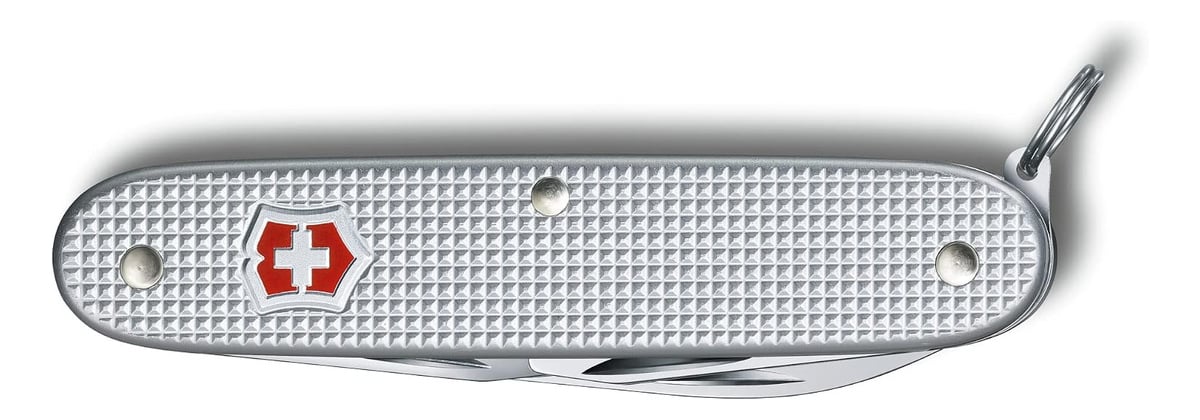
The ordinary Pioneer is an old favorite of mine. In the earlier guide, I described the one I had owned for a long time as an invaluable tool. What still makes the design appealing is its restraint: a large blade, awl, can opener and bottle opener with screwdriver functions, rather than a thick stack of tools you might never unfold.
The textured Alox scales give it a different feel and layout from the familiar red plastic models. Its 93 mm body is a little longer than the 91 mm tools, but only 12 mm thick, with a 71 g weight. That makes it a sensible option when you want a useful hand-sized tool without the thickness of a Fieldmaster or Explorer. The awl opens from the main tool side, which is another practical difference from models with a rear-mounted implement.
Be certain that this simple selection fits your jobs. There are no scissors, toothpick, tweezers, corkscrew, Phillips driver or wood saw. The Pioneer X adds scissors, but it also adds thickness; it is a different choice, not a free upgrade. My earlier ownership account concerns the ordinary Pioneer, not a test of every Alox version. Choose it for a slim blade-and-openers tool; the Compact adds scissors and scale tools.
Best Inline Phillips and Magnifier: Victorinox Explorer
| PROS | CONS |
|
|
The Explorer is the Swiss Army knife that started my interest in knives. In my earlier account, I wrote about getting one as a young Boy Scout and still using it around the house many years later. That history does not make it the right choice for everyone, but its particular tool arrangement remains a good reason to look beyond the more familiar outdoor models.
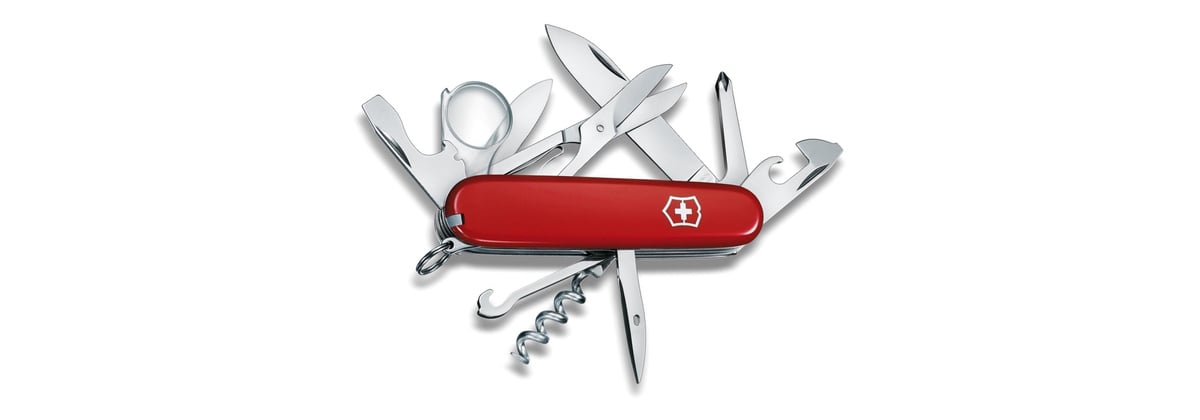
The main attraction is the inline Phillips screwdriver, paired with a folding magnifier. The driver offers a more direct approach to a screw than a rear-mounted Phillips, while the magnifier is a genuinely different tool from another opener or small blade. You still get full-size scissors, large and small blades, openers, an awl, corkscrew, toothpick and tweezers. It is a useful arrangement for small household tasks and inspecting tiny details.
The cost in carry is a 101 g tool with a 22 mm-thick body. That is considerable bulk just to keep scissors and a blade handy; the Compact is the better place to start for those jobs. There is also no wood saw or pair of pliers. Choose the Explorer when its inline driver and magnifier justify the extra pocket bulk.
Best for Small Fasteners: Victorinox CyberTool M
| PROS | CONS |
|
|
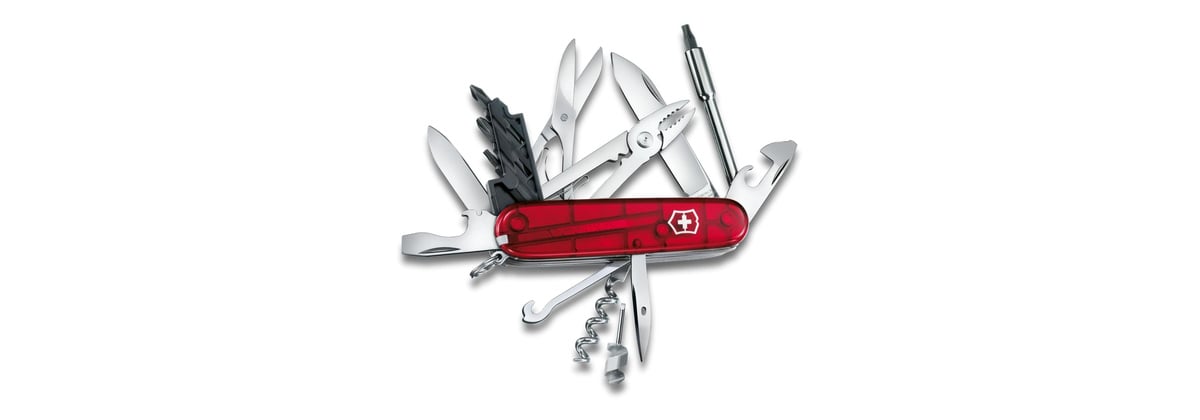
The CyberTool M makes the strongest case when small screws are the reason you reach for a pocket tool. Its folding bit driver and carried bit set are a meaningful step beyond the fixed screwdriver tips on the simpler models. For routine small-fastener jobs, that driver is a better reason to choose it than a bigger function count.
The driver is supported by eight bit tips, and the tool also includes small pliers, scissors, large and small blades, openers and a corkscrew with a mini screwdriver. A pen, pin, tweezers and toothpick add the small conveniences that are easy to appreciate once you carry them. It is a much more complete pocket kit than the Pioneer, although the little pliers and driver are still intended for small jobs rather than heavy workshop torque.
At 153 g and 28 mm thick, this is a deliberate choice to carry more equipment. There is no wood saw or metal file, so its extra bulk is best justified by fasteners rather than general outdoor use. Some shops still call this family the CyberTool 34; use the actual driver, pliers and scissors layout to distinguish it from smaller and larger relatives. Keep the Compact for light daily carry; take the CyberTool when its screw-driving capability earns the space.
Best Locking Outdoor Option: Victorinox Soldier 08
| PROS | CONS |
|
|
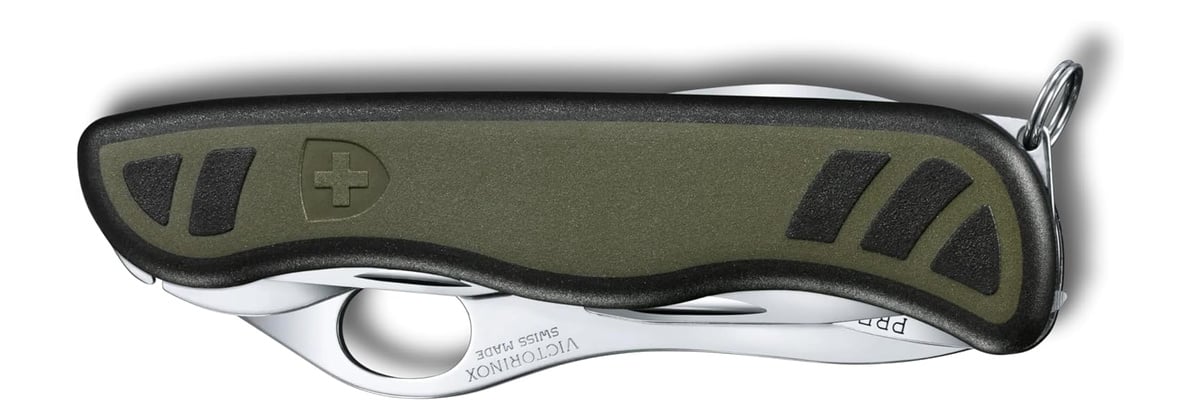
The Soldier 08 serves a different purpose from a small red pocket toolbox. Its 111 mm handle, one-hand-opening main blade and locking mechanism make it worth comparing when blade access and a larger grip matter more than scissors or tiny household extras. The olive-and-black handle also makes it easy to distinguish from the ordinary 91 mm tools.
The main blade has a partly serrated edge, and the tool includes a wood saw, rear Phillips screwdriver, can opener, awl and a bottle opener with its own lock. That is a focused outdoor selection, rather than an attempt to fit every implement into one body. At 131 g it is substantial, but still lighter than the smaller-bodied CyberTool M or SwissChamp because it carries fewer tools.
The omissions matter. There are no scissors, tweezers or toothpick, and the serrated section will not suit every small slicing task or sharpening preference. Do not confuse this exact Soldier with the related Trekker versions: their handle accessories, blade edges and opening arrangements can differ. The main blade’s one-hand opening also does not make every implement a one-handed tool. I would pick the Fieldmaster for scissors-and-saw versatility, and the Soldier when the larger locking blade is the reason for carrying it.
Best Broad Tool Selection: Victorinox SwissChamp
| PROS | CONS |
|
|
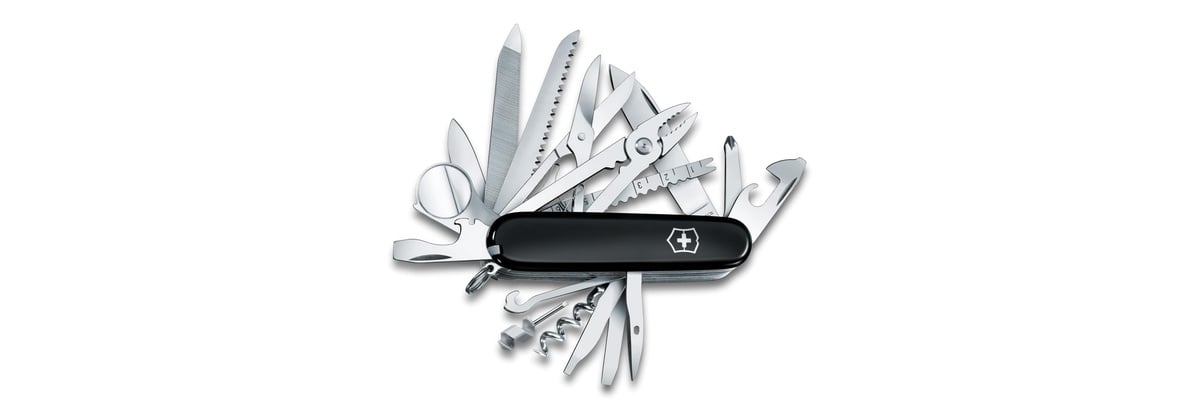
The SwissChamp is the choice for someone who knows why the smaller models are not enough. It keeps the 91 mm body length but fills it with scissors, small pliers, a wood saw, metal saw and file, magnifier, inline Phillips driver and the usual blades and openers. Those are real differences from the Compact, not just a larger number printed beside the word functions.
The selection covers a wide range of small tasks, with a pen, pin, tweezers, toothpick and several additional fine tools tucked into the package. I would compare it with the CyberTool M by asking whether saws, filing and the magnifier are more useful than interchangeable driver bits. Both include pliers; neither turns those little jaws into a replacement for full-size workshop tools.
What makes the SwissChamp difficult to recommend indiscriminately is its carry bulk. The 185 g weight and 33 mm thickness are a long way from the Compact, even though both close to the same length. Its main blade is also nonlocking. The selected black model is the ordinary SwissChamp tool layout, not an excuse to add collectible giant versions. I would buy it only when several of its extras solve recurring jobs; if most remain folded, a slimmer tool will be easier to keep with you.
Best Keychain Option: Victorinox Classic SD
| PROS | CONS |
|
|
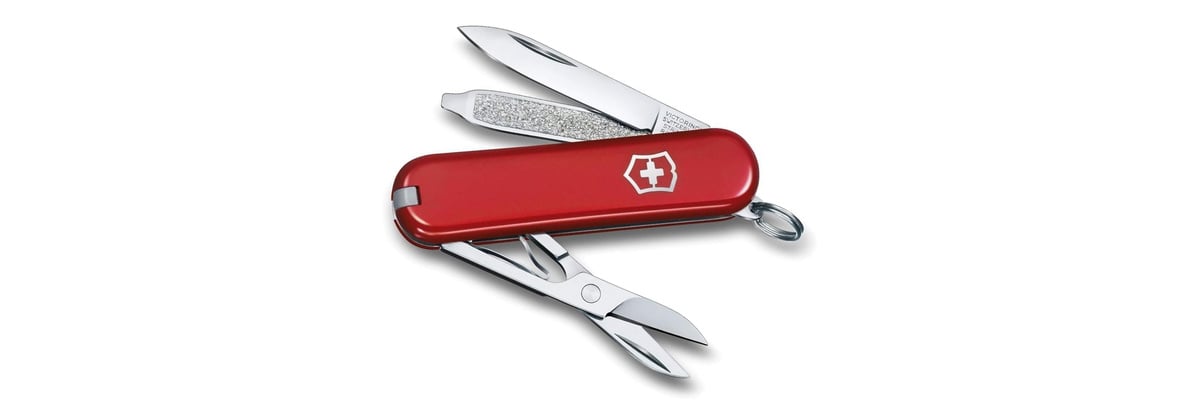
The Classic SD makes sense when even a slim 91 mm tool feels like more knife than you need. It fits a small blade, scissors and nail file with a flat screwdriver tip into a 58 mm body, with a toothpick and tweezers in the red scales. That is enough for many minor everyday jobs without turning your keyring into a heavy collection of gadgets.
In Travis Smola’s Classic SD account in our earlier buying guide, he described using his for packages, fishing line and tiny screws, and finding the toothpick and tweezers more useful than he initially expected. He also noted how easy the little knife was to forget he was carrying. His examples capture the practical attraction of a simple keychain tool.
The limits are equally small-scale. The blade, scissors and screwdriver have little reach or leverage, and there is no bottle opener or Phillips driver. A MiniChamp adds more specialty implements, but extra implements are worthwhile only when you use them. Choose the Classic for light, incidental tasks and the Compact if you want more hand-sized blade-and-scissors access. Its small size does not make it automatically suitable for restricted buildings or cabin baggage, so remember it is attached to your keys before traveling.
Compare Our Picks
Scroll sideways on smaller screens to compare all the details.
| Knife | Closed length | Weight | Useful tools |
|---|---|---|---|
| Victorinox Compact | 91 mm | 2.26 oz (64 g) | Scissors, pen, combination opener |
| Victorinox Fieldmaster | 91 mm | 3.53 oz (100 g) | Scissors, wood saw, rear Phillips |
| Victorinox Pioneer Alox | 93 mm | 2.50 oz (71 g) | Awl, can/bottle openers |
| Victorinox Explorer | 91 mm | 3.56 oz (101 g) | Inline Phillips, magnifier, scissors |
| Victorinox CyberTool M | 91 mm | 5.40 oz (153 g) | Bit driver, pliers, scissors |
| Victorinox Soldier 08 | 111 mm | 4.62 oz (131 g) | Locking blade, wood saw, Phillips |
| Victorinox SwissChamp | 91 mm | 6.53 oz (185 g) | Pliers, wood/metal saws, magnifier |
| Victorinox Classic SD | 2.3 in | 0.70 oz | Small blade, scissors, nail file |
How to Choose a Swiss Army Knife
Start with two or three real jobs
If you mainly open packages and trim loose threads, the Compact or Classic SD deserves a look before the larger tools. Add a saw for repeated outdoor use, a proper inline driver for recessed screws, or pliers when those solve a job you regularly face. Function totals count multiple jobs on some individual implements, so they are not a count of separate tools.
Compare thickness as well as length
The Compact, Explorer and SwissChamp all have 91 mm bodies, but their thicknesses are 16, 22 and 33 mm. That is a meaningful difference against your leg or in your hand. The 71 g Pioneer is a slim alternative without scissors; the 185 g SwissChamp earns its bulk only when its extra tools get used.
Choose your screwdriver arrangement
The Fieldmaster’s rear Phillips driver is useful when there is room around the screw. The Explorer’s inline Phillips offers a different approach to reach, while the CyberTool’s bit driver covers more fastener types. None should be used to force a seized fastener beyond the little tool’s capacity.
Understand the blade and lock
The Soldier 08 is the only selected model here with a locking main blade and one-hand opening. The other blades fold against a spring rather than locking. Keep pressure controlled and fingers clear of the closing path; a lock is not permission to pry. Check local restrictions for the exact knife and carry method, especially when traveling.
Keep it maintained
After a wet or dirty job, clean out the joints, dry the tool and follow Victorinox’s care instructions. Grit between crowded implements can spoil access long before the blade is worn out. Keep the edge sharp and do not twist the small blade or use it as a substitute for a screwdriver.
Why Trust Us
My earlier Swiss Army knife guide included long-term experience with the ordinary Pioneer and Explorer. Travis Smola’s Classic SD account adds his everyday-use perspective. These choices compare the tool layout, dimensions and access that matter for the jobs each design suits.
Final Thoughts
For most everyday blade-and-scissors jobs, I would begin with the Compact. Choose the Fieldmaster when a wood saw belongs in your kit, the Pioneer when slim Alox carry matters more than scissors, or the Classic SD for light keychain use. The larger Explorer, CyberTool and SwissChamp make more sense when their particular extras solve a regular problem. The Soldier 08 serves a different need: a larger locking blade and outdoor tools, rather than a small pocket toolbox. For other makers worth comparing, see my guide to the best knife brands.
Frequently Asked Questions
What is the best Swiss Army knife for everyday carry?
The Compact is my starting point when you want a useful blade, full-size scissors and little pocket bulk. If you need a wood saw, Phillips driver or pliers, choose around that requirement instead. There is no benefit in buying more tools than you will carry.
Do Swiss Army knives have locking blades?
Some do. The selected Soldier 08 has a locking main blade, while the Compact, Fieldmaster, Pioneer, Explorer, CyberTool M, SwissChamp and Classic SD have nonlocking blades. Similar-looking models and related versions can differ, so check the actual model.
What is the difference between the Fieldmaster and Huntsman?
Both pair scissors and a wood saw in a 91 mm body. The Fieldmaster has a rear Phillips screwdriver where the Huntsman has a corkscrew. Choose the implement you will actually use; neither arrangement gives you the Explorer’s inline Phillips driver.
Is Alox better than the plastic handle?
Alox offers thin textured aluminum scales, but ordinary Alox models omit the tweezers and toothpick stored in many plastic scales. It is a different balance of slimness and features. The plain Pioneer also lacks scissors; the Pioneer X adds them in a thicker body.
Should I buy a SwissChamp or CyberTool M?
Choose the CyberTool for its bit driver and small-fastener work. Choose the SwissChamp when a wood saw, metal file/saw and magnifier are more useful than interchangeable bits. Both include small pliers, and both are much bulkier than a Compact.
Can I take a Swiss Army knife when flying?
Do not assume a small blade or keychain attachment makes it acceptable in cabin baggage. Check the current airport, airline and destination rules before packing it. Keep a knife out of a travel bag unless you have confirmed how it may be transported.
