


We independently evaluate all recommended products and services. Any products or services put forward appear in no particular order. If you click on links we provide, we may receive compensation.

Stiletto describes a blade style, not an opening mechanism. The familiar long, pointed profile can belong to a manual folder, a side-opening automatic or an out-the-front knife. That makes the useful buying question broader than which switchblade opens fastest: how do you want to open, close, carry and cut with the knife?
The Benchmade Auto Fact remains my overall pick for its operation and easy carry. The Cold Steel Ti-Lite adds a value manual option, the AKC Swinguard supplies traditional automatic styling, and the AGA Campolin Zero+ offers a larger lever lock. The Kershaw Launch 8 is a particularly light side-opening choice.
Key Considerations
- Mechanism: The Ti-Lite is manual. The Auto Fact, Swinguard, Zero+ and Launch 8 deploy automatically but close manually. Choose the opening and closing arrangement that fits how you use a knife.
- Cutting and grip: A slender point does not guarantee a useful working edge or a comfortable handle. Judge the cutting you will actually do, and avoid treating any of these fine points as a pry bar.
- Carry: Overall size, pocket weight and control placement matter together. A reversible clip does not necessarily make a one-sided button equally convenient for either hand.
- Rules: Manual opening, a short blade or a single edge does not establish permission for every place and activity. Ownership, carrying and shipment require separate consideration.
Top Picks
- Best Overall: Benchmade Auto Fact
- Best Value Manual: Cold Steel Ti-Lite
- Best Traditional Style: AKC Swinguard
- Best Lever-Lock Choice: AGA Campolin Zero+
- Best Light Carry: Kershaw Launch 8
Best Overall: Benchmade Auto Fact

| PROS | CONS |
|
|
The Auto Fact’s Auto AXIS system doubles as its deployment method: pull the crossbar and the blade snaps open. I loved how this knife handled during testing. There is enough jimping at the top to give fine control of the blade, and the factory edge on my knife was fantastic.
I have used it extensively as an EDC knife. The slim profile and 3.11-ounce weight make it a joy to slip into a pocket despite the long 3.95-inch blade. Its aluminum and carbon-fiber construction also gives the traditional pointed profile a distinctly modern appearance.
S90V’s wear resistance is useful for regular cutting, but substantial sharpening takes suitable abrasives and technique. The price is the other obvious compromise. I would choose the Auto Fact for its combination of operation, working edge and carry comfort, rather than expecting a slender point to tolerate prying or twisting.

Best Value Manual: Cold Steel Ti-Lite
| PROS | CONS |
|
|
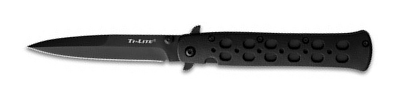
The Ti-Lite is the value choice if you want the long, pointed stiletto profile in a manual folder. This version has a black-coated 4-inch AUS-8A blade, a black polymer handle, thumb-stud opening and a liner lock. Its steel-lined handle gives you the familiar stiletto outline without an automatic mechanism.
At 8.75 inches overall and about 4 ounces, it is a substantial pocket knife. The 4.75-inch closed handle needs room, and its weight exceeds the Auto Fact’s 3.11 ounces and the Launch 8’s approximately 2.4 ounces. Choose it for its lower price and manual format rather than expecting the smallest or lightest carry.
AUS-8A is a simpler steel choice than S90V, with lower wear resistance. The long, narrow point also makes a different cutting tool from a broad utility blade. If the shape and a value manual folder are what you want, the Ti-Lite makes sense; if automatic opening and lower weight matter more, consider the Auto Fact or Launch 8.
Best Traditional Style: AKC Swinguard

| PROS | CONS |
|
|
The Swinguard is the budget choice for someone who enjoys the traditional automatic stiletto. Press its button and the guard swings into position with the blade. This black-G10 version combines that distinctive mechanism with a 3.875-inch blade, a lockback and a 9-inch overall length.
At 4.50 ounces, it is substantially heavier than the Auto Fact despite having a slightly shorter blade. Its attraction is the classic design at a lower price, rather than premium blade steel or a promise of hard-use performance. Blade HQ lists this particular model as made in Italy.
Choose the Swinguard for its appearance and mechanism, with collecting and occasional light tasks in mind. The Auto Fact and Launch 8 make a stronger case when daily cutting and pocket weight are the priorities.
Best Lever-Lock Choice: AGA Campolin Zero+
| PROS | CONS |
|
|
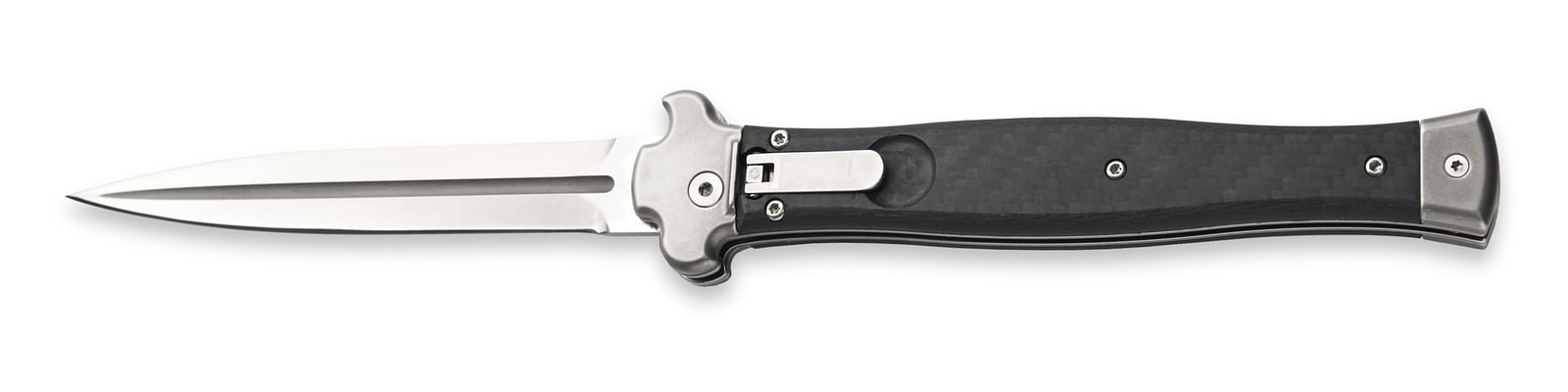
The Zero+ is the choice for someone who wants a lever-lock Italian automatic in a larger, more modern format. For this carbon-fiber offer, Blade HQ lists a 4.5-inch N690 blade, a 10.25-inch overall length and a 6.85-ounce weight. Its right-hand, tip-down pocket clip gives it a different carry orientation from the Swinguard.
The lever mechanism is the main reason to choose it. Its carbon-fiber scales do not make this a lightweight knife: it is more than twice the Auto Fact’s weight. That matters if you plan to carry it all day, and the larger dimensions deserve consideration alongside the named steel and distinctive construction.
Choose the Zero+ for its mechanism and size, rather than assuming every stiletto is an interchangeable everyday tool. The smaller, lighter Auto Fact is the more straightforward recommendation for pocket comfort. Our Italian switchblade guide compares the country-of-manufacture side of this category.
Best Light Carry: Kershaw Launch 8

| PROS | CONS |
|
|
The Launch 8 gives you a long, elegant stiletto-style profile without much pocket weight. Kershaw puts a 3.5-inch CPM 154 blade into an 8.25-inch knife weighing approximately 2.4 ounces. The aluminum handle and carbon-fiber insert give it a modern appearance while keeping the familiar slender outline.
It is a side-opening push-button automatic with manual closing. The clip can be moved for either pocket, but the button remains on one side. That is an important distinction from calling the whole knife ambidextrous. A reversible clip solves carry orientation, not every question about operating the controls.
I would choose the Launch 8 for light carry and its stiletto styling. A narrow handle and fine point are compromises to consider for your own grip and cutting. For a longer blade and crossbar controls, consider the Auto Fact. For a manual opening mechanism, look at the Ti-Lite.

Compare the Five Stiletto Picks
Swipe sideways on a small screen to see every column. Follow a model link for the current offer.
| Knife | Blade / weight | Mechanism / steel | Choose it for / tradeoff |
|---|---|---|---|
| Benchmade Auto Fact | 3.95 in / 3.11 oz | Side-opening Auto AXIS / S90V | Long blade and easy carry / High price |
| Cold Steel Ti-Lite | 4 in / Approx. 4 oz | Manual thumb stud; liner lock / AUS-8A | Value manual stiletto / Long handle and simpler steel |
| AKC Swinguard | 3.875 in / 4.50 oz | Side-opening push button; lockback / Stainless steel | Classic swinging guard / Collection-focused |
| AGA Campolin Zero+ | 4.5 in / 6.85 oz | Side-opening lever; lever lock / N690 | Large lever-lock format / Heaviest automatic here |
| Kershaw Launch 8 | 3.5 in / Approx. 2.4 oz | Side-opening push button / CPM 154 | Light carry and slim profile / Narrow grip and one-sided button |
How to Choose a Stiletto Knife
Start With Manual or Automatic
A manual folder gives you the stiletto profile without automatic deployment. That is the Ti-Lite’s role here. A side-opening automatic swings its blade out from the handle when you operate its release, but you fold it closed manually. A double-action OTF uses the same slide to deploy and retract through the front. Those differences change the handling more than the shared stiletto label.
Our automatic stiletto guide covers the automatic side in more depth. For a different view of the category, our Italian switchblade guide focuses on Italian-made choices.
Choose a Working Edge and Manageable Carry
A long, fine point can be useful for precise tasks, but blade geometry and handle comfort determine how a knife feels during repeated cutting. A broader utility blade may suit some jobs better. Likewise, a light knife can be easier to keep in a pocket, while a heavier model may appeal for its mechanism or construction. Consider what you value rather than treating weight or price alone as proof of quality.
Steel names help explain wear resistance and maintenance, not a guaranteed factory edge. Our knife steel guide explains those tradeoffs. Choose sharpening equipment appropriate to the steel and blade configuration, especially when both edges are sharpened.
Separate Ownership, Carrying and Shipment
Opening mechanism, blade configuration, location and activity can each matter. Federal law restricts interstate commerce involving switchblades and conduct in specified jurisdictions, with statutory exceptions. State and local requirements add separate rules. Use our state knife-law directory as a starting point for the place and activity involved. A retailer accepting an order is not legal clearance for every use or place.
Why Trust Us
Over a decade of professionally writing about knives, I have tested hundreds of knives, including some of the best automatic knives being manufactured today. I’ve also extensively talked to knife companies to get their views on modern knives. This has given me much insight into what makes a good stiletto.
Final Thoughts
The Benchmade Auto Fact remains my overall pick for its handling, factory edge and carry comfort. Choose the Cold Steel Ti-Lite if a value manual folder is what you want, or the AKC Swinguard for traditional automatic styling. The AGA Campolin Zero+ offers a larger lever lock, while the Kershaw Launch 8 combines a long profile with particularly light carry. Start with the format you want to handle, then judge the blade, grip and weight together.
FAQs
Does Stiletto Mean Automatic?
No. Stiletto describes a long, pointed blade style. It can be manual, automatic or fixed. A switchblade describes automatic deployment, while an OTF deploys through the front of its handle.
Are Stiletto Knives Useful for Everyday Cutting?
Some modern designs can handle ordinary tasks well, while traditional models may emphasize collecting and appearance. Judge the exact blade geometry, working edge and handle instead of assuming every stiletto is either a practical tool or a novelty.
Does Expensive Steel Guarantee a Sharper Edge?
No. Steel, heat treatment, geometry and sharpening all contribute to performance. A wear-resistant alloy may hold an edge longer, but the steel name alone does not establish the factory edge quality or how comfortably the knife cuts.

