


We independently evaluate all recommended products and services. Any products or services put forward appear in no particular order. If you click on links we provide, we may receive compensation.
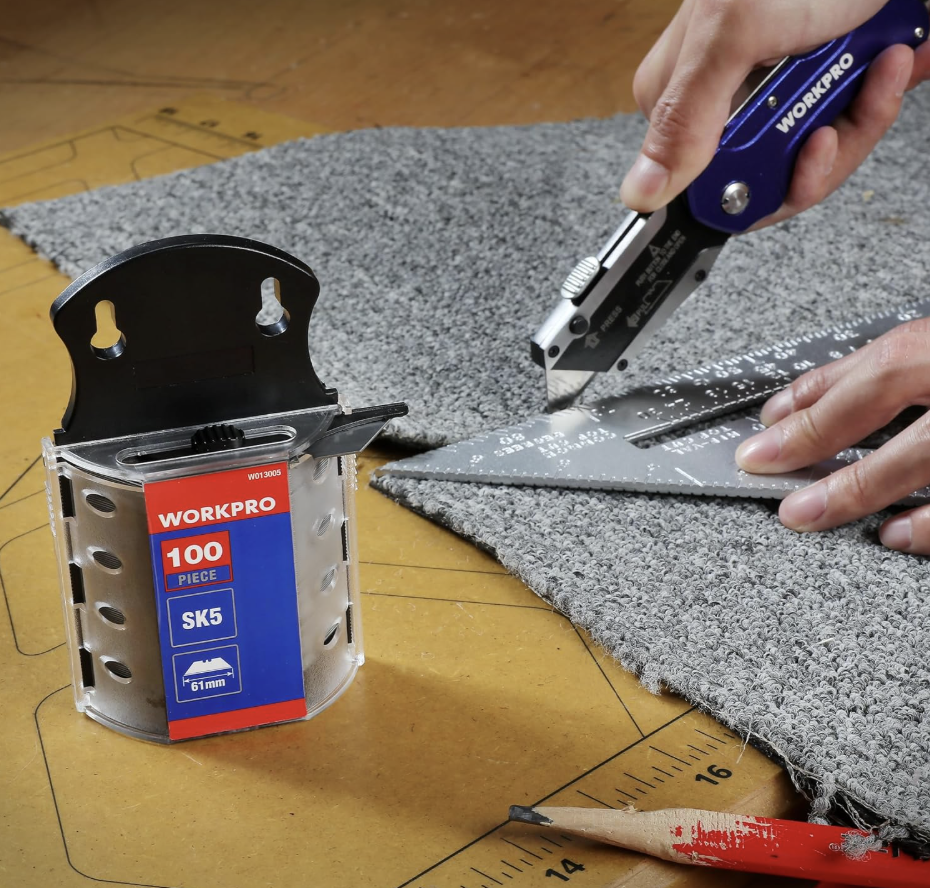
Walk into any job site, warehouse, or workshop and you'll see utility knives everywhere. Contractors use them to cut drywall. The right blade matters too: choose an edge and size suited to the material and your knife, rather than relying on the handle's price or the words “heavy duty.”
The problem is that not all utility knife blades are created equal. A blade that works well for opening cartons may not be the right choice for flooring or roofing. Worse, dull blades are dangerous—they require more pressure, which leads to slips and injuries.
The cutting results below describe my experience with particular blades and materials, not standardized lifespan guarantees. Pack sizes and product details refer to the identified models and linked offers.
Key Considerations
Utility knife blades might look like a commodity product, but several factors dramatically impact performance, safety, and value. After cutting through hundreds of boxes, sheets of drywall, and various materials, here's what actually matters:
- Steel Type: Compare the exact blade construction, not a blanket ranking of steel types. Bi-metal does not mean stainless or rust-proof; the cutting edge and body can use different steels. The material you cut and the knife you use should guide your choice.
- Blade Thickness: Check the specific thickness and your knife's compatibility requirements. “Heavy duty” is not a universal thickness category: Stanley labels its .024-inch 11-921A blade heavy duty. I tried thinner and thicker examples and found that thicker was not always better for my work; compatibility and the cutting task still come first.
- Edge Type: Straight blades are a practical starting point for general cutting. Hook blades excel at cutting materials from underneath (carpet, linoleum, roofing). Serrated edges grip slippery materials. Snap-off blades provide multiple fresh edges from one blade but aren't compatible with standard utility knives. Understanding these blade formats prevents buying the wrong product.
- Sharpness vs Durability: Initial sharpness and useful edge life are different qualities; neither can be predicted from price alone. For precision work, prioritize sharpness. For high-volume cutting, prioritize durability. I tested both scenarios by counting actual cuts until performance degraded.
- Safety Features: Choose a blade and knife designed for the job, follow the blade-change instructions and keep unused blades in a suitable dispenser. Rounded tips are one task-specific option, not proof that a blade is safest for every use.
- Packaging & Value: Compare the current total price and actual blade count, including any seller multipack. Buy a quantity you can store safely and dry. I calculated the actual cost-per-cut for different applications to find the real value leaders.
Top Picks
- Best Overall: Stanley 11-921A Heavy Duty
- Basic Dispenser Option: Sheffield 12282
- Best Heavy Duty: Lenox Gold 20350
- Best for Precision: Milwaukee 48-22-1975
- Best Carbide Blade: DeWalt DWHT11131 Carbide Utility Blades
- Best Bulk Value: WORKPRO SK5
- Bi-Metal Option: Irwin 2084400 Bi-Metal
Best Overall: Stanley 11-921A Heavy Duty Utility Blades
| PROS | CONS |
|
|
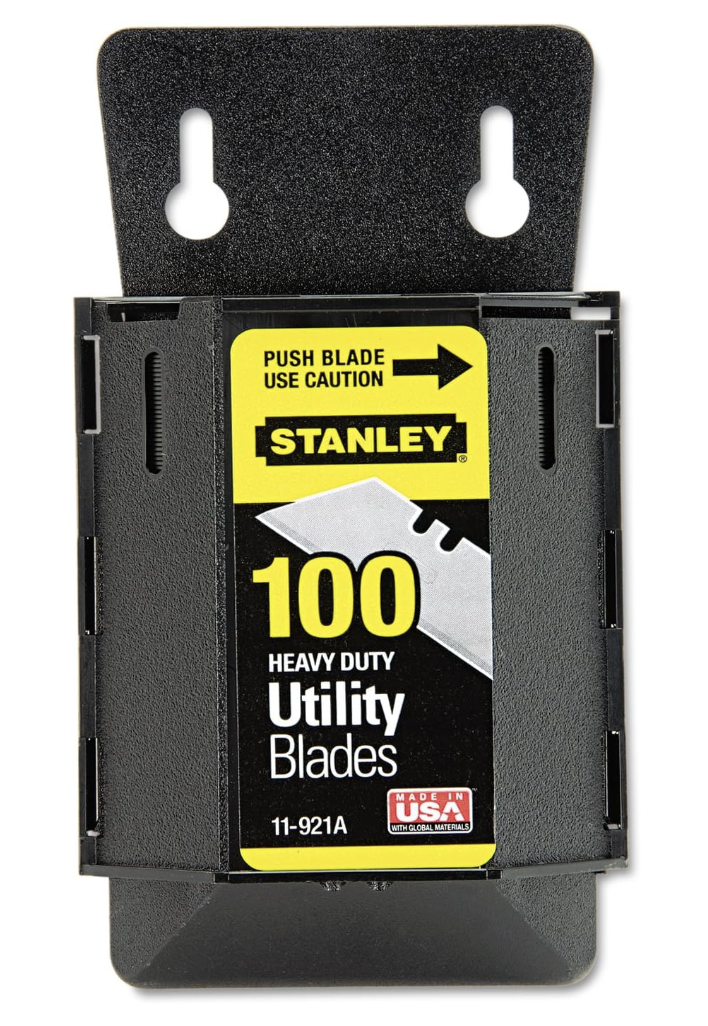
The 11-921A remains my general-purpose pick based on the cutting experience described here. In my testing, a single blade cut through 47 cardboard boxes before I noticed any degradation in performance. That was my result with the materials I cut.
What sets Stanley apart is consistency. Every blade in the 100-pack performed identically—no random dull blades, no premature breaks. I used these blades on cardboard, plastic strapping, drywall, and vinyl flooring. They excelled at everything except the most abrasive materials. In my cutting, the edge stayed sharp and the blades held their shape. That is not a reason to bend or pry with a blade.
The dispenser keeps the unused blades together; use a designated puncture-resistant container for discarded blades. Compare the current offer against its 100-blade count rather than relying on an old per-blade price. These blades will develop surface rust if exposed to moisture, but that's true of all carbon steel blades. For most contractors and serious DIYers, these represent the best balance of performance, safety, and value.
Basic Dispenser Option: Sheffield 12282 Utility Blades
| PROS | CONS |
|
|
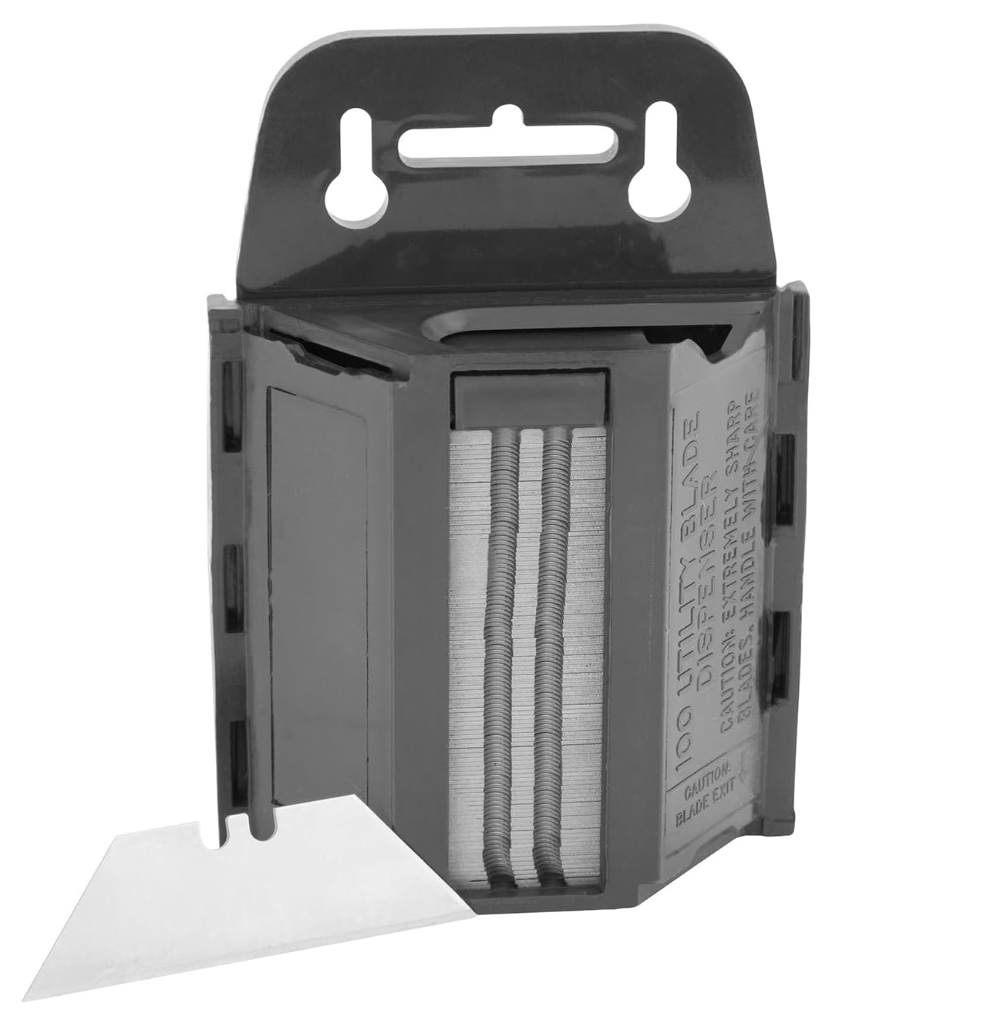
Sheffield's 100-blade dispenser is an option for users who change blades frequently; compare its current price with other 100-packs. I tested these against premium options by cutting identical materials, and while Sheffield blades dulled faster, they still delivered 20-25 cardboard boxes per blade—perfectly acceptable for the price point.
My Sheffield sample was less consistent than the Stanley and LENOX blades I tried. Out of 100 blades, I encountered two that seemed slightly duller from the factory and one with a minor edge imperfection. That describes the pack I used. The remaining 97 performed as expected for general-purpose utility blades. They cut cleanly through cardboard, plastic wrap, and light materials without issue.
Where these blades fall short is in tougher materials. Cutting drywall dulled them noticeably faster than premium options, and I wouldn't trust them for roofing work or other demanding applications. But for warehouse workers opening boxes all day or DIYers doing occasional projects, Sheffield blades deliver adequate performance at a price point that makes frequent blade changes economically sensible. The dispenser is basic but functional, keeping unused blades organized and safe.
Best Heavy Duty: Lenox Gold 20350 Utility Blades

| PROS | CONS |
|
|
When contractors ask, "Who makes the best utility knife blades for demanding work?" the answer is consistently Lenox Gold. LENOX describes the GOLD cutting edge as titanium-nitride coated. The maker lists drywall, insulation, flooring and roofing among its applications; that is not a guarantee against wear or breakage.
I tested these extensively on the materials that destroy budget blades: roofing shingles, thick rubber, laminate flooring, and drywall. A single Lenox Gold blade cut through 18 sheets of 1/2" drywall before noticing degradation—that was triple the result I got with the standard blades in that drywall test. The blade's construction does not make it immune to bending or breakage. I tried (unsuccessfully) to break one by flexing it repeatedly. That observation is not a safe-use recommendation: do not deliberately bend or stress a utility blade.
The real magic is in edge retention. Even after dozens of cuts through abrasive materials, these blades maintained a working edge longer than the other blades I tried. The linked offer contains three five-blade packs. Compare its total price with that 15-blade count; cutting life depends on the material and use. For professional contractors, flooring installers, or anyone cutting tough materials regularly, Lenox Gold blades are worth every penny. For occasional DIY use, they're probably overkill.
⚠️ SAFETY REMINDER
Always cut away from your body. Keep your free hand out of the cutting path, change blades when they start to dull (dull blades require more pressure and slip more easily), and always retract the blade when not actively cutting. Dispose of used blades in puncture-resistant containers—never throw them loose in the trash.
Best for Precision: Milwaukee 48-22-1975 Utility Blades

Illustration: 48-22-1950 (50 blades). The linked 48-22-1975 dispenser contains 75 blades.
See @ Amazon
| PROS | CONS |
|
|
These are general-purpose blades; I found their cut quality useful for precision work. The factory edge on these blades is legitimately impressive—sharper than any other utility blade I tested. I used them to cut vinyl graphics, thin plastic sheet, and craft materials. The cuts were consistently clean without the tearing or ragging that duller blades produce.
I liked the cut quality. Milwaukee identifies this as a general-purpose model, not a rounded-tip carton blade. Choose the blade your handle specifies and judge its suitability on the material you actually cut.
In my test, these did not last as long as the Stanley blades. I got about 30 cardboard boxes per blade compared to 45+ with Stanley heavy duty blades. I valued the clean cuts even though I changed these blades sooner. The linked 48-22-1975 offer is a 75-pack; compare prices using that count, not the 50-pack shown in the illustrative photo. For contractors doing finish work or anyone who needs consistently clean cuts, these general-purpose blades are worth considering for the cut quality I observed.
Best Carbide Blade: DeWalt DWHT11131 Carbide Utility Blades
| PROS | CONS |
|
|
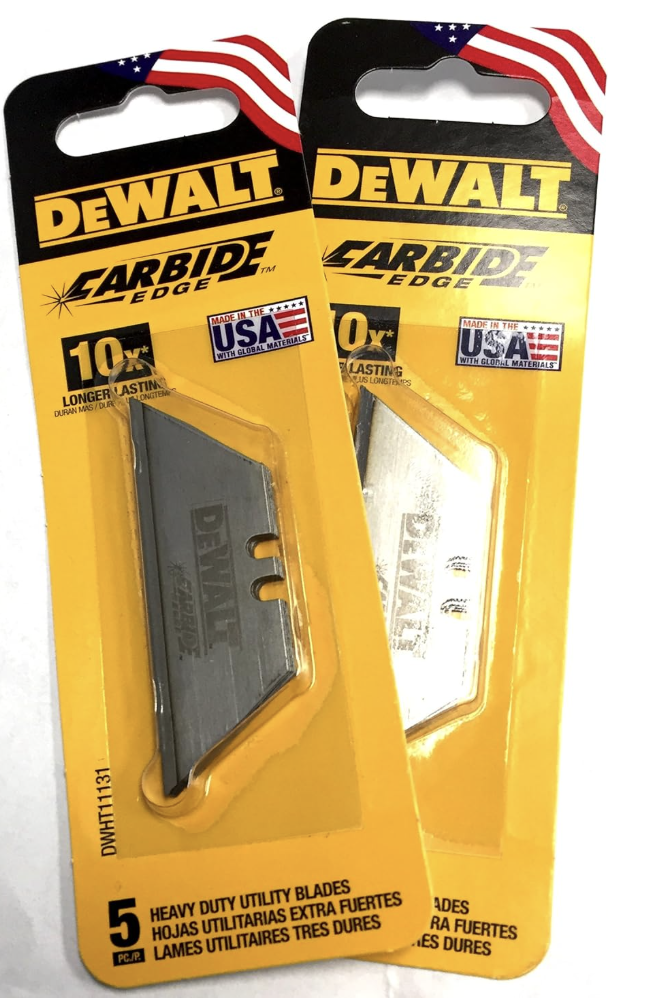
DeWalt uses a carbide cutting edge laser-deposited onto a steel body. Here is how it performed in my cutting.
I used a single DeWalt carbide blade to cut through 200+ cardboard boxes before noticing any performance degradation. That's not a typo—two hundred boxes with one blade. Carbide edges still wear and must be replaced when they no longer cut properly.
DeWalt pairs a carbide edge with a steel body. I deliberately flexed and bent these blades during testing and observed them spring back. Do not repeat that handling: the observation does not make a thin cutting blade safe to bend, twist or use for prying.
For regular cutting, compare the current blade price with the usable cutting life you observe on your own material. The 200-plus-box result above is not evidence that every carbide blade replaces ten conventional blades. For occasional package opening, compare these with simpler general-purpose options before paying for a specialty edge.
Best Bulk Value: WORKPRO SK5 Utility Blades
| PROS | CONS |
|
|
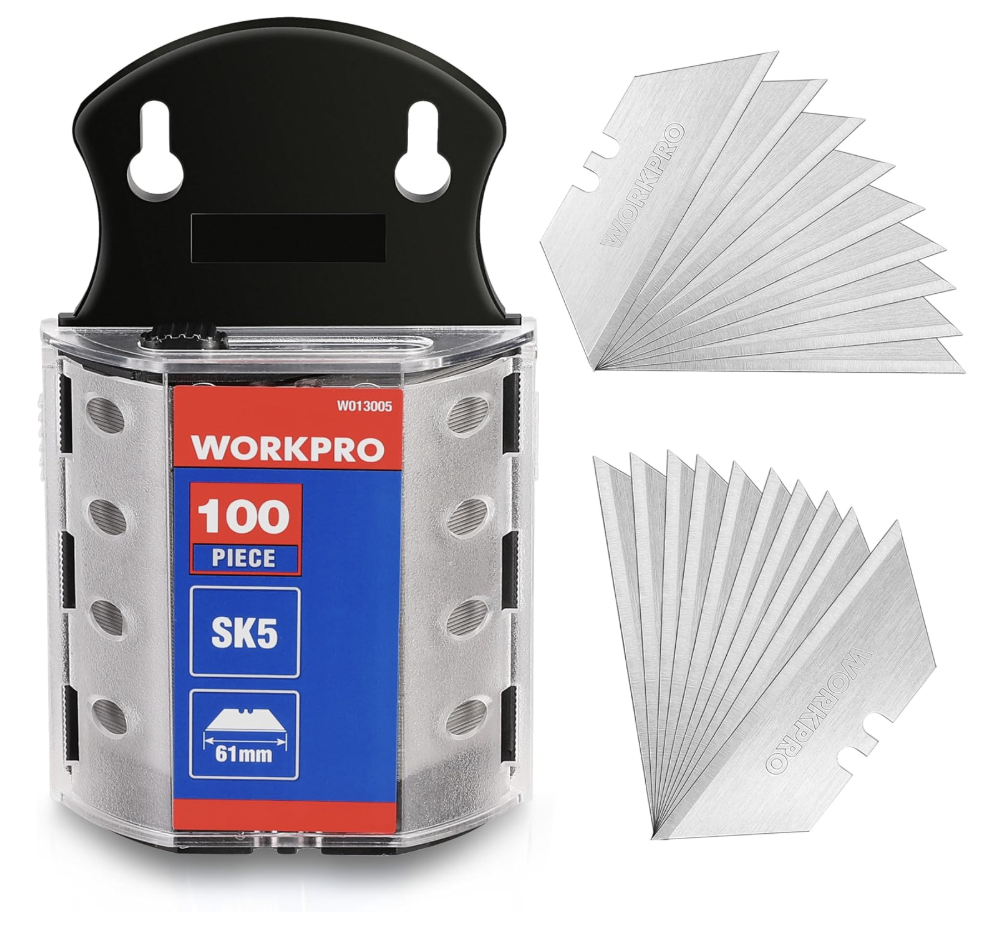
For frequent blade changes, WORKPRO's 100-pack is worth comparing with other bulk dispensers. Divide the current total price by the actual blade count; the label alone does not establish that it is the cheapest option.
In my testing, WORKPRO blades performed adequately for high-volume, low-demand cutting. Opening cardboard boxes, cutting plastic strapping, and similar tasks work fine. I got about 15-20 boxes per blade before noticeable dulling, compared to 40+ with premium blades.
For frequent blade changes, compare this pack with other dispensers using the actual blade count and price. Always use a suitable sharp blade; a large supply is not a reason to accept a dull edge. The dispenser includes a used-blade compartment. In my 100-pack, I found about 5-7 blades that seemed duller from the factory. That sample experience is worth weighing alongside the current offer.
Bi-Metal Option: Irwin 2084400 Bi-Metal Utility Blades
| PROS | CONS |
|
|
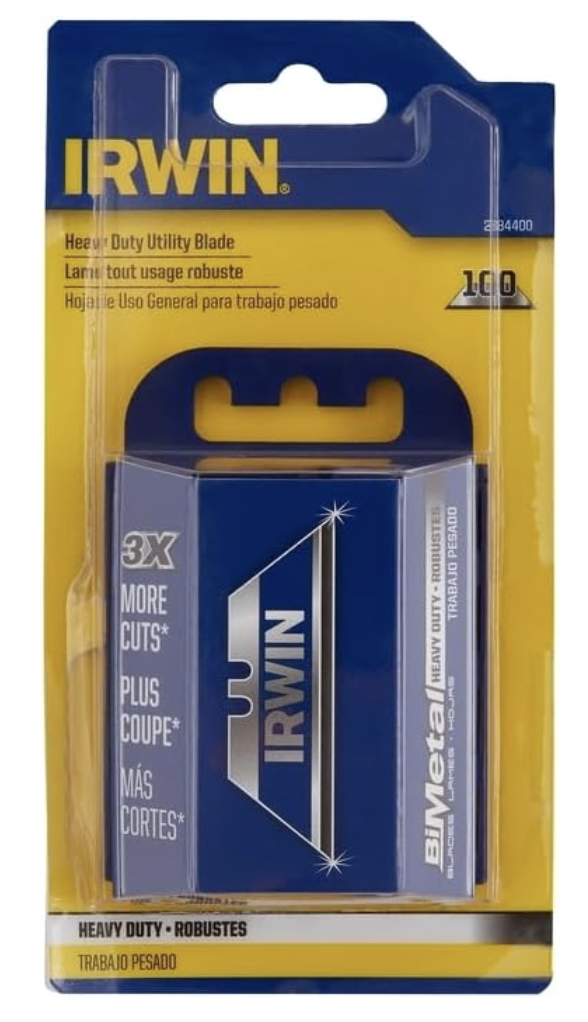
IRWIN 2084400 is a 100-blade bi-metal dispenser option. Bi-metal does not mean stainless: IRWIN describes its bi-metal family as a high-speed-steel edge joined to spring steel. Do not choose it on a promise of rust immunity or suitability for wet, marine or food-service work.
I tested these blades by deliberately storing them in a damp basement for two weeks. The body stayed shiny while the cutting edge developed minimal surface oxidation that wiped away easily. This was my observation, not proof of a stainless body or a corrosion-resistance guarantee. Replace rusty blades rather than treating surface rust as harmless.
I got about 30–35 cardboard boxes per blade before noticeable dulling. The 2084400 manufacturer pack contains 100 blades; use the product details to distinguish it from other IRWIN blade models.
Utility Blade Quick Comparison
Compare the actual pack or seller bundle as well as the blade construction.
| Blade | Pack or bundle | Buying distinction |
|---|---|---|
| Stanley 11-921A | 100-blade dispenser | High-carbon steel; .024-inch thickness |
| Sheffield 12282 | 100-blade dispenser | General-purpose replacement blades |
| LENOX 20350GOLD5C | Linked bundle: 3 × 5 blades | Titanium-nitride-coated cutting edge |
| Milwaukee 48-22-1975 | 75-blade dispenser | General-purpose model, not rounded-tip carton blades |
| DeWalt DWHT11131 | Linked bundle: 2 × 5 blades | Carbide edge on a steel body |
| WORKPRO SK5 | 100-blade dispenser | SK5 steel; separate used-blade compartment |
| IRWIN 2084400 | Manufacturer pack: 100 blades | Bi-metal, not stainless or rust-proof |
How To Choose The Best Utility Knife Blades
Start with the material, the knife's approved blade format and how often you change blades. The best choice for your work is not necessarily the blade with the strongest marketing claim or the largest pack.
Understanding Blade Materials
- Carbon steel: Stanley's 11-921A is one example of a high-carbon-steel utility blade. Keep blades dry and replace rusty or damaged ones.
- Bi-metal: The cutting edge and backing can use different steels. IRWIN describes a high-speed-steel edge with spring-steel backing; that does not make the blade stainless or rust-proof.
- Coated and carbide edges: LENOX GOLD uses a titanium-nitride-coated edge, while DeWalt DWHT11131 has a carbide edge on a steel body. These constructions do not establish a fixed lifespan multiplier across different materials.
Standard vs Heavy Duty Thickness
Read the model specifications rather than treating “heavy duty” as a universal size. Stanley's heavy-duty 11-921A is .024 inch thick. Blade length, thickness, shape and mounting notches must suit the knife; do not force an incompatible blade into its holder.
Types of Blades: Edge Configurations
- Straight utility blades: A general-purpose option for compatible knives. Where the holder and blade instructions permit, reverse a trapezoidal blade end-for-end to expose its unused tip—not a second separate cutting edge.
- Hook blades: Match the exact model to the job. Stanley lists cartons as well as roofing, linoleum and carpet for its regular hook blade. The shape can help protect material beneath the cut; it does not guarantee against damage.
- Other profiles: Serrated, snap-off and scraper blades are not interchangeable merely because they are sold as replacement blades. Follow the handle manufacturer's specified format and intended use.
Utility Knife Blade Sizes and Compatibility
“Fits most standard utility knives” is not the same as universal fit. Check the exact handle's instructions, blade dimensions and mounting arrangement before buying a bulk pack. In particular, do not substitute a snap-off segment or a single-edge scraper blade for a trapezoidal blade unless the tool manufacturer specifies it.
When to Change Blades
Replace a blade when it becomes dull, rusty or damaged. Stop if it catches, tears the material or needs excessive force; check that you have the right blade and cutting technique rather than pushing harder. Retract or guard the blade when it is not in use.
Best Razor Blades for Utility Knife Applications
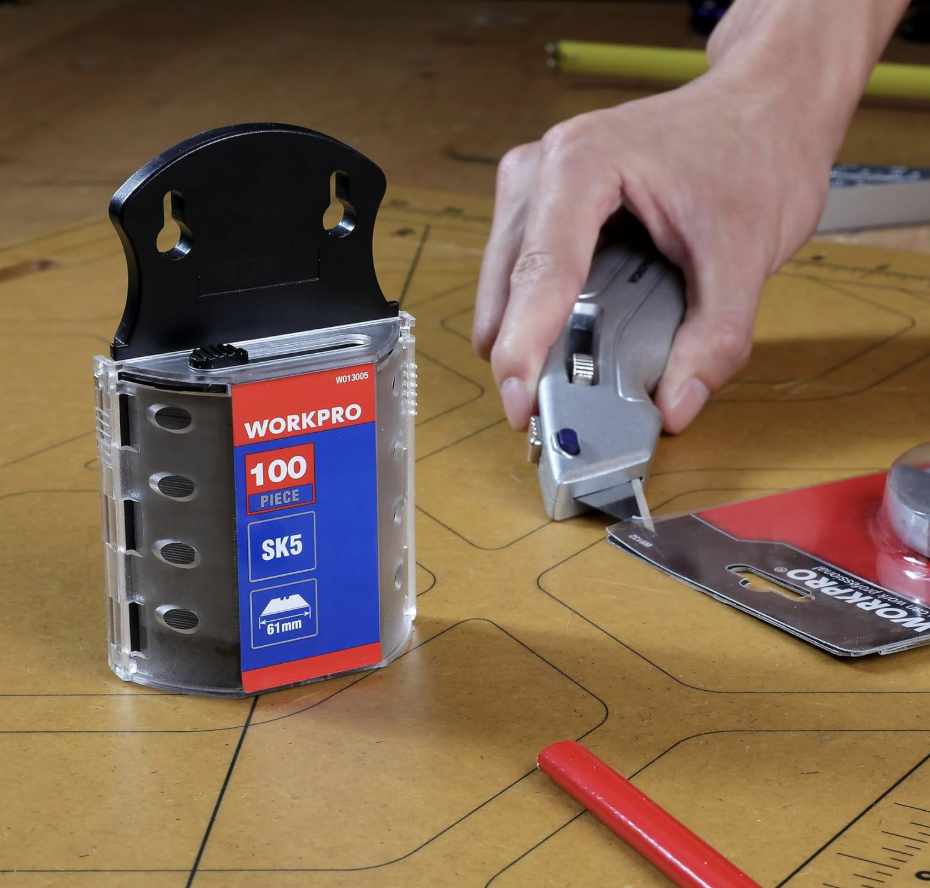
Check the blade format your tool requires. A single-edge razor/scraper blade and a trapezoidal utility blade are different formats; names in a search result are not a compatibility specification. Use the blade type listed for your particular knife or scraper.
Storage and Safety
Keep unused blades in their dispenser or suitable protected storage. Keep your body and free hand out of the cutting and slip path, support the work, and follow the tool's instructions for blade changes and protective equipment. Do not use utility blades for prying or deliberately bend them.
Put discarded blades in a designated puncture-resistant container; do not leave them loose in a toolbox or rubbish bag. Use a dispenser's disposal compartment only if it is designed for used blades, and do not overfill it. Follow local disposal requirements.
No single blade shape is safest for every task. Select an appropriate knife and blade, use its guards or retraction mechanism as instructed, and keep the edge sharp and undamaged.
Final Thoughts
The Stanley 11-921A heavy duty blades remain my overall pick from the experience described here. In testing, a single blade cut through 47 cardboard boxes before requiring replacement.
Sheffield 12282 is another option to compare for a 100-blade supply. In my sample, some blades were less consistent than others; do not treat that observation as a guaranteed defect rate or assume the current pack is cheaper without comparing offers.
Choose the right blade for the material and replace it when needed. Compare the actual pack price, useful features and your own cutting experience rather than assuming the most expensive blade—or the cheapest bulk pack—will always be the best value.
FAQs
How long do utility knife blades last?
It depends on the material and use. The counts in the reviews are the author's observations, not standardized lifespan ratings. Replace blades when dull, rusty or damaged instead of aiming for a fixed number of boxes.
Are expensive utility blades worth it?
Compare the actual price and useful cutting life for your work. A specialty edge may be worth trying for frequent use, but a price premium does not establish a universal two- or three-times lifespan.
Can you sharpen utility knife blades?
For these replaceable utility blades, follow the manufacturer's replacement instructions. Where permitted, expose the unused end of a trapezoidal blade; replace it when no serviceable edge remains.
What's the difference between standard and heavy-duty blades?
The terms are not universal thickness standards. Check the exact model dimensions and your handle's requirements; do not force a thicker or differently shaped blade into a knife.
Are hook blades better than straight blades?
They serve different cutting needs. Some hook blades are specified for cartons as well as carpet and roofing. Match the particular blade to the task and knife; a hook is not a guarantee that the surface underneath will be undamaged.
Do utility knife blades fit all utility knives?
No. Check the blade format, dimensions and mounting requirements in the tool's instructions. “Fits most standard knives” does not include every knife, scraper or snap-off system.
What should I do if a blade rusts?
Replace it and store unused blades dry. Bi-metal is not a synonym for stainless or rust-proof. Dispose of the rusty blade in a puncture-resistant container.
What is the safest type of utility blade?
Use the correct blade in a suitable knife, keep your hands and body clear of the cut and slip path, and retract or guard it after use. Rounded tips do not make a blade universally safest.
