

The Short Version
What I Like
- Excellent chopping on the limbs and brush I tried
- Comfortable wooden handle with a useful rear swell
- Convex blade geometry that suits the work
- Smooth finish and well-fitted handle on my example
What to Consider
- The heavy sheath can swing; a tie-down is untested
- Polished carbon steel picks up marks and needs attention
- An axe remains the better choice for splitting logs
My yard gives me a recurring excuse to use large knives. Trees and woody growth keep coming back, and I have roughly a quarter acre to deal with, including the house. There are more civilized ways of handling it. I happen to enjoy chopping.
Everest Forge sent me this parang after contacting me about trying one of its blades. I already have plenty of kukris, so I asked for something different. This turned into a useful excuse to learn about parangs, try a different blade shape and spend considerably more time hacking at things in the yard.
Full Specs
- Blade steel
- 5160 carbon steel
- Handle material
- Rosewood
- Sheath
- Leather
Specifications: Manufacturer listing
Introducing the Parang
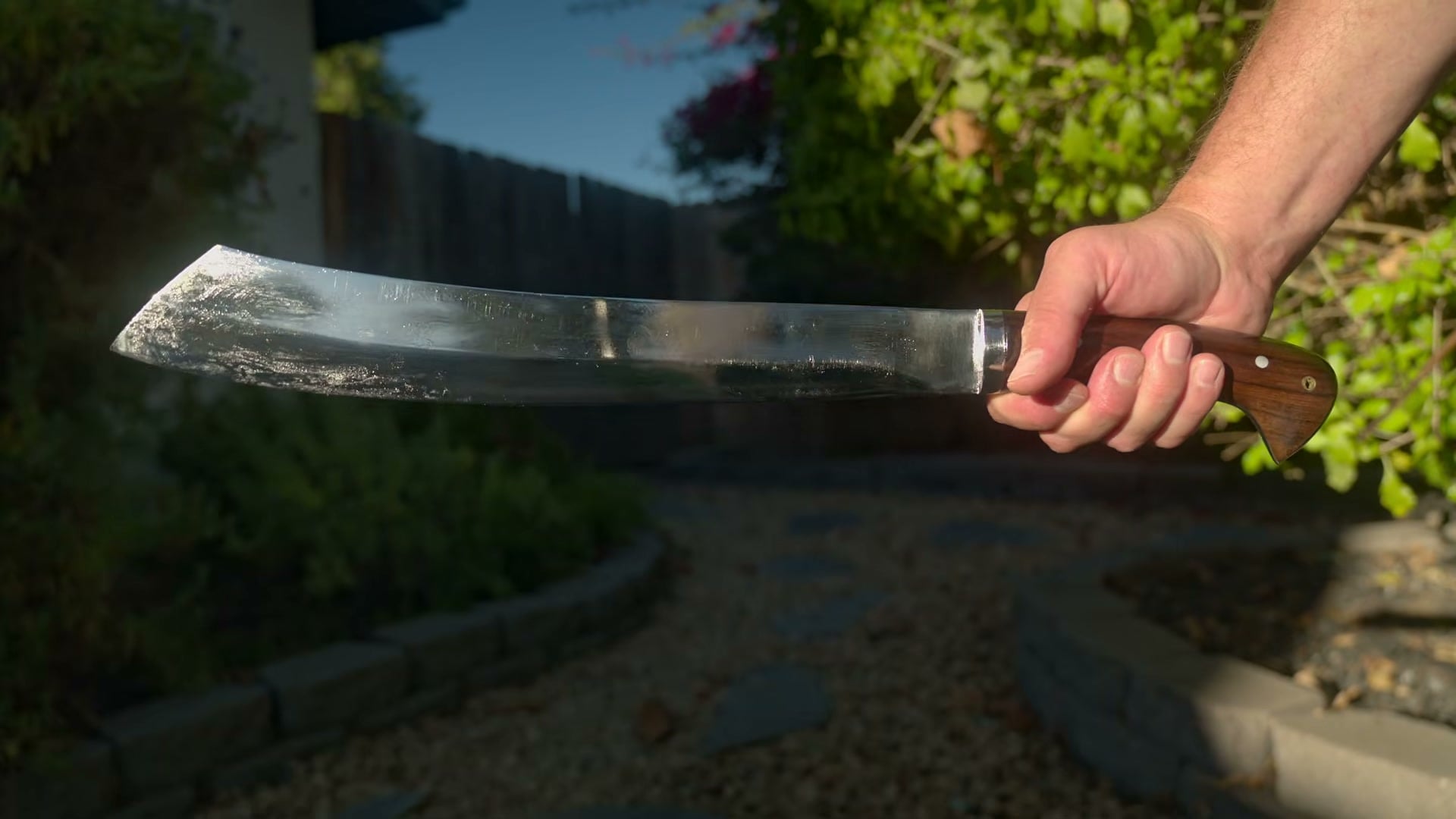
What drew me to the parang was its shape. The blade curves forward, with a broad working end, while the handle feels fairly neutral until the swell and curl at the back. It looks like something that ought to be comfortable to swing for a while, and that is what I wanted to find out.
I associate the traditional parang with Malaysia. Everest Forge’s version comes from Nepal, so I’m treating it as that maker’s interpretation rather than pretending I bought a traditional Malaysian example. Once I started looking into the real thing, finding a straightforward way to get one into the United States became part of the exercise.
Sourcing and Research
My search took me beyond the usual knife retailers. I looked through maker pages, social posts and discussions from people trying to buy parangs while traveling. Getting interested in a regional working knife is easy. Figuring out which maker to buy from, and how to get the knife home, takes more effort.
The Urban Knife Guy article on Malaysian parangs and their makers was particularly useful for getting my bearings. My Parang was another name I came across. I wanted to understand the available shapes and makers before treating one knife as representative of the whole category. That research is part of the appeal for me, even if it does turn a simple purchase into a small project.
Regional Blade Styles
Looking at parangs also led me to related tools such as Indonesian goloks and Philippine bolos. There is plenty of variation in these blades. I don’t find it useful to force everything into one rigid shape or assume that a familiar name tells me exactly how an individual knife will feel.
The attraction here is a large blade that can get through woody growth. I want enough weight and geometry to make a cut count, without turning every job into a chopping-block exercise. That puts this kind of knife in a different role from a small belt knife, and it is why I wanted to try it on the brush and limbs around my yard.
Everest Forge and Materials
Everest Forge is a Nepalese maker, and I came to this parang with an existing interest in the big blades made there. I’ve accumulated a number of kukris, but I didn’t need another version of something I already owned. The different profile was the point of asking for this one.
Forums and social media are a big part of how I’ve found these makers. Nepalese shops known for kukris also make their own versions of other regional blades, and this is one of those interpretations. Mine is a big knife, with a nominal 16-inch blade and the polished finish I asked for. Putting it to work is what tells me whether I actually enjoy using it.
Blade Maintenance
The blade is 5160 carbon steel. Everest Forge suggested a coated finish, but I wanted the polished version. I like being able to see the steel, even though that means accepting scratches, discoloration and the possibility of rust rather than expecting it to stay pristine.
My cleaning routine has included Goo Gone, Brasso and a little 3-in-One oil. That is what I’ve used on my own knife, not a claim that the finish is maintenance-free. Yard work leaves things on the blade, and I clean it up afterward. Some marks are simply part of using a polished carbon-steel chopper. I wanted a working knife, not something I’d be afraid to take outside.
Axes Versus Large Knives
I like large knives, but I’m not going to argue that one replaces an axe for every job. Splitting logs is an obvious example where I would rather have the axe. Different woods also behave differently, so a good result on one piece of wood isn’t proof that every cutting task will feel the same.
For brush, limbs and the smaller trees I’m dealing with, I enjoy the large knife. I can move between the things that need cutting without treating each one like a log on a chopping block. That is the work that makes the parang interesting to me. I tried some splitting, too, but it didn’t change my mind about choosing the right tool for that particular job.
Performance and Design
The convex blade has no distinct secondary bevel, and I like the way it cuts. It wasn’t shaving-sharp out of the box, but that has not stopped it from doing an excellent job on the limbs I’ve been chopping. Most of the wood in my yard is relatively soft, so I’m not presenting this as a test against every kind of hardwood.
The blade is differentially hardened, with a harder edge and softer spine. I did put a small ding near the tip after contacting a rock. That was my mistake, and the damage was minor. Otherwise, the cutting has left me very happy with the way the edge and blade geometry work together.
I also like how rigid this knife feels. The full tang adds to that impression, although I don’t think a traditional hidden-tang parang has to be a bad tool because it is built differently. This particular combination of weight, geometry and handle works well for the chopping I’m actually doing.
Handle and Sheath Details
The wooden handle is smooth and comfortable, with a swell at the rear that helps it stay in my hand. I’ve used it without gloves, including when my hands were sweaty, and I like the grip. There are no obvious gaps or filler around the handle on my example. It feels like someone took care with the fit.
I like the sheath’s low ride: the handle butt sits around belt level rather than sticking up high. It appears to be thin leather over wood, although I can’t be certain about the base material. The drawback is weight. Without securing the bottom, it swings around. There is a bottom ring, and I think anchoring it to my leg could help, but that remains an untested idea here. I liked the secondary leg strap on my Zombie Tools kukri, which is the arrangement I’m thinking of.
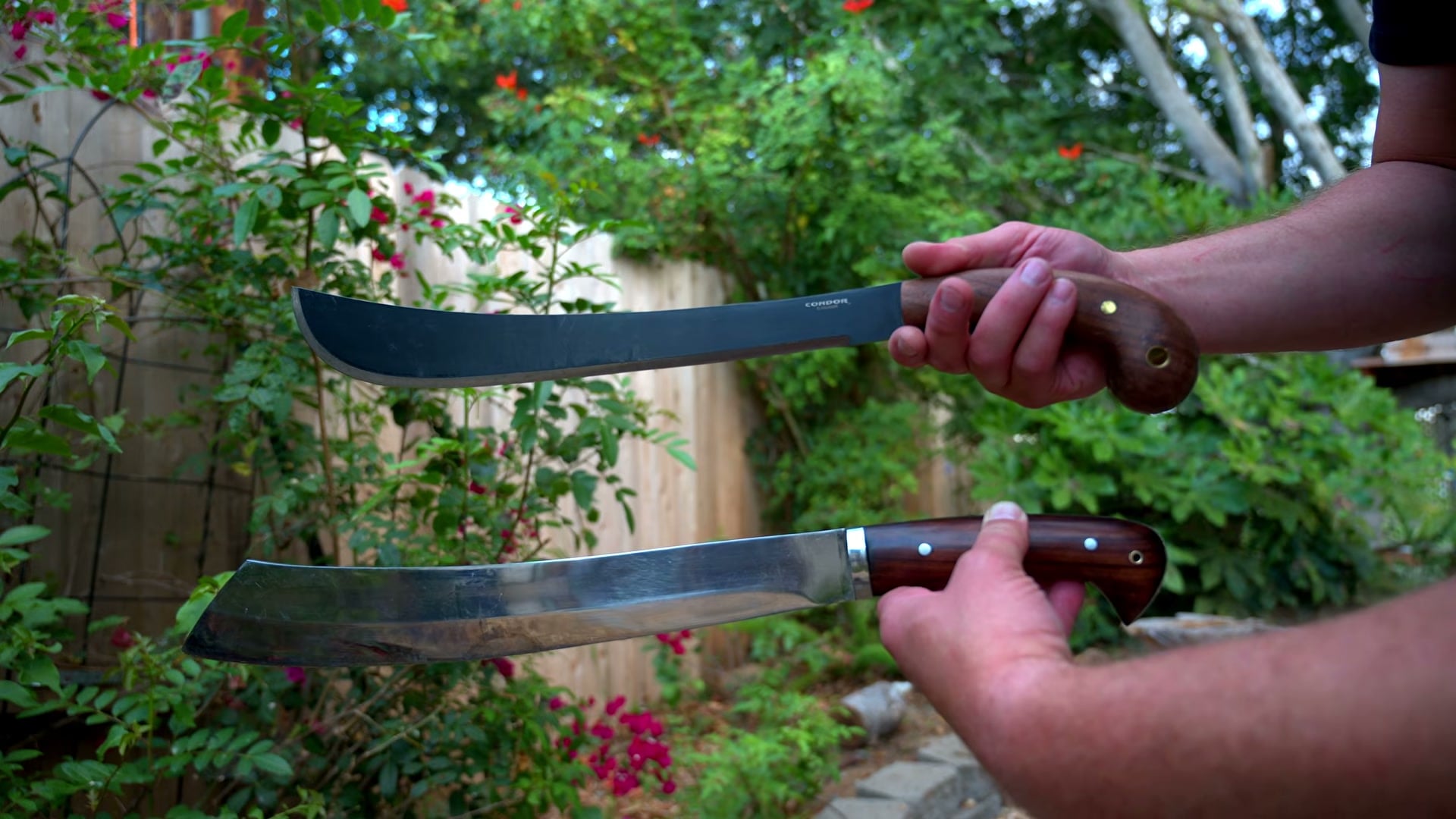
Among my other large blades, the Condor Golok makes an interesting shape comparison. I prefer the Everest Forge’s curved rear swell to the handle of my KA-BAR Parangatang, which makes me think more about where I put my hand. I also brought out my Gerber parang and Kailash Scourge. The Scourge is a favorite of mine: thin and light, with buffalo-horn handles. These give me useful reference points without making every big blade the same tool.
Final Conclusions
I’m very pleased with this parang. The finish is smooth, the handle fit is good, and the little asymmetries I can see are the sort of thing I expect from a hand-forged blade. Nothing about my example makes me wish I had chosen a different knife.
More than anything, I like using it. Chopping with it has been fun, and it has done the yard work I wanted it to do. The heavy sheath can swing around, but the knife itself has won me over. I wouldn’t change anything about the chopper I’m holding.
Where to Buy the Everest Forge Parang Machete
Watch Mark’s Full Review

