

The Short Version
What I Like
- Large, comfortable handle with room for my hand
- Classic wood-and-bolster styling with orange accents
- Smooth thumb-stud action after a small pivot adjustment
- Useful large blade for cardboard cutting
- Reversible tip-up pocket clip
What to Consider
- Slightly uneven factory bevels on my sample
- Occasional sticky lock after forceful opening
- Lock disengaged during my batoning demonstration
- Mild jimping adds little traction
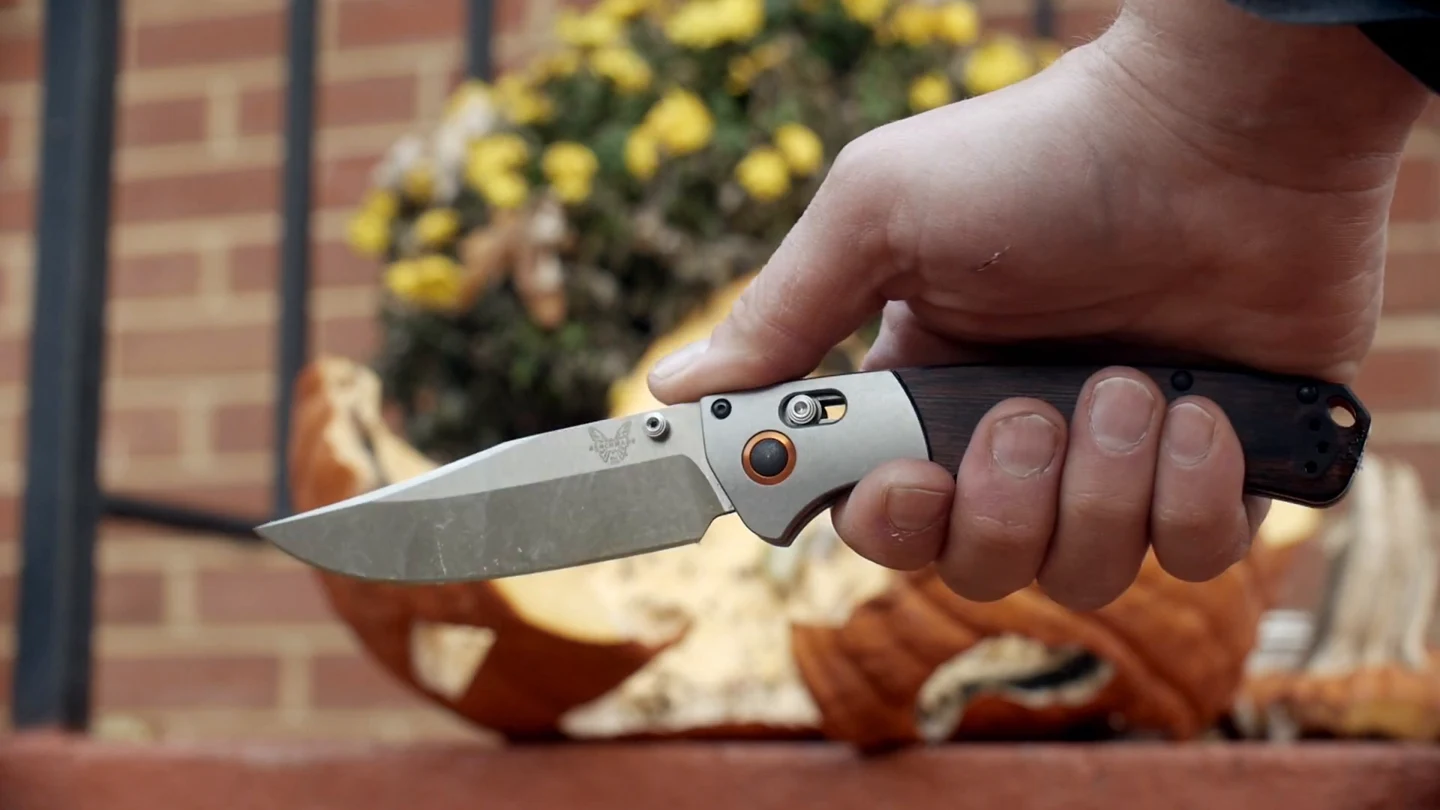
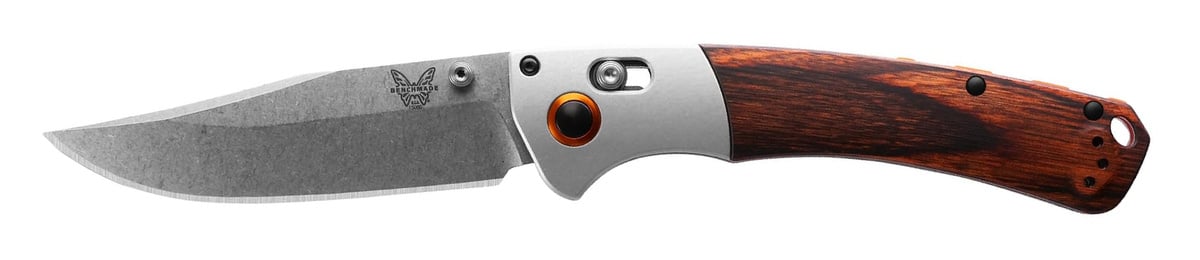
The Benchmade Crooked River is the sort of knife that makes you start rationalizing a purchase. A big blade, wood scales, bolsters and bright orange accents: there is a lot here that I like.
This is the full-size wood-handled version. It has a generous, comfortable grip and smooth action, but my sample also gave me a slightly uneven factory edge and a lock that folded when I tried batoning with it. There is plenty to enjoy here, provided we keep the cutting and the questionable experiments separate.
Introduction and specs
The Crooked River is a substantial folder. The full-size 15080-2 has a four-inch blade and a 9.30-inch overall length. At 5.33 inches closed, it is not pretending to be a tiny pocket knife.
Full Specs
- Reviewed model
- 15080-2, full-size wood version
- Blade steel
- CPM S30V
- Blade length
- 4.00 in
- Overall length
- 9.30 in
- Closed length
- 5.33 in
- Blade thickness
- 0.124 in
- Handle thickness
- 0.60 in
- Weight
- 5.41 oz
- Handle
- Stabilized wood / aluminum bolsters
- Lock
- AXIS
- Clip
- Reversible, tip-up
- Origin
- USA
Specifications: Benchmade catalog specifications for the reviewed 15080-2.
I know: I complain about heavy knives, and here I am with this one. I don’t own a Buck 110, but the specifications I looked up put it roughly two ounces heavier. Heavier folders have their place. I also have to rationalize the price.
Blade and lock mechanism
The big clip-point blade is S30V, with a flat grind and a two-tone satin and stonewashed finish. It was pretty sharp out of the box, although the edge bevels looked slightly different from one side to the other. It was not a major concern for me because I planned to use and sharpen it, but it is worth pointing out.
The lock is Benchmade's familiar AXIS mechanism. I loosened the pivot slightly to let the blade fall more freely and make deployment a little easier. That small adjustment did not appear to change the centering, which was spot-on on my knife. The action is smooth and fluid.
Design and materials
An easy push on the thumb stud opens the big blade. Occasionally, if I open it particularly hard, the lock gets a little sticky. It does not happen every time, and I have noticed similar behavior on my 551. Pulling the AXIS bar back also lets me swing the blade open, though normal thumb-stud opening is straightforward enough.
The construction has a classic look: wood scales, bolsters up front and a bright orange backspacer. It does not look exactly like a Buck 110, or even especially close to one, but it has that traditional character.
The orange accents remind me of hunting safety colors, and they stand out against the wood. The choices when I picked mine were stabilized wood or G10. I like wood, so I got wood.
Ergonomics and carry
The handle and ergonomics are great for me. There is plenty of room, and it feels good in the hand. My hands are not small, but I am not a six-foot-eight giant either. If you want a generous handle, this is one of the Crooked River's obvious attractions.
The light jimping on the blade spine and toward the rear is not very aggressive and does not provide much traction. I cannot tell you how the G10 version feels, but the wood is fairly smooth without feeling slick to me. Inside are skeletonized stainless-steel liners, taking some material out of an already substantial folder.
The clip can move to either side for right- or left-handed carry, but it is tip-up only. It is not a particularly deep-carry clip. Mid-depth is about how I would describe it.
Testing and performance
For a big outdoor hunting knife, you might expect an elk or a moose. You are getting fallen limbs and a cardboard bed-frame box instead.
I really like the knife's styling and the room in the handle. Cutting up the box gave me a useful chance to put that grip and long blade to work. It cut the thick cardboard just fine, although not like butter, particularly across the grain.
Earlier, while attacking a rotting pumpkin, I caught the edge on the concrete porch and dinged a small section. The blade still cut the box.
Stress testing and conclusion
I also did some chopping and managed to cut a stick in two. An awkward job, perhaps, but it was a goal on my list for the day. Some of us have to aim low.
Batoning was a different matter. I expected the AXIS lock to fold under those spine impacts, based on my previous experience, and this one did. It disengaged before I reached the knot farther down the stick. I eventually got through, but it was not an easy or sensible use of a folding hunting knife.
A SOG with an Arc Lock that I had used previously did not fold during my similar antics. Striking the spine with wood caused the lock to disengage. Do not take the chopping footage as a recommendation to baton with it.
At the end, the edge was still working sharp, rather than hair-shaving sharp. Between the concrete ding and the uneven factory bevels, I was going to touch it up anyway. About ten minutes on the Sharpmaker brought it back into shape.
I like the Crooked River's large handle, smooth action and classic styling. The factory edge and occasional sticky opening are sample details I would want to know about, and my batoning result is a reason to keep this folder in a cutting role. For the smaller and lighter alternatives, see our Benchmade knife guide.
Where to Buy the Benchmade Crooked River
Watch Mark’s Full Review

