


A Buck 110 can be a great knife and still be the wrong thing to drop into a light pair of shorts. The brass-and-wood classic, a small three-blade traditional and a clipped aluminum folder solve different carry problems. Buck’s fixed blades are just as varied: a compact hunting knife and a six-inch 119 are very different tools.
I’ve narrowed the choice to five different jobs, from a small budget traditional to a compact hunting fixed blade. Here’s where I’d spend more, where I’d keep it simple, and which compromises matter once the knife is on your belt or in your pocket.
Key Considerations
Start with where the knife will ride and what you actually need to cut.
- Pocket or belt: The 110 weighs 7.20 ounces and has no pocket clip. The 3.20-ounce Spitfire is the more practical clipped option, while the tiny Trio carries loose in a pocket. Fixed blades add a sheath to the package.
- Locking or nonlocking: The 110 and Spitfire use lockbacks. The Trio’s three blades do not lock, so they call for light, controlled cutting and careful finger placement.
- Blade size: The Alpha Scout Pro’s 2.875-inch blade gives a different kind of control from the 119’s six-inch clip point. More blade is not automatically better for detailed game work.
- Steel and maintenance: The selected 110, Spitfire and 119 use 420HC; the Trio uses 420J2, and the Alpha Scout Pro uses S35VN. Consider the extra cost and sharpening demands alongside the knife’s size and grip.
- Exact version: Buck offers variations within familiar model families. The walnut Alpha Scout Pro here is an S35VN knife, not the MagnaCut-and-G10 Elite. These particular models are US-made except for the Chinese-made Trio.
Best Buck Knives: Top Picks
- Best Classic Folding Hunter: Buck 110 Folding Hunter
- Best Budget Traditional: Buck Trio
- Best Compact Hunting Fixed Blade: Buck Alpha Scout Pro
- Best for Everyday Pocket Carry: Buck Spitfire
- Best Larger Outdoor Fixed Blade: Buck 119 Special
Best Classic Folding Hunter: Buck 110 Folding Hunter
| PROS | CONS |
|
|
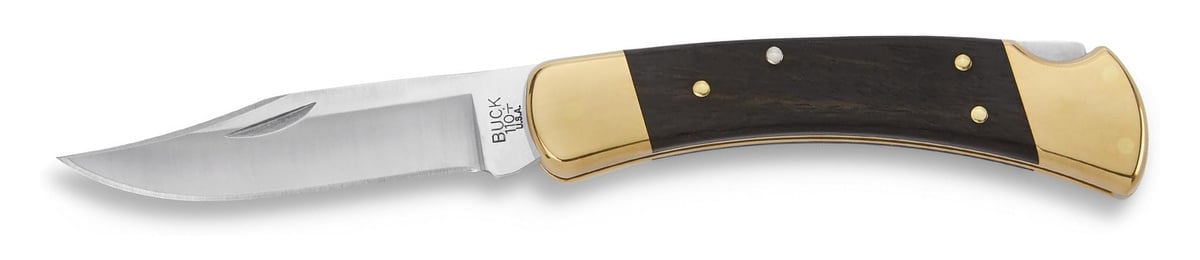
The 110 Folding Hunter is the knife many people picture when Buck comes up. Its ebony handle and brass bolsters give it the old-school appearance many people want from a Buck. I would choose it for that substantial traditional layout and a useful hunting blade, rather than treating it as a lightweight pocket knife.
KnifeInformer’s earlier Buck 110 review highlights the weight tradeoff: this is a knife that makes more sense in its belt sheath than rattling around a pocket. Travis Smola, who wrote our earlier Buck buying guide, also recalled his father using a 110 almost daily while installing commercial doors. That is a good example of why the design appeals beyond hunting, but it does not make the weight disappear.
The standard knife here pairs 420HC with a manual nail-nick opener and rear lockback. Choose it if you want the familiar full-size 110 experience. If your main job is opening packages throughout the day, I would look at the clipped Spitfire first. It gives up the brass-and-wood character for a much lighter carry.
Best Budget Traditional: Buck Trio
| PROS | CONS |
|
|
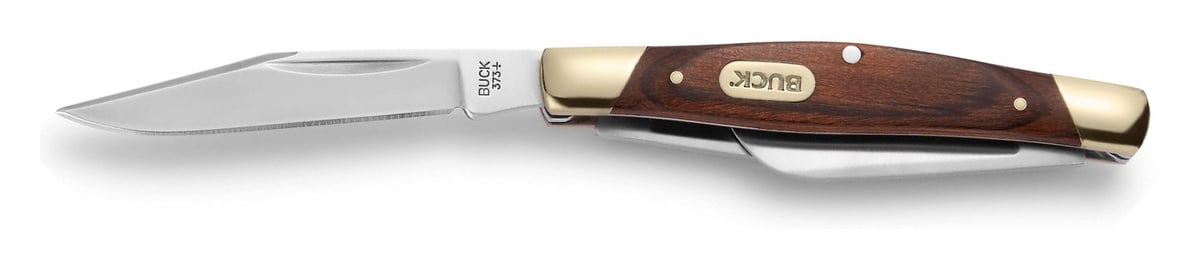
The 373 Trio keeps the useful part of a traditional pocket knife simple: several small cutting shapes without much weight or expense. It combines a clip-point blade with a sheepsfoot and a spey blade, so you can choose the shape that suits a small job. I would use this kind of knife for packages, light cordage and ordinary careful utility cutting.
At 1.90 ounces and 3.25 inches closed, it is an easy alternative to the substantial 110. The woodgrain handle and metal bolsters retain a traditional appearance. The important limitation is the slipjoint construction: none of the three blades locks open. This is not a substitute for a locking folder when the work calls for more force or an awkward cutting angle.
The Trio is made in China, which is worth knowing if US manufacture is part of your buying decision. Its short handle is another reason to consider how you will hold it, especially with larger hands. Choose the Spitfire if you want a longer grip, a locking blade and a pocket clip instead of three small blades.
Best Compact Hunting Fixed Blade: Buck Alpha Scout Pro
| PROS | CONS |
|
|
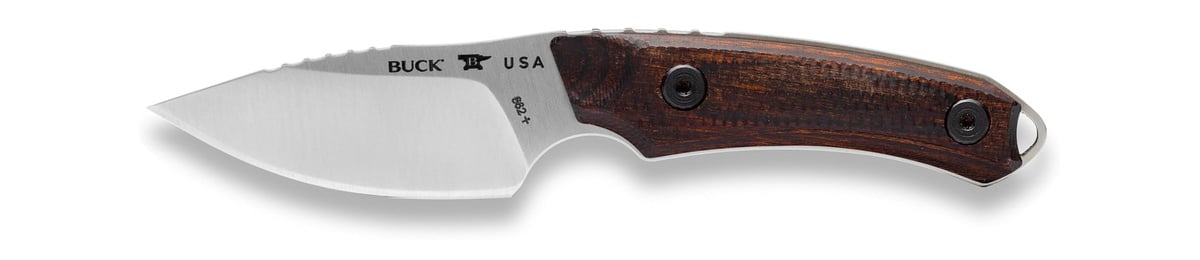
The Alpha Scout Pro is the fixed blade I would look at for someone who values control more than extra blade length. Its 2.875-inch drop point is much smaller than the 119, and the whole knife measures 6.50 inches. That compact layout makes more sense for close, deliberate hunting cuts than choosing a long blade simply because it looks more capable.
This 662 Pro uses S35VN and textured DymaLux walnut laminate scales. It is a different configuration from the black G10, MagnaCut Alpha Scout Elite, so the family name alone is not enough to identify the knife. A leather sheath is included. The exposed lanyard opening and textured scales give it a more modern layout than the 119’s smooth phenolic handle.
I would pay the premium only if the small size and hunting-focused shape suit the work. The compact handle may offer less room than you want with large hands or bulky gloves. For longer general outdoor cuts, compare the 119; for a knife that folds away between jobs, the 110 is a very different alternative. S35VN still needs cleaning and sharpening, regardless of its premium position.
Best for Everyday Pocket Carry: Buck Spitfire
| PROS | CONS |
|
|
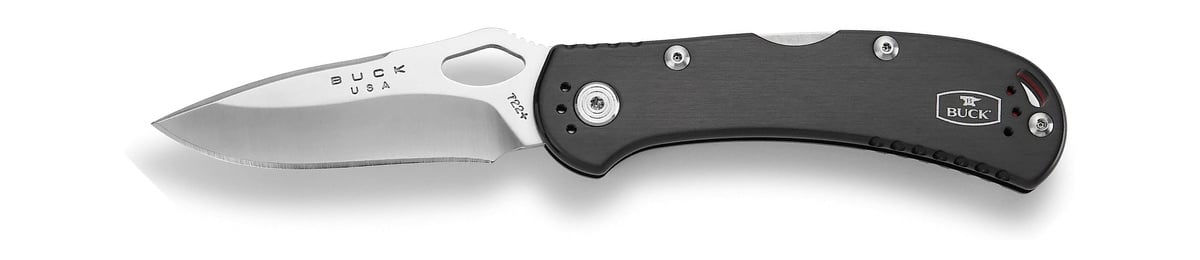
The 722 Spitfire is my practical choice if you want a Buck that rides on a pocket clip throughout the day. It weighs 3.20 ounces, compared with the classic 110’s 7.20, and uses an aluminum handle rather than brass bolsters and thick wood scales. That is a meaningful carry difference before you get into steel preferences.
The black-handled configuration here has a plain 420HC blade, a thumb hole for manual opening and a lockback. Its clip can be set for left- or right-side, tip-up or tip-down carry. Those options are useful if your pocket arrangement matters more than a traditional appearance.
It is a straightforward everyday knife for someone who wants the lighter clipped layout without paying for a premium steel. I would choose it for carry convenience and value, accepting that 420HC will need routine edge maintenance. For a tiny loose-pocket traditional instead, the Trio is the better fit.
Best Larger Outdoor Fixed Blade: Buck 119 Special
| PROS | CONS |
|
|
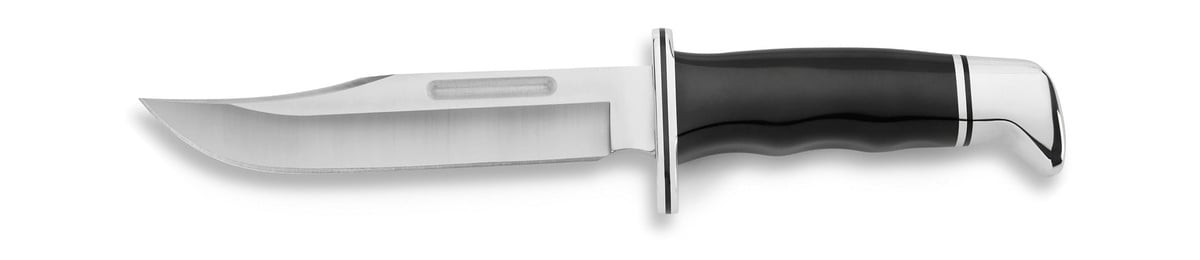
The 119 Special is the larger, traditional fixed blade in this group. Its six-inch clip point and 10.50-inch overall length give you much more blade than the Alpha Scout Pro. I would choose it when that extra length has a purpose, rather than assuming a bigger hunting knife is always more useful.
The standard black-handled 119 uses 420HC, phenolic and an aluminum guard and pommel. In Advanced Knife Bro’s Buck 119 review, he found the handle smoothly finished but short on traction, and the leather sheath secure but higher-riding than he preferred. Those are more useful considerations than a vague promise that any classic design will suit every hand.
The long blade is capable of ordinary outdoor slicing and hunting work, but it is less convenient for small, precise cuts close to your fingers. I would not make its fine clip point a reason to choose it for heavy batoning or prying. Take the compact Alpha Scout Pro if control and a smaller belt package matter more; take the 119 when you actually want the extra blade.
Compare Our Picks
Scroll sideways on smaller screens to compare all the details.
| Knife | Best for | Blade / steel | Carry |
|---|---|---|---|
| Buck 110 Folding Hunter | Classic Folding Hunter | 3.75 in / 420HC | Belt sheath / no clip |
| Buck Trio | Budget Traditional | Clip 2.50 in / 420J2 | Loose-pocket carry |
| Buck Alpha Scout Pro | Compact Hunting Fixed Blade | 2.875 in / CPM S35VN | Leather sheath |
| Buck Spitfire | for Everyday Pocket Carry | 3.25 in / 420HC | Four-position clip |
| Buck 119 Special | Larger Outdoor Fixed Blade | 6.00 in / 420HC | Leather belt sheath |
How to Choose a Buck Knife
Choose the carry method first
A knife you like on a belt may be frustrating in a pocket. The classic 110 has no clip and carries considerable weight. The Spitfire solves a different problem with its lighter aluminum handle and adjustable clip. The Trio is smaller again, but gives up a locking blade. For the fixed blades, allow for the sheath as well: Buck doesn’t say whether it’s included in those weight figures.
Match blade length to the cutting
The Alpha Scout Pro is the compact fixed blade for deliberate work. The 119 gives more reach and cutting length, with more bulk to manage. A long blade can make detailed game work harder, so buy the size you can control rather than the largest knife in the range.
Understand the blade and lock
The Trio’s blades do not lock. The 110 and Spitfire use lockbacks, while the two fixed blades stay open and need secure sheath carry. Our pocket knife lock guide explains folding mechanisms in more detail. No lock removes the need to keep fingers clear while closing.
Pay for something you will use
The Alpha Scout Pro’s S35VN and compact construction come at a premium. The 420HC choices keep the cost lower and are sensible if routine sharpening is part of your knife care. Neither steel choice compensates for a grip or blade size that does not suit your work.
Why Trust Us
KnifeInformer’s earlier Buck 110 review supplies the classic knife’s carry tradeoff. Travis Smola’s original buying guide contributes his family’s working-use perspective, and Advanced Knife Bro’s 119 review adds his handle and sheath observations. Their different carry, grip and cutting priorities help explain why there is no single Buck for every job.
Final Thoughts
I would choose the 110 for a traditional folding hunter and the Spitfire for lighter clipped pocket carry. The Trio makes sense for small utility jobs on a budget. For a fixed blade, start with the Alpha Scout Pro if compact control matters, and choose the 119 only when you have a use for its longer blade. Decide how you will carry and use the knife before paying for a particular steel or finish. For other makers worth comparing, see my guide to the best knife brands.
Frequently Asked Questions
Which Buck knife is best for everyday carry?
I would start with the Spitfire for a lighter locking knife with a pocket clip. The Trio suits small, careful tasks and loose-pocket carry, while the classic 110 is a heavier traditional choice that makes more sense in its sheath.
Are all Buck knives made in the USA?
No. The particular 110, Alpha Scout Pro, Spitfire and 119 here are US-made, while the Trio is made in China. Check the exact model rather than applying one country claim to the whole brand.
Does the Buck Trio lock open?
No. It is a slipjoint with three nonlocking blades. Keep the work light and controlled, and do not treat spring resistance as a locking mechanism.
Does the Alpha Scout Pro use MagnaCut?
The walnut 662 Alpha Scout Pro selected here uses S35VN. The MagnaCut-and-G10 Alpha Scout Elite is a different configuration. Confirm the exact model and steel rather than relying on the Alpha name alone.
Is the Buck 119 too big for hunting?
That depends on the job and your preferences. Its six-inch blade offers length for longer cuts, but a compact blade such as the Alpha Scout Pro is easier to manage for close detail work. Bigger is not automatically better.
