


A Buck 110 can be a great knife and still be the wrong thing to drop into a light pair of shorts. The brass-and-wood classic, a small three-blade traditional and a clipped aluminum folder solve different carry problems. Buck’s fixed blades are just as varied: a compact hunting knife and a six-inch 119 are very different tools.
I’ve narrowed the best Buck knives down to five different jobs, from a small budget traditional to a compact hunting fixed blade. Here’s where I’d spend more, where I’d keep it simple, and which compromises matter once the knife is on your belt or in your pocket.
How We Earn Your Trust
Hands-On Testing
Where a knife was tested, we say who tested it, and partner footage is labelled. How We Test →
Specs You Can Check
Figures come from the manufacturer’s product page or catalog. Where a figure comes from a retailer or differs from the knife we tested, we say so.
How We Make Money
We earn a commission when you buy through our links. Commissions do not decide which knives we pick. How We Make Money →
Top Picks
The best Buck knife for most people is the 110 Folding Hunter, the ebony and brass lockback that has been Buck’s signature knife since 1964, with a leather belt sheath in the box. If you want a Buck you clip in a pocket every day, get the 722 Spitfire, which weighs less than half as much and has a four-position clip.
Buck Knife Comparison
Figures come from Buck for the exact version recommended, with overall length and thickness from Blade HQ where Buck doesn’t list them. Buck doesn’t say whether fixed blade weights include the sheath.
| Knife | Best For | Blade | Overall | Thickness | Weight | Steel | Sheath and Carry | Main Trade-off |
|---|---|---|---|---|---|---|---|---|
| Buck 110 | Traditional folding hunter | 3.75 in95 mm | 8.5 in216 mm | 0.12 in3.0 mm | 7.2 oz204 g | 420HC → | Leather belt sheath, no clip | Heavy, no clip |
| Trio | Small utility jobs | 2.5 in64 mm | 5.88 in149 mm | 0.07 in1.8 mm | 1.9 oz54 g | 420J2 → | Loose in a pocket | Blades don’t lock |
| Alpha Scout Pro | Field dressing and close cuts | 2.88 in73 mm | 6.5 in165 mm | 0.14 in3.6 mm | 2.79 oz79 g | CPM S35VN → | Leather belt sheath | Short handle |
| Spitfire | Everyday pocket carry | 3.25 in83 mm | 7.5 in190 mm | 0.12 in3.0 mm | 3.2 oz91 g | 420HC → | Four-position pocket clip | 420HC needs touch-ups |
| Buck 119 | Camp and big-game work | 6 in152 mm | 10.5 in267 mm | 0.18 in4.4 mm | 7.5 oz213 g | 420HC → | Leather belt sheath, rides high | Bulky for fine work |
Best Classic Folding Hunter: Buck 110 Folding Hunter
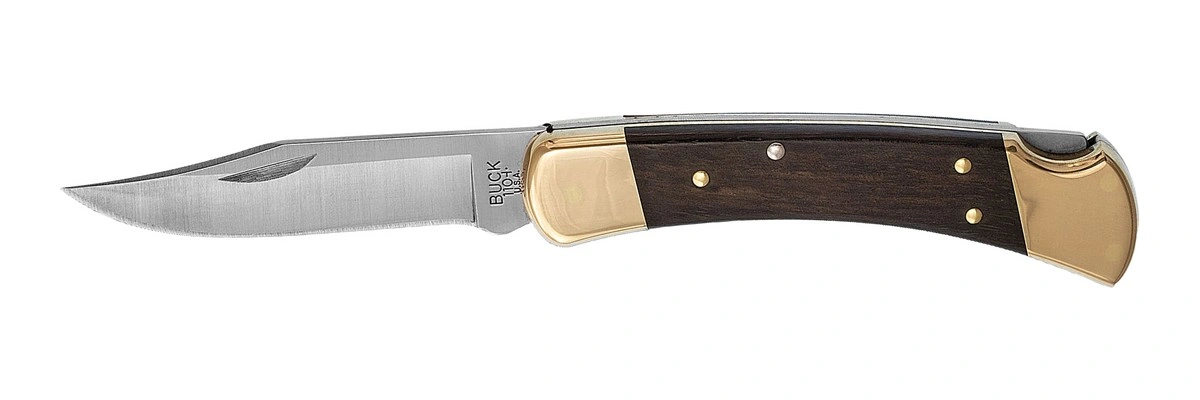
The knife most people picture when they hear Buck: ebony, brass and a lockback with no blade play, made to ride in its leather belt sheath.
What We Like about Buck 110
- +Ebony handle and brass bolsters with the classic Buck look
- +Lockback holds the blade with no play
- +Clip point handles game and camp chores
- +Made in the USA, with a leather belt sheath
Good to Know about Buck 110
- Heavy at 7.2 ounces, with no pocket clip
- Nail nick opening takes two hands
Full Specs
- Model
- 0110BRS-B, ebony and brass
- Blade Length
- 3.75 in95 mm
- Overall Length
- 8.5 in216 mm
- Blade Thickness
- 0.12 in3.0 mm
- Blade Shape
- Clip point
- Grind
- Hollow
- Steel
- 420HC →
- Handle
- Ebony wood, brass bolsters
- Lock
- Lockback
- Weight (Listed)
- 7.2 oz204 g
- Origin
- USA
Specs source: buckknives.com · Overall length and blade thickness from Blade HQ.
The 110 Folding Hunter is the knife many people picture when Buck comes up. Its ebony handle and brass bolsters give it the old-school appearance many people want from a Buck. I’d choose it for that traditional layout and a useful hunting blade, not as a lightweight pocket knife.
My Buck 110 review came down to the weight: at 7.2 ounces, this is a knife that makes more sense in its belt sheath than rattling around a pocket. Travis Smola, who wrote an earlier version of this guide, remembers his dad using a 110 almost daily while installing commercial doors, and he liked how crisply the lock works, with no play in the blade once it’s open. That’s why the design appeals beyond hunting, but it doesn’t make the weight disappear.
The standard knife here pairs 420HC with a nail-nick opener and a rear lockback. Mine came sharp out of the box, but 420HC needs touching up more often than premium steels like S30V, so plan on a few minutes with a stone after heavy use. Choose it if you want the familiar full-size 110 experience. If your main job is opening packages throughout the day, look at the clipped Spitfire first. It gives up the brass-and-wood character for a much lighter carry. Read the full Buck 110 review →
Best Budget Traditional: Buck 373 Trio
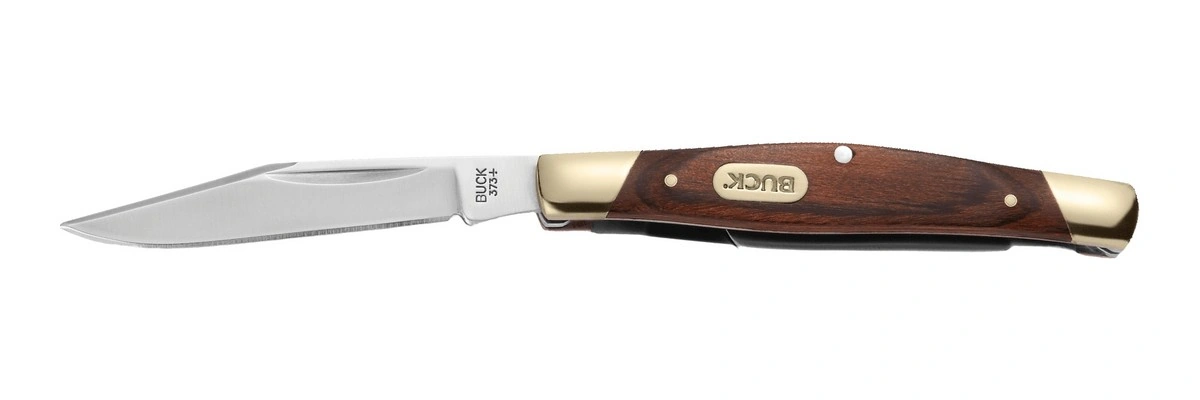
The cheapest way into a Buck: three small blades in a 1.9-ounce traditional pocket knife for packages, cord and light utility work.
What We Like about Trio
- +Costs the least of any knife here
- +Clip, sheepsfoot and spey blades for different small jobs
- +Just 1.9 ounces and 3.25 inches closed
- +Woodgrain handle with nickel silver bolsters
Good to Know about Trio
- None of the three blades locks open
- Made in China, unlike the other four picks
Full Specs
- Model
- 0373BRS-B, woodgrain
- Blade Length
- 2.5 in64 mm
- Overall Length
- 5.875 in149 mm
- Blade Thickness
- 0.07 in1.8 mm
- Blade Shape
- Clip, sheepsfoot and spey
- Steel
- 420J2 →
- Handle
- Woodgrain, nickel silver bolsters
- Lock
- Slip joint (no lock)
- Weight (Listed)
- 1.9 oz54 g
- Origin
- China
Specs source: Buck 2026 catalog · Overall length and blade thickness from Blade HQ.
The 373 Trio keeps the useful part of a traditional pocket knife simple: several small cutting shapes without much weight or expense. It combines a clip-point blade with a sheepsfoot and a spey blade, so you can choose the shape that suits a small job. Travis Smola picked it for an earlier version of this guide and found it ideal for opening packages and slicing light cordage, and that’s the work it suits.
At 1.90 ounces and 3.25 inches closed, it is an easy alternative to the substantial 110. The woodgrain handle and metal bolsters retain a traditional appearance. The important limitation is the slipjoint construction: none of the three blades locks open. This is not a substitute for a locking folder when the work calls for more force or an awkward cutting angle. If the traditional style is what you want, I compare more options in the best slip joint knives guide.
The Trio is made in China, which is worth knowing if US manufacture is part of your buying decision. Its short handle is another reason to consider how you will hold it, especially with larger hands. Choose the Spitfire if you want a longer grip, a locking blade and a pocket clip instead of three small blades.
Best Compact Hunting Fixed Blade: Buck 662 Alpha Scout Pro
A small S35VN drop point with walnut scales and a leather sheath, sized for field dressing and close, controlled cuts.
What We Like about Alpha Scout Pro
- +S35VN holds an edge longer than the 420HC picks
- +Short drop point is easy to control for field dressing
- +Textured walnut DymaLux scales on a full tang
- +Leather sheath, made in the USA
Good to Know about Alpha Scout Pro
- Short handle leaves little room for big hands or gloves
- Costs the most of any knife here
Full Specs
- Model
- 0662WAS-B, walnut DymaLux
- Blade Length
- 2.875 in73 mm
- Overall Length
- 6.5 in165 mm
- Blade Thickness
- 0.14 in3.6 mm
- Blade Shape
- Drop point
- Grind
- Flat
- Steel
- CPM S35VN →
- Handle
- Walnut DymaLux
- Tang
- Full
- Weight (Listed)
- 2.79 oz79 g
- Sheath
- Leather
- Origin
- USA
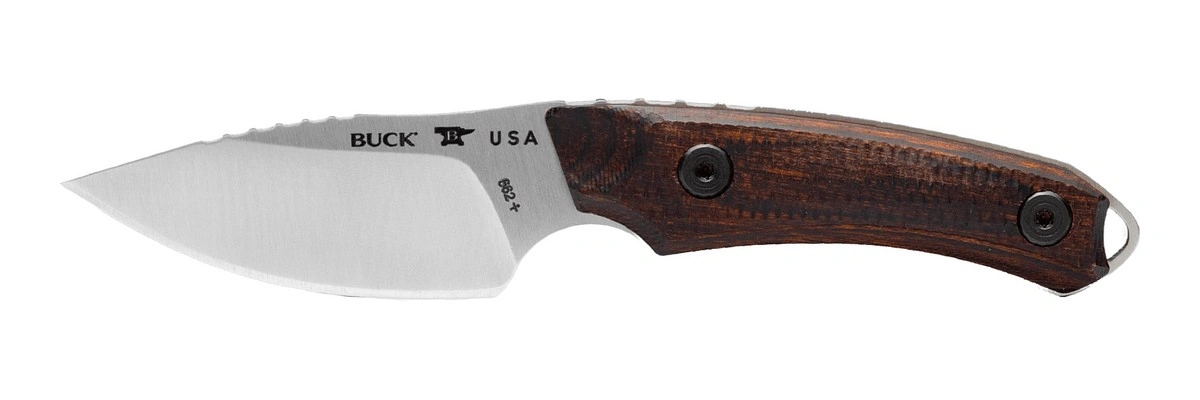
The Alpha Scout Pro is the fixed blade I’d hand someone who values control more than extra blade length. Its 2.875-inch drop point is much smaller than the 119’s, and the whole knife measures 6.50 inches. That compact layout makes more sense for field dressing and close, deliberate cuts than a long blade chosen simply because it looks more capable.
In my hand the handle takes three fingers, and my little finger ends up off the end. That pushes my grip forward, so my index finger sits right behind the edge, which is exactly where I want it for slow, careful cuts. With gloves on, the handle gets crowded fast.
This 662 Pro uses S35VN and textured DymaLux walnut laminate scales. It is a different configuration from the black G10, MagnaCut Alpha Scout Elite, so the family name alone is not enough to identify the knife. A leather sheath is included. The knife weighs under 3 ounces, and in its leather sheath I forget it’s on my belt until I reach for it. The exposed lanyard opening and textured scales give it a more modern layout than the 119’s smooth phenolic handle.
Pay the premium only if the small size and hunting-focused shape suit the work. The compact handle may offer less room than you want with large hands or bulky gloves. For longer general outdoor cuts, compare the 119. For a knife that folds away between jobs, the 110 is a very different alternative. S35VN holds an edge longer than 420HC, but it takes more work to bring back once it does go dull, and it still needs cleaning after game work.
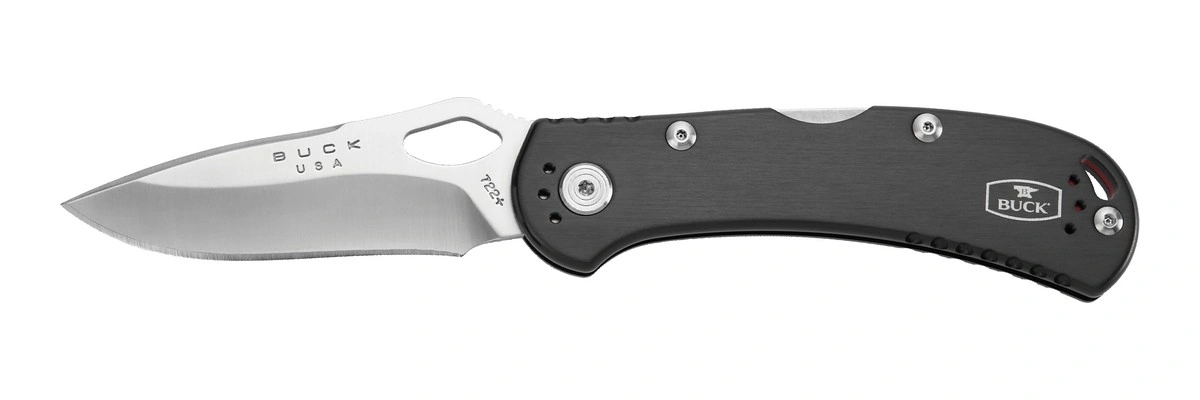
Best for Everyday Pocket Carry: Buck 722 Spitfire
A light aluminum lockback with a thumb hole and a four-position clip: the Buck to carry in a pocket every day.
What We Like about Spitfire
- +3.2 ounces with an aluminum handle
- +Thumb hole opens it with one hand
- +Clip sets up tip-up or tip-down, left or right
- +Made in the USA
Good to Know about Spitfire
- 420HC needs regular edge touch-ups
- Longer in the pocket than the Trio
Full Specs
- Model
- 0722BKS1-B, black
- Blade Length
- 3.25 in83 mm
- Overall Length
- 7.5 in190 mm
- Blade Thickness
- 0.12 in3.0 mm
- Blade Shape
- Drop point
- Steel
- 420HC →
- Handle
- Anodized aluminum
- Lock
- Lockback
- Weight (Listed)
- 3.2 oz91 g
- Origin
- USA
Specs source: Buck 2026 catalog · Overall length from Blade HQ.
The 722 Spitfire is my practical choice if you want a Buck that rides on a pocket clip throughout the day. It weighs 3.20 ounces, compared with the classic 110’s 7.20, and uses an aluminum handle rather than brass bolsters and thick wood scales. That is a meaningful carry difference before you get into steel preferences.
The black-handled configuration here has a plain 420HC blade, a thumb hole for manual opening and a lockback. Its clip can be set for left- or right-side, tip-up or tip-down carry. Clipped tip-up in a jeans pocket, it doesn’t drag the pocket down the way the 110 does in its belt pouch. The thumb hole is easy to find without looking, and I can roll the blade open with one thumb while the other hand holds the box or the rope. The 110 and the Trio can’t do that. The clip options are useful if your pocket arrangement matters more than a traditional appearance.
It is a straightforward everyday knife for someone who wants the lighter clipped layout without paying for a premium steel. I’d choose it for carry convenience and value, accepting that 420HC will need routine edge maintenance. For a tiny loose-pocket traditional instead, the Trio is the better fit.
Best Larger Outdoor Fixed Blade: Buck 119 Special
Buck’s classic six-inch clip point for camp and big-game work, with a sturdy leather sheath and a design that has barely changed since the 1940s.
What We Like about Buck 119
- +Six-inch hollow-ground clip point for long cuts
- +Smooth phenolic handle with no hot spots
- +Thick leather sheath with a liner and drain hole
- +Made in the USA
Good to Know about Buck 119
- Slick handle offers little traction when wet
- Sheath rides high on the belt
Full Specs
- Model
- 0119BKS-B, black phenolic
- Blade Length
- 6 in152 mm
- Overall Length
- 10.5 in267 mm
- Blade Thickness
- 0.175 in4.4 mm
- Blade Shape
- Clip point
- Grind
- Hollow
- Steel
- 420HC →
- Handle
- Black phenolic, aluminum guard and pommel
- Weight (Listed)
- 7.5 oz213 g
- Sheath
- Black leather
- Origin
- USA
Specs source: buckknives.com · Overall length from Blade HQ.
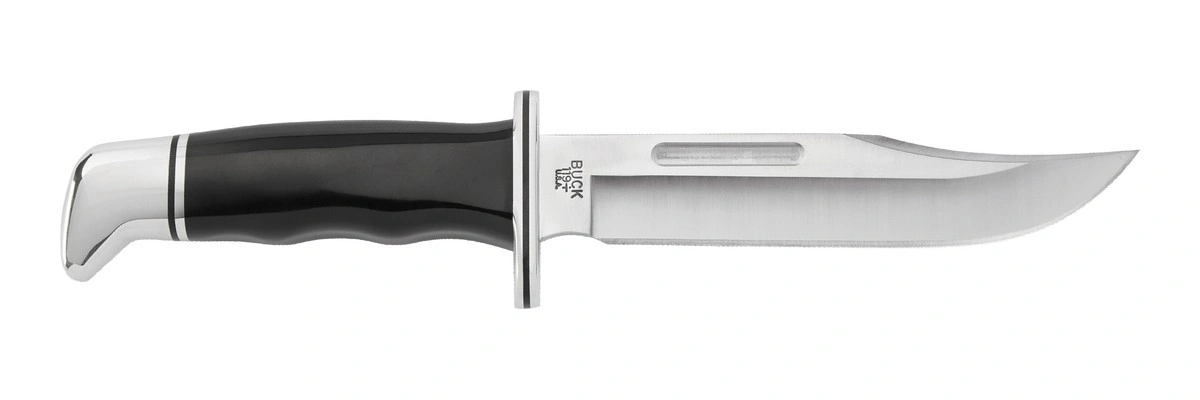
The 119 Special is the larger, traditional fixed blade in this group. Its six-inch clip point and 10.50-inch overall length give you much more blade than the Alpha Scout Pro. I’d choose it when that extra length has a purpose, rather than assuming a bigger hunting knife is always more useful.
The standard black-handled 119 uses 420HC, phenolic and an aluminum guard and pommel. In Mark Hanlen’s Buck 119 review for Advanced Knife Bro, he found the handle smoothly finished but short on traction, and the leather sheath secure but higher-riding than he preferred. Those are more useful considerations than a vague promise that any classic design will suit every hand.
Mark also split firewood with his on purpose, and came away saying a clip point is the wrong shape for batoning on a fixed blade, because it chews up the edge. He also found the wrap-around snap makes the knife slightly harder to draw, which he says might be a feature, since it could keep the knife in the sheath if you forget to snap it.
The long blade is capable of ordinary outdoor slicing and hunting work, but it is less convenient for small, precise cuts close to your fingers. I wouldn’t buy this fixed blade for heavy batoning or prying either. Take the compact Alpha Scout Pro if control and a smaller belt package matter more. Take the 119 when you actually want the extra blade. Read Mark’s full Buck 119 review →
How to Choose a Buck Knife
Quick Checklist
- Carry: Belt sheath, pocket clip or loose in a pocket
- Lock: Lockback for force, slip joint only for light work
- Blade size: Short for control, long only when the job needs reach
- Version: Check the full model number for the steel and handle you want
Choose the carry method first
A knife you like on a belt may be frustrating in a pocket. The classic 110 has no clip and carries considerable weight. The Spitfire solves a different problem with its lighter aluminum handle and adjustable clip. The Trio is smaller again, but gives up a locking blade. For the fixed blades, allow for the sheath as well: Buck doesn’t say whether it’s included in those weight figures.
Match blade length to the cutting
If you want a Buck hunting knife for deer, the compact Alpha Scout Pro is the fixed blade for deliberate work. The 119 gives more reach and cutting length, with more bulk to manage. A long blade can make detailed game work harder, so buy the size you can control rather than the largest knife in the range.
Understand the blade and lock
The Trio’s blades do not lock. The 110 and Spitfire use lockbacks, while the two fixed blades stay open and need secure sheath carry. The pocket knife lock guide explains folding mechanisms in more detail. A blade that doesn’t lock can fold onto your fingers under pressure, so keep the Trio to light, controlled cuts.
Pay for something you will use
The Alpha Scout Pro’s S35VN and compact construction come at a premium. The 420HC choices keep the cost lower and are sensible if routine sharpening is part of your knife care. Neither steel choice compensates for a grip or blade size that does not suit your work.
Check the exact version
Buck sells the same model number in several steels, handles and sizes, so read the full model before you buy. The walnut Alpha Scout Pro here uses S35VN, while the black Alpha Scout Elite uses MagnaCut. Most Buck knives are made in the USA, but not all of them: the Trio here is made in China.
How I Picked These Knives
I picked one knife per job: a traditional folding hunter, a budget pocket knife, a compact hunting fixed blade, a clipped everyday folder and a large fixed blade. Each had to be in Buck’s current lineup, and I named the exact version, because Buck sells the same model number in several steels and handles.
I reviewed the Buck 110 for Knife Informer, Travis Smola wrote an earlier version of this guide from his own experience with Buck knives, and Mark Hanlen (Advanced Knife Bro) put the 119 through his own review, including some deliberate misuse. Their different carry, grip and cutting priorities help explain why there is no single Buck for every job. How Knife Informer Tests →
You might expect the 112 Ranger or the 110 Slim here. The 112 is a smaller 110 with the same brass-and-wood build, so the 110 covers that role, and the Spitfire is the lighter clipped option. An earlier version of this guide picked the 664 Alpha Hunter Elite in MagnaCut. I picked the smaller Alpha Scout Pro instead, because it’s easier to control for field dressing and costs less.
Final Thoughts
I’d choose the 110 for a traditional folding hunter and the Spitfire for lighter clipped pocket carry. The Trio makes sense for small utility jobs on a budget. For a fixed blade, start with the Alpha Scout Pro if compact control matters, and choose the 119 only when you have a use for its longer blade. Decide how you will carry and use the knife before paying for a particular steel or finish. For other makers worth comparing, see my guide to the best knife brands.
Buck Knife FAQs
Which Buck knife is best for everyday carry?
I’d start with the Spitfire for a lighter locking knife with a pocket clip. The Trio suits small, careful tasks and loose-pocket carry, while the classic 110 is a heavier traditional choice that makes more sense in its sheath.
Are Buck knives good?
Yes, for what they are. Most Buck knives are made in the USA, Buck’s heat treatment gets a lot out of 420HC, and the company backs its knives with its Forever Warranty. What you don’t get at these prices is premium steel. 420HC is easy to sharpen and resists rust, but it needs touching up more often than S35VN or MagnaCut. The 110 has stayed in the lineup since 1964 for a reason.
Are all Buck knives made in the USA?
No. The particular 110, Alpha Scout Pro, Spitfire and 119 here are US-made, while the Trio is made in China. Check the exact model rather than applying one country claim to the whole brand.
Why are Buck knives so expensive?
Most of them aren’t, by knife enthusiast standards. The 110, Spitfire and 119 cost less than many premium folders. The price reflects US manufacturing, which most of Buck’s line uses, and the materials on knives like the Alpha Scout Pro, whose S35VN steel and walnut scales make it the most expensive knife here.
Does the Alpha Scout Pro use MagnaCut?
The walnut 662 Alpha Scout Pro selected here uses S35VN. The MagnaCut-and-G10 Alpha Scout Elite is a different configuration. Confirm the exact model and steel rather than relying on the Alpha name alone.
Is the Buck 119 too big for hunting?
That depends on the job and your preferences. Its six-inch blade offers length for longer cuts, but a compact blade such as the Alpha Scout Pro is easier to manage for close detail work. Mark Hanlen points out in his 119 review that many hunters prefer blades of 4 inches or less. Bigger is not automatically better.
Still Not Sure?
Take our 60-second quiz and get matched with the right knife.

