

If you’re looking for a fixed blade, start with the jobs you need it to do, whether that’s everyday cutting, hunting or work around camp. These eight picks cover a range of sizes and budgets to help you find one that makes sense for you.
Key Considerations
- Start with the job. A compact fixed blade makes sense for everyday cutting, but woodwork and game processing put different demands on the blade. Choose for what you’ll actually do, not just what looks impressive.
- Think about the whole carry setup. Blade length is only part of the picture. A longer, heavier knife can be useful outdoors, but add the sheath and it may be more than you want on your belt all day.
- Pick your steel with maintenance in mind. Stainless steel makes corrosion care easier, but it isn’t rust-proof. Edge retention, toughness and ease of sharpening all involve trade-offs, so consider how you’ll use and maintain the knife.
- Don’t overlook the handle and sheath. A knife can look great on paper and still be a poor fit for your hand. Look for a comfortable grip, secure sheath retention and a carry position that works for you.
Top Picks
- Best Overall: Knafs Lulu
- Best Budget: Morakniv Companion
- Best Value Full Tang: Petrified Fish Beluga
- Best Premium Field Knife: Toor Field 2.0
- Best Small Fixed Blade Knife: MKM Mikro 1
- Best Hunting Fixed Blade Knife: Benchmade Raghorn
- Best Fixed Blade Survival Knife: ESEE-6
- Best Everyday Carry Fixed Blade Knife: ESEE Xancudo
Best Overall: Knafs Lulu

| PROS | CONS |
|
|
Ben Petersen is a renowned public figure, knife designer, and founder of Knafs. Ben is well known for his Banter family of knife designs and the Lander series. With the Lulu, Knafs took its first stab at the USA-made fixed blade market. Let’s take a look at how it stacks up against the fierce competition as well as some of its strengths and weaknesses of the design as a whole.
When I first handled the Lulu, I was thoroughly impressed by a few things, specifically the handle design. At first glance, the Lulu isn’t the most flashy or stylish-looking knife I’ve ever seen. But for what it might lack in aesthetic appeal it makes up for greatly in comfortable ergonomics, versatility, and impressive build quality. The micarta handle is perfectly sculpted to fit effortlessly into the palm of your hand. When you pick up the Lulu, you can feel the time and effort Ben put into contouring the handle scales. There are very few knives out there from my experience that feel like they were designed first and foremost around ergonomics. If this is as important to you as it is for me, then the Lulu should be at the top of your wishlist if you’re shopping for a new fixed blade.
Ergonomics aren’t the only thing I love about the Lulu. I’ve handled and tested thousands of knives of all kinds. And I’ve grown to love the performance and durability a Scandi grind has to offer. Scandi grinds have long been associated with bushcraft and survival knives, and for good reason. But I think people tend to overlook the usefulness of a Scandi grind for day-to-day cutting tasks. The Lulu features a 2.95-inch CPM-MagnaCut blade with a Scandi grind, which has a very small micro-bevel. The micro-bevel adds support behind the edge to help resist chipping; edge retention also depends on the steel, heat treatment, sharpening and use. Even when the blade is “dull,” it still feels sharp. I’ll spare you the geometry lesson here; it’s something you need to truly experience for yourself, especially if you haven’t tested out a knife with a scandi grind before.
I chose the Lulu as the Overall Best Fixed Blade Knife for many reasons. Even with drawbacks like the thin blade stock and the small size, which could be concerning for those with larger hands, I feel the benefits greatly outweigh the downsides, making this one of the best choices you can make if you’re looking for a new EDC or even a camp knife.
Best Budget: Morakniv Companion
| PROS | CONS |
|
|
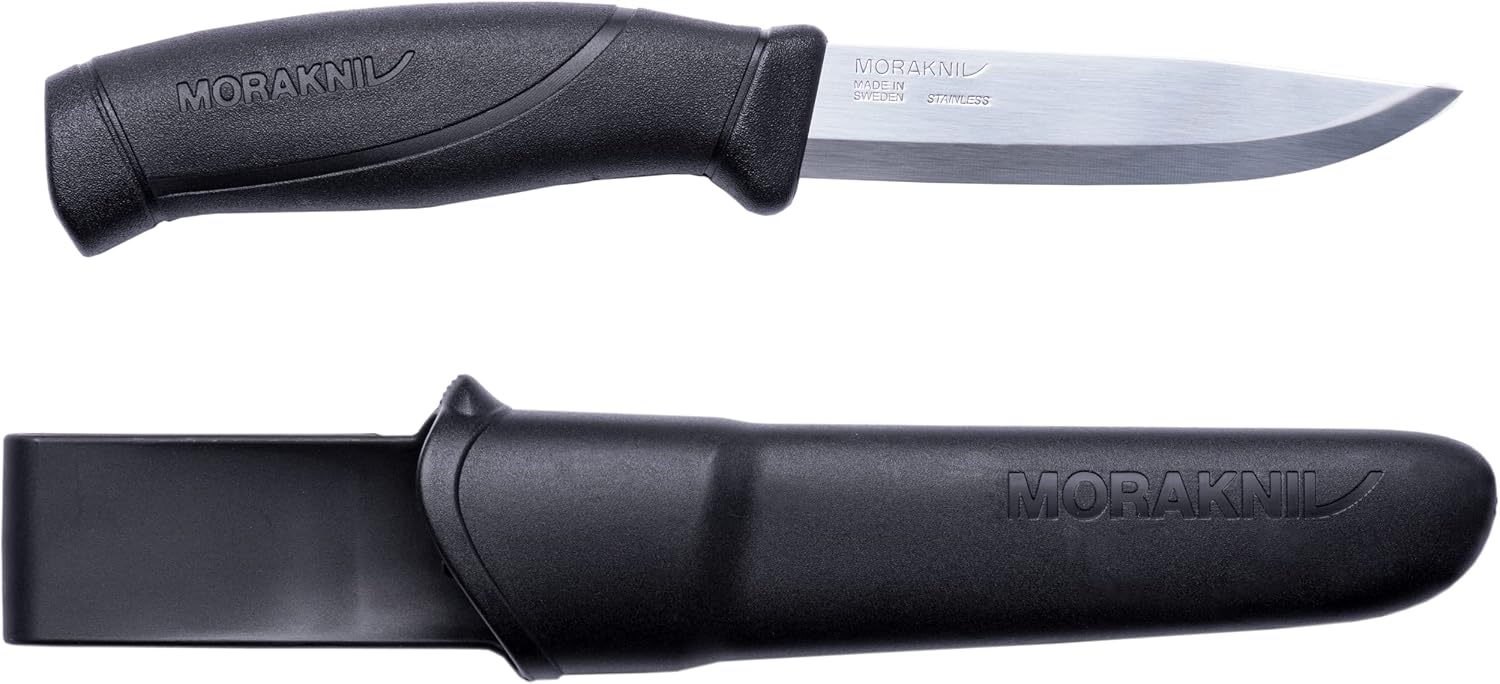
If you’re looking for a simple camp knife without spending much, the stainless Companion is a good place to start. You get a useful 4.1-inch blade, a grippy handle and a sheath without paying for the more elaborate materials found elsewhere on this list. For cordage, carving and routine outdoor chores, that may be all you need.
There are a few things to keep in mind before buying one. The black Companion (S) uses 12C27 stainless steel and Morakniv’s standard tang, not a full tang. This is the regular model, not the thicker HeavyDuty or the fire-starter-equipped Spark. If full-tang construction is a priority, the Beluga is the better value choice; if you need a dedicated survival knife, look at the larger ESEE-6. And whatever you’re cutting, don’t use the Companion as a pry bar.
Best Value Full Tang: Petrified Fish Beluga

| PROS | CONS |
|
|
Petrified Fish is a knife brand that started making huge waves in the industry in 2022. They are well known for their great designs and very attractive prices. One quick Google search will show you that they have built somewhat of a cult following online. Let’s dive in and see what all the hype is about surrounding the Beluga fixed blade.
The Beluga was initially released as a folding pocket knife, and like many folding knives before it quickly found its way into the hands of many who wanted the same great design, but with the added durability you get from a fixed blade. The fixed blade variant improves upon the potential weaknesses the original liner lock variant had, without significantly changing the design. You still get the same great ergonomics as before (maybe even better now) with the contoured G10 handle scales, but with zero moving parts. The drop point blade makes this a perfect companion for nearly any task you could imagine.
There are some downsides I’ve noticed with the Beluga that I think are important to keep in mind when shopping for a new fixed-blade knife. The biggest one for me is the sheath. I’m not a huge fan of scout carry sheaths, and when the sheath is set up for scout carry out of the box it honestly is a major drawback for me. However, this issue can be solved by switching the hardware out to a clip system that you prefer. I just would like to see more options out of the box. There is one thing I do love about this sheath, and that’s the integrated thumb-ramp; having this makes a huge difference in improving the ease of use and overall quality of life when carrying the Beluga. The blade steel is another drawback for me personally. The Beluga fixed blade ships with a Bohler N690 stainless steel blade.
Although it’s certainly not a bad steel choice, it’s just not going to perform as well as other steels. However, I do believe that the Bohler N690 steel is a great choice at this price point, easily beating out most of the competition in the affordable full-tang category. The Petrified Fish Beluga earns the Best Value Full Tang spot for balancing price with performance. You’re getting way more knife than you are paying for here, and this would be a fantastic choice for you if you are a little more price-conscious.
Best Premium Field Knife: Toor Field 2.0
| PROS | CONS |
|
|
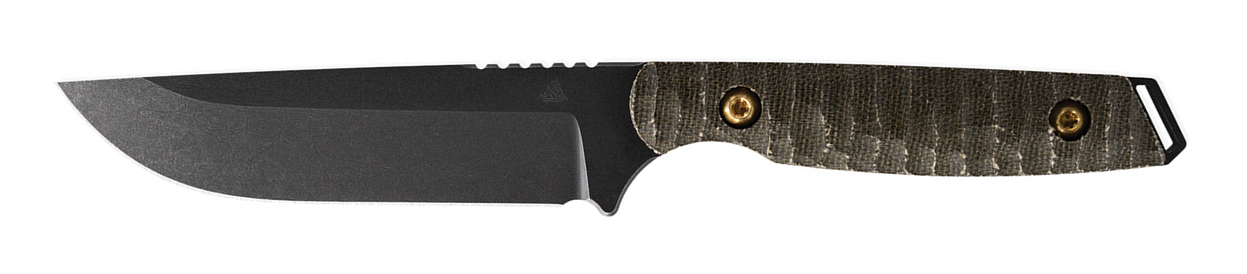
The Campfire Field 2.0 is worth a look if you like a more traditional belt knife. Its 4.5-inch drop point, textured Micarta scales and leather sheath earn it the premium field-knife spot here. You get a substantial step up in size from the small EDC picks without going all the way to a full-size survival blade.
This Campfire version pairs a black CPM-154 blade with forest green canvas Micarta and dark-earth G10 liners. The textured handle and full-tang construction suit a working knife, while the included Hermann Oak leather sheath adds to that traditional feel.
There’s a lot to like here, but price and weight are worth keeping in mind. If you want the lightest knife for everyday errands, the smaller options below make more sense. But if you’re looking for a premium belt knife for camp chores and general outdoor use, the Campfire could be a good fit.
Best Small Fixed Blade Knife: MKM Mikro 1
| PROS | CONS |
|
|
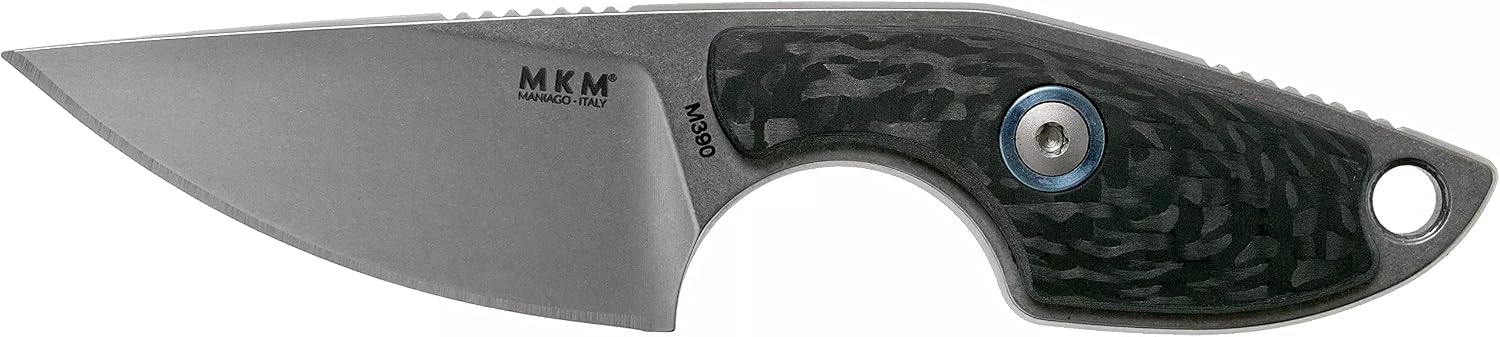
The MKM Mikro 1 is the pick here when keeping things small matters most. Designed by Jesper Voxnaes, it has a 1.97-inch M390 drop-point blade and measures just 4.33 inches overall. That makes it a sensible option for light everyday cutting or as a backup, rather than carrying a full-size belt knife for a small job.
The carbon-fiber version has black handle scales and a stonewashed blade, with a leather pocket sheath and magnetic clip included.
Small size brings real compromises. There is less handle to work with, especially for larger hands, and the short cutting edge is not the choice for heavy wood processing. The included sheath is leather rather than Kydex, so make sure that carry setup suits you before buying. For more substantial everyday work, the Xancudo offers a larger grip and blade.
Best Hunting Fixed Blade Knife: Benchmade Raghorn

| PROS | CONS |
|
|
Benchmade has been an industry leader for knives of all kinds for decades, especially in the hunting category. They just flat-out know how to make a great hunting knife. The Raghorn is no exception. I feel like the Raghorn is the next evolutionary step towards hunting knife perfection. Let’s dive into it!
The Raghorn sports a 4” CPM-S30V blade with tons of jimping to enhance your grip and keep your hand from slipping during use. Plus the huge finger choil accommodates a wide range of grip styles, making game processing so much easier. The blade isn't too long, so it's not difficult to use it in tight spaces. And because of the steel choice (CPM-S30V), you can easily strop and resharpen the blade in the field without much effort. No, it’s not the greatest steel in the world, but it’s proven to be extremely effective for what the Raghorn was designed for. The G-10 handle scales are comfortable and smooth and have very few hot spots, which is very nice when you are doing a lot of cutting.
Overall, I chose the Benchmade Raghorn as the best fixed blade hunting knife for many reasons as stated above. However, there are some downsides to the design, as no knife is perfect for everyone. A few things to take into account if you are looking to buy a Raghorn. The first: It’s expensive… especially considering it’s made from CPM-S30V steel. Additionally, I don’t particularly like the sheath. The orange Boltaron sheath you get with the knife is fine, but it doesn’t come with a clip of any kind, and the holes of the sheath don’t accommodate very many clip options. So attaching this knife to a belt can be quite frustrating sometimes if you don’t want to use the included belt loop slots.
All in all, the Raghorn is an incredible hunting fixed blade with a somewhat lackluster sheath. I do feel the pros outweigh the cons for this one, however, and I’d happily recommend this knife to anyone who needs a high-end hunting fixed blade.
Best Fixed Blade Survival Knife: ESEE-6
| PROS | CONS |
|
|
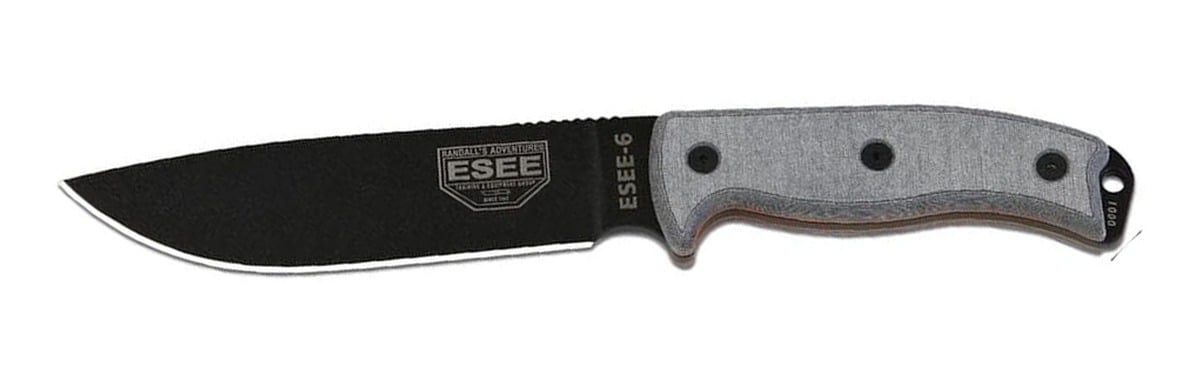
The ESEE-6P is the choice here when you need a full-size outdoor knife rather than a compact daily companion. Its long, plain-edged blade gives you more working room for wood processing and camp chores, while the full-flat grind keeps it useful for ordinary cutting.
In our survival-knife guide, Matt Davidson describes using the ESEE-6P to split and chop wood and prepare food.
The versions linked here come with a black 1095 blade, gray linen Micarta scales and a molded sheath with a clip plate. The first thing to keep in mind is the steel: 1095 isn’t stainless, so dry the knife after use and protect the exposed edge from corrosion. Then there’s the weight. At 12 ounces before you add the sheath, it’s much heavier than the smaller knives in this guide. This is a knife to choose for outdoor work, not discreet pocket carry.
Best Everyday Carry Fixed Blade Knife: ESEE Xancudo
| PROS | CONS |
|
|
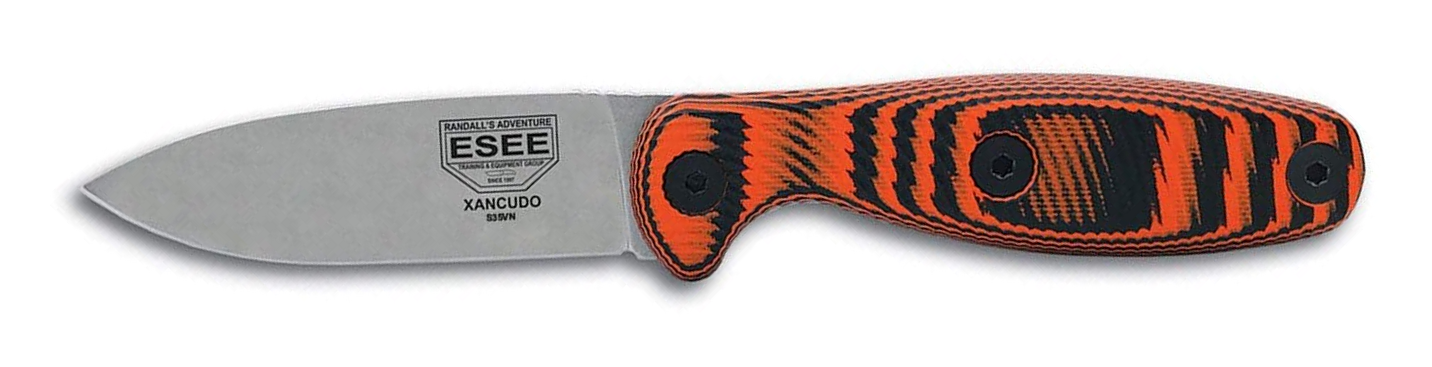
The Xancudo is worth considering when the MKM Mikro 1 looks a little too small for you. It pairs a stainless S35VN blade with contoured G10 scales for everyday cutting and light outdoor tasks. You get a more substantial handle than the tiny Mikro 1 without stepping up to a full-size survival knife.
The version here is the XAN2-006, with orange-and-black G10 scales, no large carabiner hole and a black molded sheath. Don’t confuse it with ESEE’s similarly named Zancudo, which is a folding knife.
The main thing to keep in mind is the size. At 7.12 inches overall and 3.8 ounces without the sheath, the Xancudo isn’t an ultralight neck knife. It makes more sense if you want a more substantial everyday belt knife; if keeping bulk to a minimum is your priority, stick with the MKM Mikro 1. And although S35VN provides corrosion resistance, you should still clean and dry the blade after use.
Fixed Blade Knife Comparison
Swipe or scroll sideways to see all seven columns.
| Knife | Blade | Overall | Weight | Steel | Handle | Price range |
|---|---|---|---|---|---|---|
| Knafs Lulu | 2.95 in | 6.75 in | 4.1 oz¹ | CPM-MagnaCut | Micarta G10 liners |
$$$ |
| Morakniv Companion | 4.1 in | 8.6 in | 4.18 oz¹ Product weight |
12C27 | Polymer / TPE | $ |
| Petrified Fish Beluga | 3.62 in | 8.27 in | 6.63 oz¹ | N690 | G10 | $ |
| Toor Field 2.0 | 4.5 in | 8.75 in | 6.8 oz¹ | CPM-154 | Micarta G10 liners |
$$$ |
| MKM Mikro 1 | 1.97 in | 4.33 in | 1.41 oz¹ | M390 | Carbon fiber | $$ |
| Benchmade Raghorn | 4 in | 8.9 in | 3.56 oz¹ | CPM-S30V | G10 | $$$ |
| ESEE-6 | 6.5 in 5.75 in cutting edge |
11.75 in | 12 oz² | 1095 | Micarta | $$ |
| ESEE Xancudo | 3 in cutting edge | 7.12 in | 3.8 oz² | CPM-S35VN | G10 | $$ |
Blade measurements are blade length unless marked as cutting edge. ¹ Manufacturer-listed weight; sheath inclusion is not specified. ² Knife-only weight. Price tiers ($–$$$) indicate relative cost across these picks; exact prices are available through the linked retailers.
How To Choose The Best Fixed Blade Knife
Weight
Weight is one of the main concerns for many when choosing a fixed blade knife because often fixed blade knives weigh more than folding knives. This is either a good or a bad thing, depending on what you need for your knife. Extra weight could make the knife uncomfortable to carry for long periods of time or provide useful momentum for chopping, though weight alone does not tell you how strong a knife is. It is important to understand what is important to you specifically when shopping for a new fixed blade knife.
Size
Fixed blades range from small pocket backups to large outdoor knives. More blade can help with larger cutting jobs, but extra length can get in the way of detailed work and make daily carry less comfortable. Choose enough blade and handle for your tasks, rather than assuming bigger is more versatile.
Blade Steel
Our knife steel guide explains the trade-offs to consider when choosing a fixed blade knife. Usually, fixed blades are intended for harder use work environments so the blade steel is carefully chosen to suit the use case of the knife. For harder outdoor work, compare toughness and edge geometry as well as edge retention; steel choice alone does not tell the whole story.
Use Case
As with any tool, you need to fully understand what you are going to be using it for. Fixed blades handle many of the same cutting jobs as folders, without a folding joint or lock. Are you looking for an EDC knife? Or maybe you're looking for a more heavy-duty wood splitter to take with you on weekend camping trips. Fixed blades cover the whole gamut of use-cases, so understanding what you need is crucial here.
Sheath
A fixed blade is only as good as the sheath that it’s in. If the sheath is not good, then you’ll never want to carry it. So making sure that you buy a fixed blade with a good sheath is imperative if you want to get the most out of your tool.
Why Trust Us
I’ve worked in various roles in the knife industry. I’ve had the privilege of having access to the largest knife library in the world, allowing me to handle, test, and carry thousands of knives from a plethora of different makers. Because of this history, I’ve been able to experience many knives first-hand and see reviews, customer feedback, and comments online about the products, giving me a very in-depth knowledge of what I and others like and dislike about so many different knives.

Final Thoughts
The Knafs Lulu remains the overall pick for its mix of utility and comfort. If you have a more specific job in mind, start with that category. Just make sure the knife’s size, maintenance needs and carry setup work for you.
FAQs
Question: Who Makes The Best Fixed Blade Knives?
Answer: There is no single maker that is best for every use. Start with the size, steel and carry setup you need: a compact everyday knife and a full-size survival knife solve different problems. The selections above give you a useful starting point for each role.
Question: What Is The Most Famous Fixed Blade Knife?
Answer: The KA-BAR USMC Fighting/Utility Knife is one of the most recognizable, thanks in large part to its association with the U.S. Marine Corps during World War II.
Question: What Should You Use Fixed Blade Knives For?
Answer: Fixed blades can suit everyday cutting, hunting, carving and camp chores. Choose the size and construction for the job. They have no folding joint that can close during use, but safe handling and a secure sheath are still essential.

