


We independently evaluate all recommended products and services. Any products or services put forward appear in no particular order. If you click on links we provide, we may receive compensation.

A flexible fillet blade can bend away from the abrasive just when you think you’re sharpening it. Pressing harder usually makes that problem worse.
I’d choose the sharpener around two jobs: restoring the edge at home and keeping it cutting cleanly during a day of fishing. These options cover adjustable and lower-cost powered setups, a full-size manual bench plate and compact field maintenance. They’re for ordinary plain-edge fillet knives; powered reciprocating blades need their own maker’s care instructions.
Key Considerations
- Match the existing bevel: Fillet knives do not all share one sharpening angle. Check the knife maker’s guidance before choosing a fixed-angle tool. A 20° sharpener can change a shallower edge rather than simply maintain it.
- Control flex with support, not force: A long, thin blade can deflect under pressure. The sharpener needs to accommodate the blade’s length and narrow profile, and your technique needs to keep the edge in contact without bending it.
- Separate home sharpening from field upkeep: Mains-powered belts belong at a suitable dry workbench. A small manual sharpener makes more sense in the fishing kit, but it still needs a stable place to work and a clean blade.
- Start with maintenance when that is all you need: A slightly tired edge does not automatically need a coarse abrasive. A chip, rolled section or major angle change is a different job from refreshing the bite before the next fish.
Fillet Knife Sharpeners: Top Picks
- Best Powered Home Setup: Work Sharp Ken Onion Edition Mk.2
- Best Lower-Cost Powered Option: Work Sharp Knife & Tool Sharpener Mk.2
- Best Full-Size Manual Bench Option: DMT Dia-Sharp 8-Inch Fine
- Best for Matching 20° Field Touch-Ups: Work Sharp Pull Through Knife Sharpener
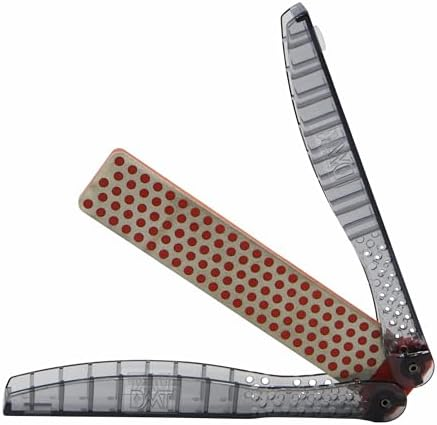
- Best Freehand Field Option: DMT Double-Sided Diafold
Best Powered Home Setup: Work Sharp Ken Onion Edition Mk.2
| PROS | CONS |
|
|
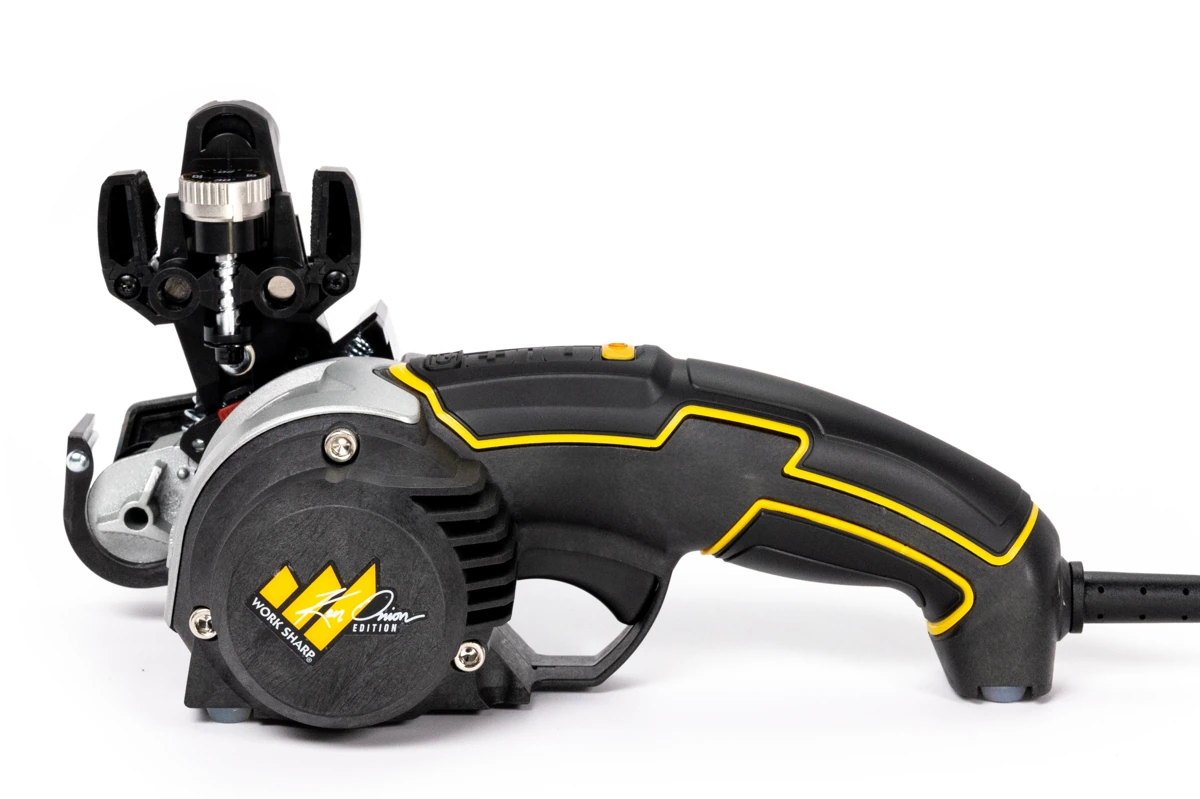
The Ken Onion Mk.2 is the option I’d look at for sharpening several fillet knives at home, particularly when their bevels need different settings. Its guide adjusts from 15° to 30° per side, and variable speed gives you more control over the setup than a simple fixed-angle sharpener. That range still has a floor: the guide cannot preserve an edge below 15°.
Work Sharp’s manual specifically addresses fillet knives. It calls for the Edge Guide to support long, flexible blades and very light pressure so the blade does not flex. That is the important feature here. A powered belt is not useful merely because it removes metal quickly; the edge must meet it consistently without being pushed out of position.
The supplied belts range from coarse shaping abrasives to fine finishing grades. I wouldn’t start every touch-up with the coarse belt or work through the entire set out of habit. Follow the manual’s belt and speed guidance for the condition of the edge, learn the tip-stopping sequence and practice on a less valuable knife before using a favorite fillet blade. Drawing the tip off a running belt can round the point.
This is a bench purchase, not a boat-side maintenance tool. Set it up away from water, keep the knife clean and dry, and allow time for belt changes and controlled passes. The simpler Work Sharp Mk.2 can make sense for knives that suit its 20° or 25° presets, but the Ken Onion’s adjustable guide is the reason I’ve chosen it for this list. Neither machine makes every thin blade an automatic fit.
Best Lower-Cost Powered Option: Work Sharp Knife & Tool Sharpener Mk.2
| PROS | CONS |
|
|
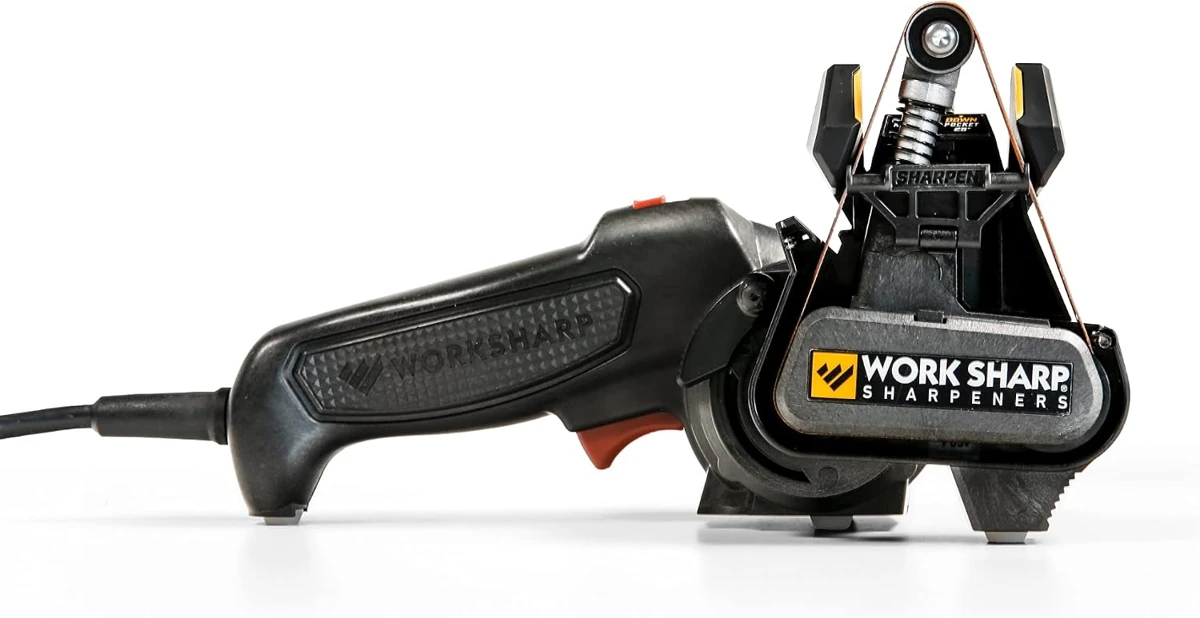
If the Ken Onion price is hard to justify for a few fishing knives, the standard Mk.2 is the powered option I’d consider first. It keeps the belt-and-guide approach but trades continuous angle adjustment and seven speeds for two speeds and a choice of 20° or 25° per side. That is a worthwhile saving when one of those settings matches the edge you want.
Work Sharp’s fillet-specific guidance recommends both this model and the Ken Onion system because their guides support a flexible blade during the pass. My earlier KnifeInformer Mk.2 review also explains the learning curve and the importance of using the lower speed for knives. That experience belongs to this standard Mk.2, not to the Ken Onion Mk.2.
The WSKTS2 kit supplies P80, P220 and 6000 belts. Don’t start with the coarsest belt simply because it is in the box. A thin fillet edge calls for light, controlled contact and the sequence in the manual; major damage and routine maintenance are different jobs. Support the knife as directed and avoid lingering at the tip.
Choose the Ken Onion instead when you need a compatible angle below 20° or want finer control of motor speed. Choose this Mk.2 when its presets fit and you want powered sharpening without paying for those adjustments. Neither turns an ordinary fillet knife into a blade that should be pressed hard against an abrasive.
Best Full-Size Manual Bench Option: DMT Dia-Sharp 8-Inch Fine
| PROS | CONS |
|
|
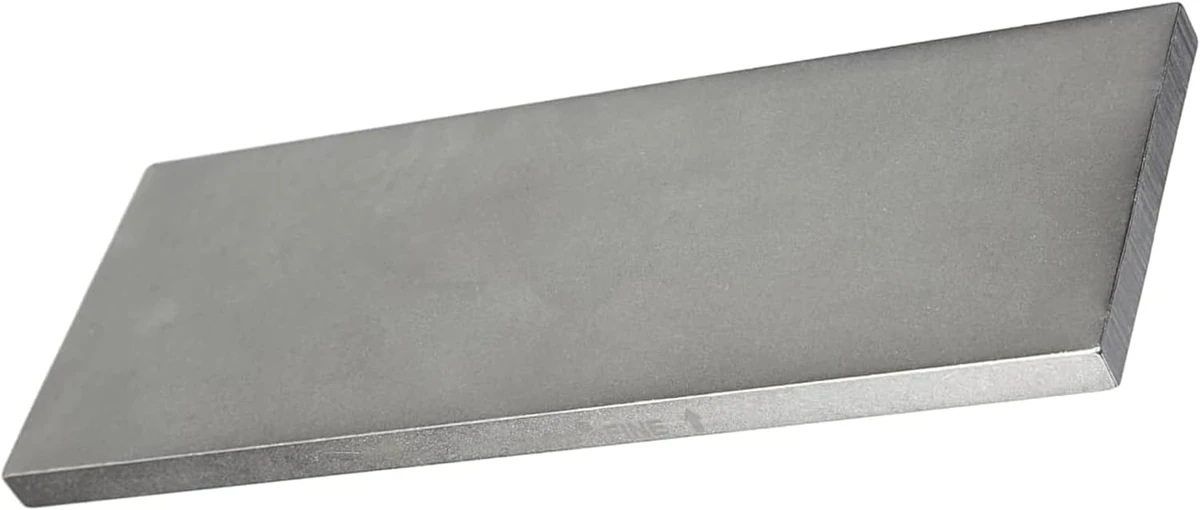
A pocket sharpener makes sense beside the tackle box, but at home I’d rather give a long fillet knife a full-size surface. The D8F measures 8 by 3 inches, so it offers considerably more working room than the folding Diafold. It also avoids a clamp that might interfere with a narrow blade.
The surface is DMT’s Fine monocrystalline diamond, specified as 25 micron or 600 mesh. It is a practical working grade for slightly dull edges, rather than a dedicated coarse repair plate or a finishing waterstone. Use that description within DMT’s system; matching numbers on other abrasives do not establish the same finish.
Freehand control is both the advantage and the catch. You can follow an appropriate existing bevel instead of selecting a fixed guide, but you still need to support the flexible blade and keep pressure gentle. Work Sharp’s fillet guidance confirms that stone sharpening is possible while stressing how much more demanding angle control becomes with a flexible blade.
I’d choose the D8F for someone who already likes bench sharpening and wants a larger manual surface. For a beginner who struggles with blade flex, the supported powered systems are easier options to consider. The Diafold remains the compact travel choice; the D8F earns its place by making home freehand work less cramped, not by eliminating the technique.
Best for Matching 20° Field Touch-Ups: Work Sharp Pull Through Knife Sharpener
| PROS | CONS |
|
|
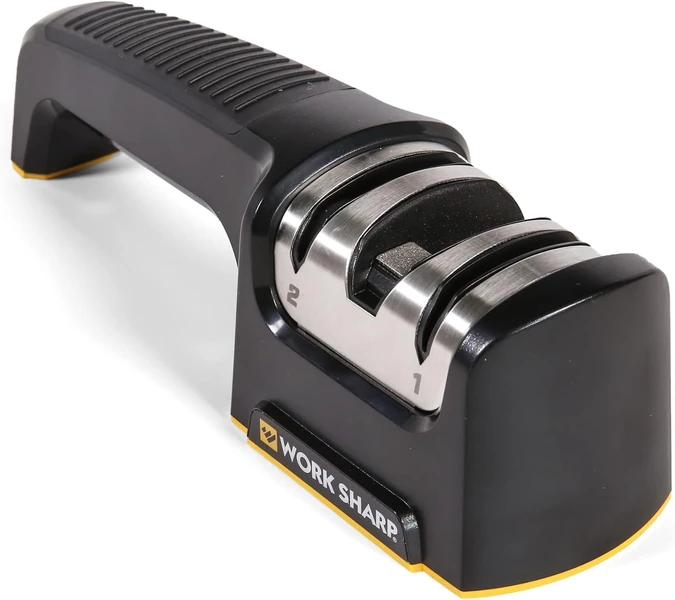
The Work Sharp Pull Through is the simplest option here for a fillet knife that suits a 20° per-side edge. The diamond wheel handles sharpening, while the ceramic wheel is the useful maintenance stage when the edge only needs refreshing. I’d put this in the fishing kit for that limited job rather than bring a powered sharpener to the cleaning station.
Work Sharp specifically recommends its Kitchen Pull Through in its fillet-knife guidance, with the ceramic slot as the routine maintenance stage. That supports the role, but your knife’s bevel still comes first. Use it for a compatible 20° per-side edge; a 15° bevel that you want to preserve needs another method.
Put the sharpener on a flat, stable surface, keep the knife upright and follow the blade’s curve so the edge stays in contact with the wheel. The slots don’t excuse forcing a narrow blade against the housing or leaning it sideways. Use the ceramic stage for suitable routine upkeep; don’t begin on the 320-grit diamond wheel simply because it is numbered first.
Clean the blade before sharpening, between abrasive stages and before returning it to food. The sharpener itself does not need water or lubricant; use the maker’s cleaning method rather than immersing it after a day around fish. This is an uncomplicated maintenance choice, with a clear limitation: I would choose the DMT or a compatible adjustable setup if preserving another bevel angle matters.
Best Freehand Field Option: DMT Double-Sided Diafold
| PROS | CONS |
|
|
The Fine/Coarse Diafold is the portable option I’d choose for someone already comfortable sharpening freehand. Its handles fold around the abrasive for storage, and it measures 5 inches closed or 9.5 inches open. You get two working grades without carrying a bench stone, although the working surface is much smaller than the overall open length.
DMT specifies Fine as 25 micron/600 mesh and Coarse as 45 micron/325 mesh. Start with Fine when an otherwise sound edge needs ordinary maintenance. Coarse is there for work that genuinely needs more metal removed, not a compulsory first pass on every thin blade. Those labels describe DMT’s diamond grades; they are not exact equivalents to every waterstone grit number.
The benefit over the pull-through is freedom to follow the knife’s existing bevel. The cost is that you must control it. There is no clamp to steady a flexible blade, and the short, narrow diamond face gives less room for a long stroke. Use light pressure and a stable, controlled setup. If keeping the angle consistent is still a struggle, the folding format won’t solve that by itself.
DMT allows dry use or water, with no oil needed. Clean the knife and sharpener after use, let them dry and keep abrasive residue away from the next fish. The Diafold is a practical small tool for an experienced user, but I wouldn’t buy it expecting the support of the Ken Onion’s Edge Guide or the simple fixed path of the Work Sharp slots.
Compare Our Picks
Scroll sideways on smaller screens to compare all the details.
| Model | Best fit | Angle control | Abrasives | Main tradeoff |
|---|---|---|---|---|
| Work Sharp Ken Onion Edition Mk.2 | Best Powered Home Setup | 15–30° per side | P120, X65, X22, X4 and 6000 belts | Powered abrasive leaves little margin for heavy pressure |
| Work Sharp Knife & Tool Sharpener Mk.2 | Best Lower-Cost Powered Option | 20° or 25° per side | P80, P220 and 6000 belts | No setting below 20° |
| DMT Dia-Sharp 8-Inch Fine | Best Full-Size Manual Bench Option | Freehand; follow the existing bevel | Fine diamond: 25 micron / 600 mesh | Blade support and angle control remain manual |
| Work Sharp Pull Through Knife Sharpener | Best for Matching 20° Field Touch-Ups | 20° per side; fixed | Diamond and fine ceramic | Fixed 20° angle will not preserve a shallower bevel |
| DMT Double-Sided Diafold | Best Freehand Field Option | Freehand; no fixed angle | Coarse and Fine monocrystalline diamond | No guide or support prevents blade flex |
How to Choose a Fillet Knife Sharpener
Check what kind of fillet blade you own
These choices concern ordinary manual plain-edge knives. A powered reciprocating fillet knife may use paired serrated blades with a specific maintenance or replacement procedure. Don’t put those blades through an ordinary plain-edge routine because the product also has “fillet” in its name.
Keep the bevel you actually want
Find the knife maker’s angle guidance and check that the sharpener can accommodate it. The Ken Onion guide covers 15–30° per side, the standard Mk.2 offers 20° or 25°, and the pull-through fixes the edge at 20°. Both DMT surfaces leave the angle to you. A guide is only useful when the blade fits and reaches the abrasive properly.
Plan for the length and flexibility
Long blades need support and gentle contact. Don’t assume a clamp system will solve this automatically: a thin blade can flex beyond the jaw, and narrow blades may have clearance problems. For freehand use at home, the D8F offers more room than the Diafold; the folding surface saves space in a travel kit. Both still depend on controlled pressure and angle.
Refresh the edge before choosing repair equipment
A ceramic maintenance stage or suitable fine abrasive can be enough for an edge that is beginning to lose bite. Chips, substantial rolling and major bevel changes deserve a deliberate repair plan. A sharpening service may be the better choice for a valuable knife with damage you aren’t confident handling.
Make cleaning part of the routine
Sharpen on a stable surface rather than trying to manage a wet knife on a moving boat. Keep food residue out of the abrasive, remove sharpening residue before cutting food, and dry the blade before storage. The knife care and maintenance guide covers caring for the blade once the fish-cleaning work is done.
Treat any serrated section separately
These picks address plain-edge fillet blades. If a fishing knife has a serrated section, use an abrasive that fits its recesses instead of taking it through the same sharpening path. The best serrated knife sharpeners guide explains that fit.
Why Trust Us
My earlier standard Mk.2 review informs its section here. Work Sharp’s fillet-specific guidance and the exact DMT specifications underpin the other comparisons. I focus on the demands of a long, flexible blade: controlled pressure, support and a practical division between home sharpening and field touch-ups.
Final Thoughts
I’d choose the Ken Onion Mk.2 for adjustable powered sharpening, or the standard Mk.2 when its 20° or 25° setting fits and cost matters more than extra adjustment. For manual bench work, the D8F offers room for a long blade; the Diafold is easier to pack. The Pull Through suits straightforward touch-ups of a matching 20° edge. Start with blade support and bevel compatibility, not extra pressure.
Frequently Asked Questions
What angle should I sharpen a fillet knife at?
Use the knife maker’s guidance and the bevel you intend to maintain. There is no single angle that applies to every fillet knife. A fixed 20° sharpener is unsuitable if your goal is to preserve a shallower edge.
Can I use an electric sharpener on a flexible fillet knife?
Only when the machine accommodates the blade and you follow its fillet-specific instructions. The Ken Onion Mk.2 manual calls for Edge Guide support and very light pressure to avoid flex. Powered sharpening also requires the correct belt, speed and tip technique; an adjustable guide does not remove those responsibilities.
Is a pull-through safe for every fillet knife?
No. Check the angle, the blade’s clearance through the slots and the maker’s compatibility guidance. The selected Work Sharp is fixed at 20° per side. Don’t force a narrow blade into a slot or use it to preserve an angle it cannot maintain.
Can these sharpen powered electric fillet blades?
Do not assume so. Paired reciprocating or serrated blades need the blade maker’s specific maintenance or replacement procedure. The ordinary plain-edge recommendations in this guide are not instructions for those assemblies.
Should I use the coarse side every time?
No. Use the abrasive needed for the condition of the edge. A fine diamond or ceramic maintenance stage can be the appropriate choice for routine upkeep; a coarse stage is for work that needs more material removed. Repeated unnecessary coarse sharpening spends blade life without a useful reason.
