


We independently evaluate all recommended products and services. Any products or services put forward appear in no particular order. If you click on links we provide, we may receive compensation.
A serrated knife needs an abrasive that reaches the curved recesses, not one that simply grinds across the tooth tips. That fit matters more than the sharpener’s name.
I’d choose a home ceramic setup for routine upkeep, a tapered diamond rod for individual scallops, or a field kit when there are plain edges to maintain too. These options serve different jobs. None is a universal fix for every bread knife, tiny microserration or damaged tooth.
Key Considerations
- Match the scallop before the grit: The abrasive must contact the curved bevel without enlarging the recess or flattening its tooth points. A taper gives you several diameters to work with, but only the part that fits belongs in that scallop.
- Check which side is beveled: Some serrated knives are beveled mainly on one side; others have a different arrangement. Follow the knife maker’s method rather than using an automatic equal number of strokes on each side.
- Separate upkeep from tooth repair: Fine ceramic and diamond abrasives can maintain an existing edge. Missing points, deep chips and severely misshapen serrations may need a specialist service, not more passes with a small rod.
- Choose a setup you can control: A home base gives you a repeatable working position; a folding rod stores compactly but leaves the angle and contact to your hands. Neither format removes the need to inspect how the abrasive meets the blade.
Serrated Knife Sharpeners: Top Picks
- Best Home Ceramic Setup: Spyderco Sharpmaker
- Best for Extra-Fine Refinement: DMT Diafold Serrated
- Best Budget Tapered Rod: Lansky Folding Diamond Tapered Rod
- Best All-in-One Field Kit: Work Sharp Guided Field Sharpener
Best Home Ceramic Setup: Spyderco Sharpmaker
| PROS | CONS |
|
|
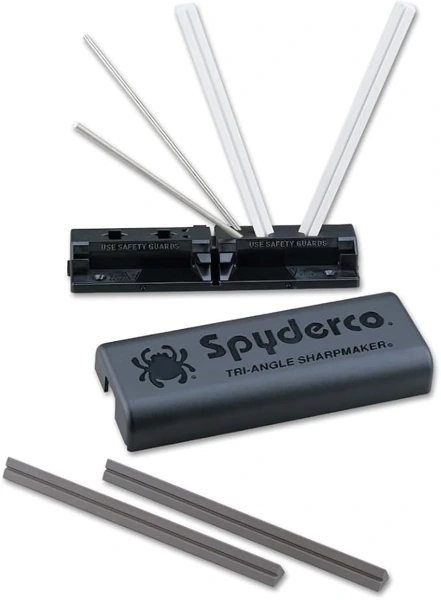
The Sharpmaker is my starting choice for someone who wants a home setup for both serrated and plain-edge knives. Its triangular ceramic rods offer rounded corners that can reach compatible serration recesses, rather than forcing a broad abrasive across the tooth tips. You still guide the blade by hand; this is not a clamp that holds its angle for you.
The 204MF kit includes medium and fine rods, with 15° and 20° per-side positions in the base. Those settings are useful options, not proof that either matches your serrated knife. Check the actual contact and use Spyderco’s serrated-blade instructions. Keep the safety rods in place, and don’t press hard enough to fight the shape of the edge.
There is relevant experience on KnifeInformer: in our knife sharpening systems guide, Travis Smola describes five years of Sharpmaker ownership and the convenience of its quick setup. That supports its role as a practical maintenance system. That is useful background on everyday upkeep, rather than a test of every serration pattern.
I’d buy it when I want one stored kit for compatible everyday knives, and choose a tapered rod when individual scallops need a more selective contact point. The supplied ceramics make more sense for upkeep than aggressive repair.
Best for Extra-Fine Refinement: DMT Diafold Serrated
| PROS | CONS |
|
|
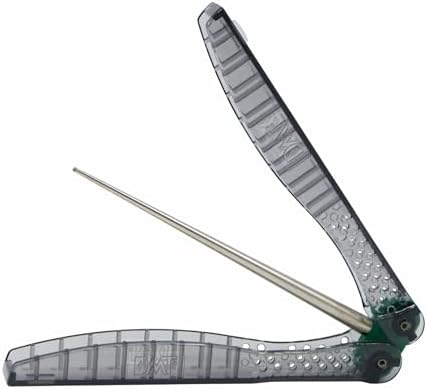
This is the Extra-Fine FSKE version of the Diafold Serrated, chosen for refining an existing serrated edge. DMT specifies 9 micron/1200 mesh for this grade. I’d choose it when a compatible scallop needs fine abrasive attention, not when a badly neglected edge needs a large amount of metal removed.
The 4.43-inch rod tapers from 1/4 inch to 1/16 inch in diameter. Find the section that matches the recess, then follow its existing bevel with short, controlled movements. Don’t pull the whole increasing taper through a small scallop: the thicker section can remove material you intended to preserve. The range gives useful choices, but doesn’t make it suitable for every microserration.
The handle folds around the rod, with an overall length of 5 inches closed and 9.5 inches open. DMT permits dry use or water, with no oil needed. Those are convenient details for a small kit, although the handle does not support the blade or hold the sharpening angle.
The Lansky is the less expensive option here if you want a Fine-grade tapered diamond rod for ordinary maintenance. The DMT’s reason to be on the list is this specific extra-fine configuration and its documented taper range. I wouldn’t buy both just to fill a case, or expect the FSKE alone to provide a complete repair-to-polish progression.
Best Budget Tapered Rod: Lansky Folding Diamond Tapered Rod
| PROS | CONS |
|
|
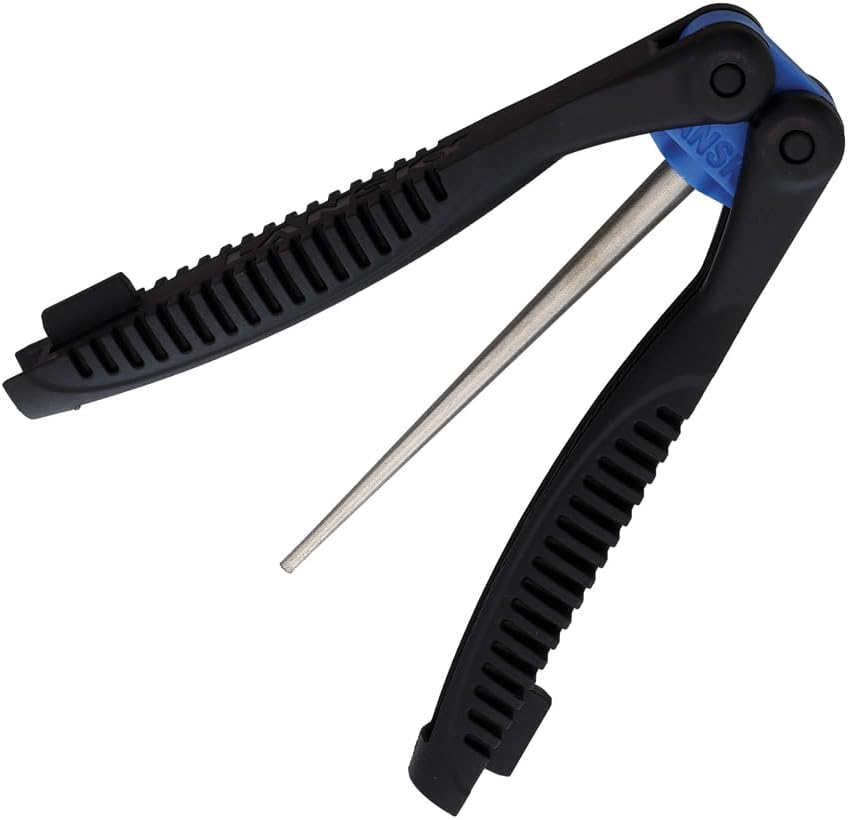
The TR-600 is the economical choice for someone who wants one small tapered diamond rod rather than a full home system. Its 3.5-inch abrasive is Fine 600 grit, and it folds into the handle for storage. The useful comparison with the DMT is ordinary Fine-grade maintenance versus the selected FSKE’s extra-fine refinement, not a claim that one brand’s grit label converts exactly into another’s.
I’d choose it for occasional attention to compatible scallops when I’m comfortable matching a bevel freehand. Work on the part of the taper that fits the recess and inspect the contact rather than treating the rod as a saw file. The tapered shape is a way to choose a suitable diameter; it is not permission to force a wider section through the tooth pattern.
There is less abrasive length than on the DMT, and no base to establish the blade’s position. That makes deliberate handling important. The price makes it an accessible tool, but doesn’t remove the need to understand which side of the knife is beveled or when the geometry should be left to a sharpening service.
Choose the Sharpmaker if a compatible bench setup is more useful than pocket storage. Choose the DMT FSKE if extra-fine refinement is the specific job. For a lower-cost folding rod to maintain suitable serrations, the Lansky has a clear place without pretending to cover every tooth shape or every stage of sharpening.
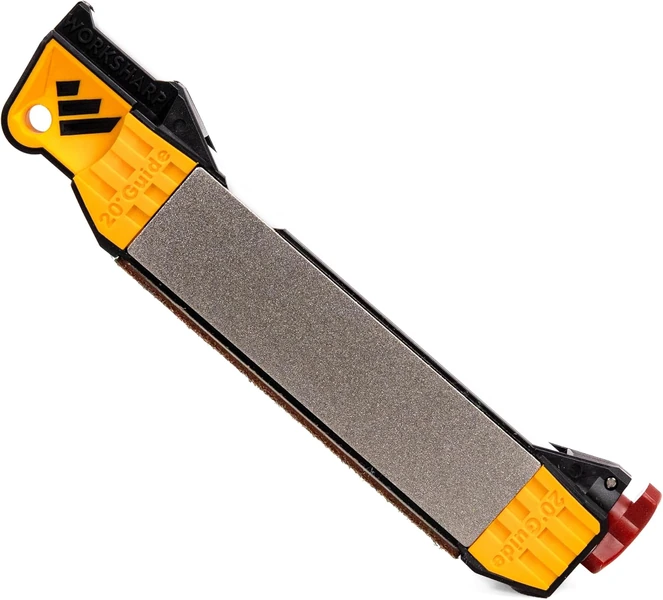
Best All-in-One Field Kit: Work Sharp Guided Field Sharpener
| PROS | CONS |
|
|
The Guided Field is the choice I’d pack when a partly serrated knife is only one of the edges that needs attention. Alongside its diamond plates, main ceramic rod and leather strop, it has a separate small ceramic rod for serrations. That makes it more useful as an all-round field kit than a single tapered rod.
Use the ceramic surface that actually fits the recess. Work Sharp’s instructions tell you to choose the appropriate rod size for the serrations; neither the large rod nor the small one is universal. The familiar 20° diamond and 25° honing references describe the tool’s plain-edge workflow. They do not establish the right angle for every serrated blade.
The 220- and 600-grit diamond plates have a separate job on compatible plain edges. Don’t drag the teeth of a bread knife across the flat plate and expect it to reach the scallops. On a partially serrated pocketknife, treat the straight section and the toothed section as different sharpening tasks.
For a home setup, I’d still favor the Sharpmaker. For individual scallops that need a range of diameters, the tapered DMT and Lansky rods are more adaptable. Choose the Guided Field when its ceramic fits your serrations and you also want to maintain plain edges without carrying several separate tools. It is a maintenance kit, not a way to rebuild damaged teeth.
Compare Our Picks
Scroll sideways on smaller screens to compare all the details.
| Model | Best fit | Abrasive | Angle control | Main tradeoff |
|---|---|---|---|---|
| Spyderco Sharpmaker | Best Home Ceramic Setup | Medium and fine ceramic | 15° or 20° per side | Preset positions do not match every factory bevel |
| DMT Diafold Serrated | Best for Extra-Fine Refinement | Extra-Fine diamond: 9 micron / 1200 mesh | Freehand; follow existing bevel | Extra-fine grade is slow for significant damage |
| Lansky Folding Diamond Tapered Rod | Best Budget Tapered Rod | Fine monocrystalline diamond; 600 grit | Freehand; follow existing bevel | No guide establishes the bevel angle |
| Work Sharp Guided Field Sharpener | Best All-in-One Field Kit | Ceramic rods for compatible serrations | Freehand; follow the existing bevel | Fixed rod sizes do not fit every scallop |
How to Choose a Serrated Knife Sharpener
Look at the actual cutting edge
Identify the recesses, tooth points and beveled side before picking an abrasive. A tool that contacts only the points can change the tooth pattern rather than sharpen the scallops. Very small serrations, saw-style teeth and paired electric fillet blades need their own maker’s guidance. For ordinary plain-edge kitchen knives, see our best kitchen knife sharpeners.
Choose the contact shape, then the grade
The rounded corner of a Sharpmaker rod, a section of a tapered diamond rod and the Guided Field’s ceramic rods contact the blade differently. Find a shape that fits, then choose the abrasive for the condition of the edge. An extra-fine finish is not a shortcut around shaping an edge that still needs that work.
Preserve the bevel instead of following a generic ratio
Do not assume every serrated knife needs equal strokes on both sides, one fixed angle or a universal stroke ratio. Follow the knife and sharpener instructions, including any specific treatment of the back side. If you cannot identify the geometry, a competent service is preferable to experimenting on a valuable knife.
Know when repair is a different job
An abrasive rod can maintain a sound tooth pattern, but missing points and large chips may require reshaping. More pressure or more coarse passes can make the shape worse. Consider the cost and suitability of professional repair before buying a tool on the assumption that it restores everything.
Keep the work and the knife clean
Use a stable, well-lit place where you can inspect contact and control the blade. Follow the abrasive maker’s cleaning method, remove sharpening residue from the knife and dry it before storage. The knife care and maintenance guide covers the wider cleaning and storage routine.
Why Trust Us
Travis Smola’s Sharpmaker ownership is credited in its section. The other comparisons use the makers’ abrasive shapes, grades and care instructions, with the exact Lansky configuration checked against its catalog and matching listings. The recommendations prioritize contact with the existing scallop and the difference between light maintenance and damaged teeth.
Final Thoughts
I’d start with the Sharpmaker for a compatible home ceramic setup, the DMT FSKE for extra-fine scallop work, or the Lansky for a lower-cost Fine-grade folding rod. The Guided Field is worth the extra space when you also maintain plain edges away from home. Pick the contact that fits first; a familiar brand or high grit number cannot compensate for the wrong shape.
Frequently Asked Questions
Can serrated knives be sharpened?
Many can, using an abrasive that fits their recesses and the knife maker’s method. That does not make every serration compatible with the same rod. Very small tooth patterns, severe damage and powered reciprocating blades may require a specialist procedure or service.
Should I sharpen both sides of a serrated knife equally?
Not automatically. Check whether the knife has one primary beveled side or another arrangement, then follow its specific instructions. A generic equal-sided routine or fixed stroke ratio can change the intended geometry.
Can I use a normal pull-through sharpener?
Only if that exact sharpener and knife combination has a supported serrated-blade method. A plain-edge carbide V-slot is not the default solution for curved scallops. Some systems permit a designated honing stage, which is different from restoring each individual recess.
What if the tapered rod is too large for a scallop?
Use a compatible smaller contact or a suitable service. Do not force the rod into the recess or grind away the tooth points to make it fit. Even a tapered rod has a minimum diameter.
Do ceramic rods remove steel?
Yes. Ceramic and diamond sharpening abrasives remove material. Do not assume that a fine abrasive merely straightens the edge without changing it; pressure, contact and the amount of work still matter.
