


We independently evaluate all recommended products and services. Any products or services put forward appear in no particular order. If you click on links we provide, we may receive compensation.
A rolling sharpener can hold the angle for you, but it cannot make the wrong angle suit your knife. Blade height, magnetic grip and the supplied abrasive matter as much as the rolling motion.
I’d compare the Work Sharp RKS for its included angle and abrasive choices, the Tumbler Pro as another modular system with optional angle and disc upgrades, and the HORL3 for its finishing upgrades. Each suits a compatible plain-edge knife that attaches securely to its holder. They are different ways to buy into the same method, with real differences in what comes in the box.
Key Considerations
- Check the fit before the angle: The blade must be attracted strongly enough to the magnetic support to stay secure. Ceramic and other non-magnetic blades need a different supported method. Check that the cutting edge clears the block and reaches the abrasive; narrow paring knives, tall cleavers and folders with protruding hardware pose different fit problems.
- Presets still change a bevel: All angles below are per side. A 15° or 20° support repeats that setting; it doesn’t identify the knife’s existing angle. Check the knife maker’s recommendation before changing a useful factory edge.
- Look beyond the diamond side: The diamond stages sharpen, while the ceramic face provides a finer finishing step. Check the included progression and whether replacement or upgrade discs fit the exact model. A disc made for one system or generation may not fit another.
- Leave room to roll: Use a stable, clear surface long enough for a controlled stroke along the blade. Keep fingers away from the exposed edge and remove the knife from its support whenever you’re not actively sharpening.
Rolling Knife Sharpeners: Top Picks
- Best for Angle Choice: Work Sharp RKS
- Best for Finishing Upgrades: HORL3
- Modular Alternative to HORL: Tumbler Pro
Best for Angle Choice: Work Sharp RKS
| PROS | CONS |
|
|
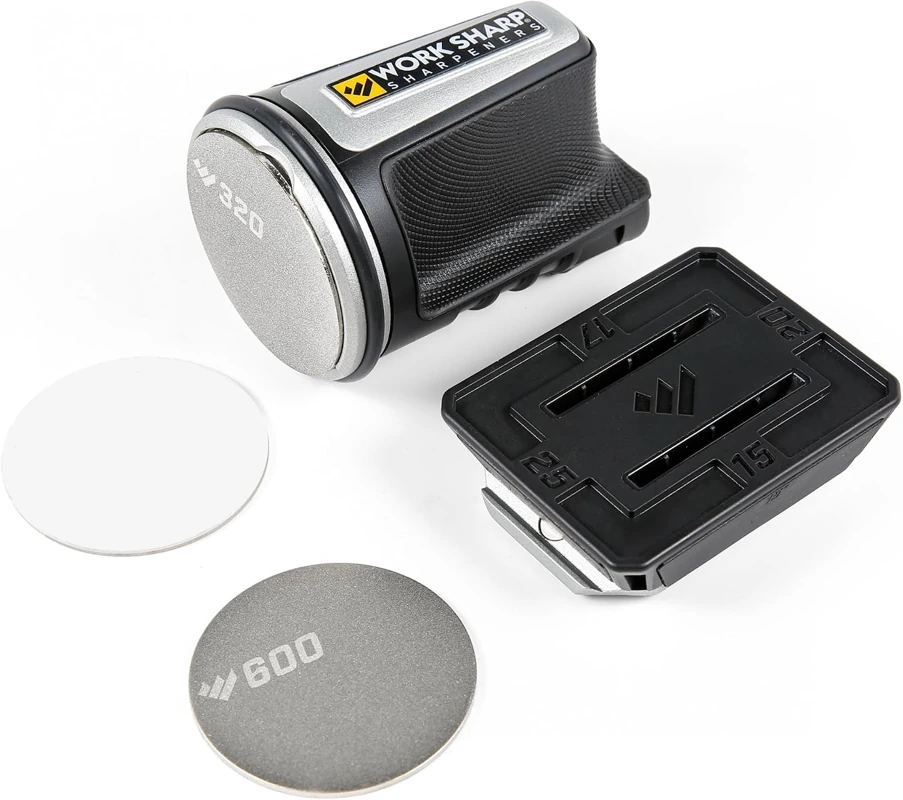
The RKS is my starting point for a mixed collection. Its magnetic block offers four settings: 15°, 17°, 20° and 25° per side. That gives you two more choices than the HORL3 here. Start with the knife maker’s angle guidance, then check that one of those presets suits the edge you want to maintain.
Work Sharp supplies 320- and 600-grit diamond discs plus a fine ceramic disc. The two diamond grades provide separate sharpening stages before the ceramic finish. Those numbers describe this system; they are not direct equivalents to every waterstone or another brand’s unnamed diamond grade.
The replaceable discs are a useful long-term feature. You can replace the appropriate abrasive without buying another complete roller, but moving between stages involves changing the fitted disc. Check the selected kit’s contents rather than assuming extra accessories come with the machine.
Work Sharp illustrates mounting arrangements for kitchen knives and folders, including a riser arrangement. Check that the blade seats firmly, the edge clears the support and any thumb stud or handle stays out of the way. The RKS earns its place here through those four angles and its replaceable abrasive progression; blade fit still decides whether it is suitable for your collection.
Best for Finishing Upgrades: HORL3
| PROS | CONS |
|
|
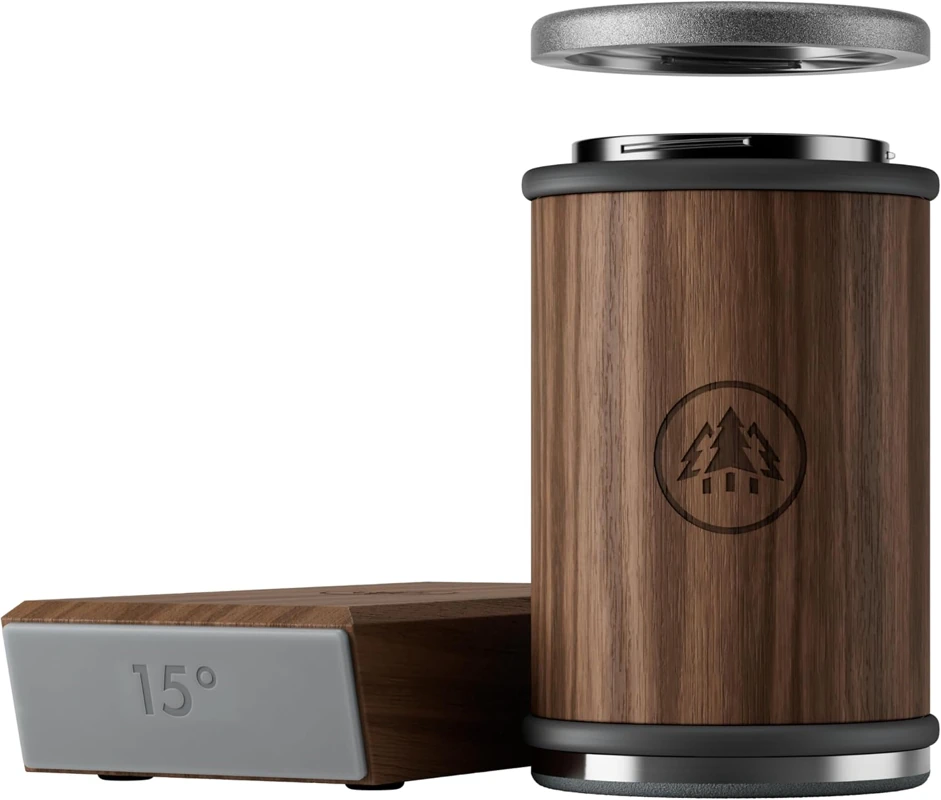
The standard HORL3 makes sense if you like a simple two-angle setup but want the option to change its abrasives later. The walnut kit has a diamond sharpening face, a ceramic honing face and a magnetic support with 15° and 20° settings. The wood finish is a design choice; the more useful buying distinction is the disc system.
HORL3 uses Quick Lock discs. They detach from the roller so you can replace them or add compatible finishing accessories. The company’s earlier HORL2 system uses screw-mounted discs, so check the generation before buying an accessory. The base kit here does not include the optional polishing stones or leather strop.
The entry-level HORL3 Cruise costs less, but its discs stay permanently fitted. The standard HORL3 earns its place here through replaceable discs and compatible finishing upgrades, not the wood body alone. Form a consistent working edge and remove the burr first; finishing accessories can wait until you know what you want to change.
Blade height needs attention with this style of sharpener. HORL explains how narrow knives can be supported with the edge above the grip pad, and how a stable cutting board beneath the roller can bring it up to a particularly tall blade. Those arrangements still need a secure knife and full abrasive contact. If your collection needs a 17° or 25° preset, the RKS is the more direct fit than buying this kit and hoping 15° or 20° will be close enough.
Modular Alternative to HORL: Tumbler Pro
| PROS | CONS |
|
|
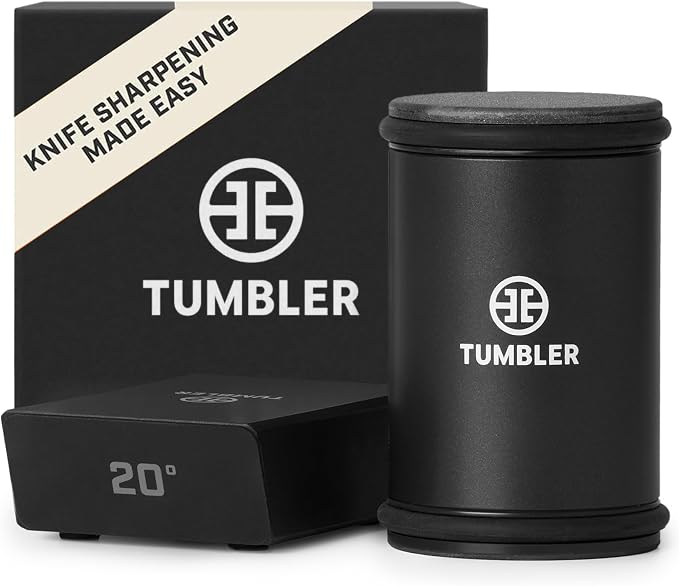
The Tumbler Pro is another modular roller to compare with the HORL3. The standard charcoal kit combines a diamond sharpening disc, a ceramic honing disc and a magnetic holder with 15° and 20° settings. Work Sharp costs less among these choices and supplies more angles; the Tumbler’s reason to consider it is its compatible disc and holder upgrade path.
The important word is standard. The 10° and 25° options belong to the separate Knife Holder Pro or a Starter Set, and the 3000/6000 polishing discs are optional. Product photos can show those extras, so check the selected bundle rather than assume everything pictured in a gallery comes in the box.
Tumbler also offers a coarse diamond disc and polishing discs for the Pro. Before ordering upgrades, check the connection on the actual roller: the maker specifies its current add-on discs for Pro models purchased after June 1, 2025, identified by the hex recess above the screw threads. These accessories are not interchangeable with the fixed-disc Original.
I’d choose the RKS when four included angle settings and its coarse-to-fine diamond stages are the priority. The Tumbler Pro is an alternative for a compatible 15° or 20° kitchen collection when you want to add refinement options later. The HORL3 remains the other supported disc ecosystem to compare. None solves weak magnetic grip, poor disc clearance or a knife that needs a different sharpening method.
Compare Our Picks
Scroll sideways on smaller screens to compare all the details.
| Model | Best fit | Angle control | Included abrasives | Main tradeoff |
|---|---|---|---|---|
| Work Sharp RKS | Best for Angle Choice | 15°, 17°, 20° or 25° per side | 320/600 diamond; fine ceramic | Changing stages means swapping discs |
| HORL3 | Best for Finishing Upgrades | 15° or 20° per side | Standard diamond; ceramic honing disc | Fewer angle settings than the RKS |
| Tumbler Pro | Modular Alternative to HORL | 15° or 20° per side | Diamond; ceramic finishing | Extra holder and upgrade discs cost more |
How to Choose a Rolling Knife Sharpener
Try the mounting position before sharpening
A magnetic holder needs firm contact with a blade that is attracted to it. Check that the knife cannot rock, its edge protrudes safely above the support and the disc can reach the entire edge without hitting the block or handle. A very narrow blade, an unusual grind or protruding folder hardware may call for another method. Choose another supported approach if magnetic attachment is weak or absent.
Know what the first session needs to accomplish
The abrasive has to reach the actual cutting edge. If the chosen preset differs from the existing bevel, early sharpening may work mainly on the shoulders before reaching that edge. Check progress rather than rolling for an arbitrary number of minutes. Deep chips, a broken tip or a valuable knife with uncertain geometry are good reasons to use a competent sharpening service.
Choose the abrasive system you’ll maintain
The RKS gives you two numbered diamond grades and a ceramic finish. The HORL3 and Tumbler Pro offer diamond and ceramic faces with their own compatible upgrade paths. Learn the supplied working-edge routine before adding polishing accessories, and buy replacement discs for the exact model and generation.
Keep the session controlled and clean
Follow the maker’s pressure, cleaning and magnetic-support precautions. Give both the support and roller a stable surface, keep the exposed edge in view and remove the knife before stepping away. Clean sharpening residue from the blade before it goes back to food preparation. Keep the blade clean and dry between sessions; the knife care and maintenance guide covers its wider upkeep.
Compare the whole system
The RKS supplies four angles and separate diamond grades. The standard Tumbler Pro supplies two angles with optional upgrade discs, and HORL3 has its own finishing ecosystem. Extra holders and discs can change the total cost considerably. Buy the kit that covers your edges before planning upgrades.
Other rollers worth considering
The HORL3 Pro adds six angle settings and a geared roller, but its much higher price is difficult to justify for occasional kitchen touch-ups. It is worth considering if those particular angles are needed; there is no reason to buy it just to move beyond the standard kit. The Tumbler Original uses a simpler fixed-disc arrangement. It is an alternative when its price makes sense, rather than an automatic addition to this shortlist.
When the holder is the wrong fit
A thin or short blade that cannot sit securely on the holder may be easier to manage with another method. The best sharpening stones guide compares freehand surfaces without a magnetic blade-height requirement.
Why Trust Us
I compare the angles in the box, the blades each holder can grip and the discs that fit each roller generation. Manufacturer instructions establish those limits. The recommendations weigh the complete system and its upgrade costs, so a useful accessory does not get mistaken for an included feature.
Final Thoughts
I’d start with the RKS when its four angles and supplied diamond stages suit your knives. Choose the Tumbler Pro for a modular alternative at 15° or 20°, or the HORL3 when its finishing system is the one you want to build around. Check the complete cost of any extra holder or discs before buying. Secure blade fit comes before any of those features.
Frequently Asked Questions
Can a rolling sharpener maintain a serrated bread knife?
Don’t assume a flat rolling disc can follow a serrated edge. These picks are aimed at suitable plain-edge knives, and serrations need their own supported procedure or an appropriate tapered tool. A maker’s specially designed bread knife may be an exception; that doesn’t establish compatibility with every serrated knife.
How long will the first sharpening take?
There isn’t a useful universal time. It depends on the edge’s condition, the abrasive and how much the selected angle differs from the existing bevel. A first session that establishes a different angle can take more work than later maintenance. Check the result rather than assuming every knife needs the same number of rolls.
Do I need to buy a leather strop as well?
Not automatically. Learn to form a consistent edge and remove the burr with the supplied system first. A compatible strop can be a later finishing choice, but it won’t repair chips or compensate for an abrasive that hasn’t reached the edge. Check bundle contents before assuming a strop is included.
Can I use the magnetic guide with ceramic knives?
Ceramic blades are not magnetic, so they won’t use the support in the same way as a suitable steel blade. Check the knife and sharpener makers’ specific instructions rather than assuming the usual guided setup will work. These recommendations focus on knives that can be held securely by the supplied magnetic support.
