

We independently evaluate all recommended products and services. Any products or services put forward appear in no particular order. If you click on links we provide, we may receive compensation.
A low price does not make a pocket knife a good buy if you leave it at home. With CJRB, the useful choice is often between a full-size blade with less weight, a genuinely small folder, and a broad cutter that asks for more pocket space.
I'd choose the size and controls before getting caught up in steel labels. These four CJRBs share AR-RPM9 steel, but their handles, blade shapes and opening methods give them very different reasons to earn a place in your pocket.
Key Considerations
- Separate small from lightweight: The Pyrite-Light offers a full-size blade at a modest weight. The Maileah is lighter still, but also much shorter. Decide whether you want less weight, less pocket space or both.
- Look at the edge and point: The Pyrite-Light has a mostly straight edge and low point for controlled utility cuts. The Crag provides a much broader blade. More blade area does not turn a folding knife into a chopping tool.
- Choose an opening method you like: The Pyrite-Light uses thumb studs; the Ekko has a front flipper and thumb hole. The Maileah combines a front flipper with studs, while the Crag uses a conventional flipper. Those differences matter more than collecting opening options you will never use.
- Check the exact version: These selections use AR-RPM9, but other versions can change steel, handle, weight and even the lock. Match the item number as well as the model name, especially with the Pyrite, Ekko and Crag.
Best CJRB Knives: Top Picks
- Best Lightweight Everyday Carry: CJRB Pyrite-Light
- Best for Opening Options: CJRB Ekko
- Best Compact Carry: CJRB Maileah
- Best Cleaver-Style Blade: CJRB Crag
Best Lightweight Everyday Carry: CJRB Pyrite-Light
| PROS | CONS |
|
|
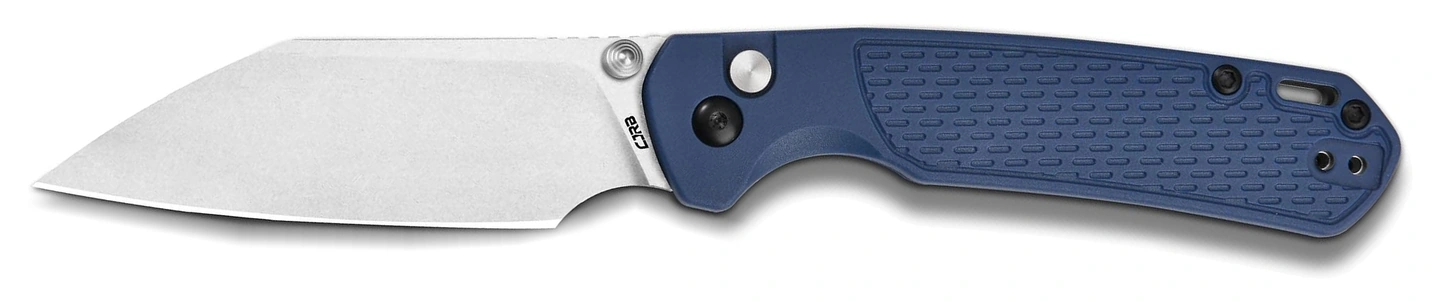
The Pyrite-Light gives you useful blade length without the weight of a steel-handled folder. This blue J1945-BU pairs a stonewashed AR-RPM9 blade with an FRN handle and button lock. Its mostly straight edge and low point make sense for opening packaging and following a short, controlled cut.
At 2.82 ounces, it is substantially lighter than the stainless-handled Ekko, even though both are 4.25 inches closed. That is why I'd choose it for a lighter everyday carry. The Maileah is smaller and lighter, but its shorter blade and handle are a different compromise. The Pyrite-Light suits someone who still wants a full-size folder.
The FRN handle keeps the weight down, with a more plainly plastic feel than the Ekko's metal scales. The blade also has less belly for long, sweeping cuts. If you are comparing Pyrite versions, our review of the original stainless-handled Pyrite covers the earlier J1925, not this Light. Its handle, blade shape and carry weight differ, so do not treat the two names as interchangeable.
Best for Opening Options: CJRB Ekko

| PROS | CONS |
|
|
The Ekko is the pick for someone who likes a front flipper but also wants a thumb hole to work with. This J1929B-ST is the stainless steel, button-lock version. It combines those opening options with a flat-ground AR-RPM9 blade and a low point, making it a useful alternative to the thumb-stud Pyrite-Light.
The steel handle is the deciding feature as much as the opening method. At 4.37 ounces, this version is appreciably heavier than the Pyrite-Light, with the same 4.25-inch closed length. Choose it because you prefer the metal handle and its controls, rather than expecting it to disappear in a light pocket. The smooth scales also have less texture than the G10 on the Maileah or Crag.
Front-flipper reach and technique vary with your hand size and preferences; the thumb hole gives you another option. Check the model suffix before ordering. The J1929B button-lock knife here differs from liner-lock Ekkos, and a lighter Micarta version's weight does not describe this steel-handled configuration.
Best Compact Carry: CJRB Maileah
| PROS | CONS |
|
|
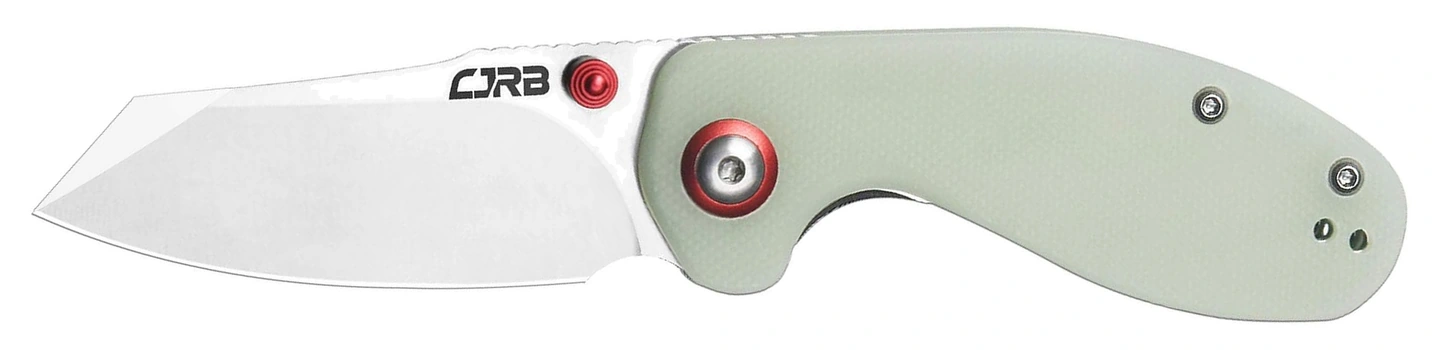
The Maileah earns its place by being small. This jade G10 J1918-NTG is only 3.14 inches closed, with a 2.39-inch blade and a 2.29-ounce weight. It is the smallest and lightest selection here, well suited to brief jobs such as cutting string or opening small packages when a larger folder would be inconvenient.
The short, broad blade keeps the point close to the handle, and the liner lock holds it open during use. You can open it with the front flipper or thumb studs. Having the studs matters on a knife this small: someone who finds the front-flipper reach awkward has a different opening method available.
The same compact handle that helps it fit a small pocket limits the room for your fingers. Move to the Pyrite-Light if you want more grip and reach for regular cutting. This is the original-sized Maileah, not the larger More Maileah; the selected jade version also has an uncoated blade rather than the black finish shown on some other listings.
Best Cleaver-Style Blade: CJRB Crag
| PROS | CONS |
|
|
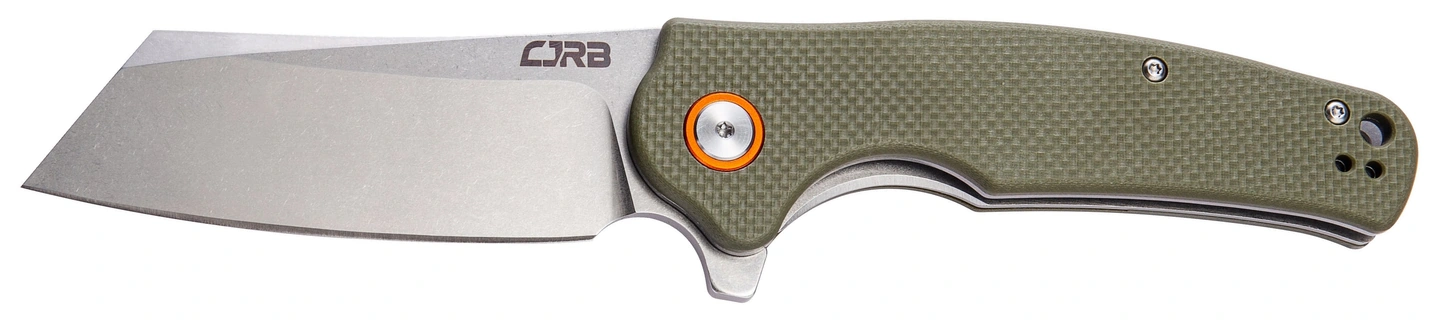
The Crag is the choice for someone who specifically wants a broad cleaver-style folder. This green G10 J1904-GNF has a 3.43-inch AR-RPM9 blade, flipper opening and liner lock. Its long handle and broad blade set it apart from the narrower everyday formats here, particularly if you prefer more blade area for slicing.
That shape asks more of your pocket. At 4.72 inches closed, it is longer than the other three, and the broad folded blade adds width. CJRB gives this version a weight of 6 ounces, while Blade HQ lists 4.88 ounces. Both figures put it above the other picks; if weight decides the purchase, ask the seller to confirm the current knife.
Choose the Crag for its cutting format, not because it looks like a miniature chopping tool. It is still a folding knife, and chopping, prying or cutting bones are poor uses for it. Match the green AR-RPM9 liner-lock version carefully: older D2 Crags and the Recoil-lock model are different configurations.
Compare Our Picks
Scroll sideways on smaller screens to compare all the details.
| Knife | Best for | Blade / steel | Weight |
|---|---|---|---|
| CJRB Pyrite-Light | Lightweight full-size carry | 3.34 in / AR-RPM9 | 2.82 oz |
| CJRB Ekko | Opening options | 3.23 in / AR-RPM9 | 4.37 oz |
| CJRB Maileah | Small pockets | 2.39 in / AR-RPM9 | 2.29 oz |
| CJRB Crag | Cleaver-style utility | 3.43 in / AR-RPM9 | 6 oz |
How to Choose a CJRB Knife
Start with what fits your pocket
If your current folder feels too bulky, decide which dimension bothers you. The Maileah reduces length as well as weight. The Pyrite-Light mainly reduces the weight of a full-size knife. The Crag moves in the opposite direction, with the largest folded footprint here.
Match the blade to ordinary cuts
For packaging, string and controlled utility work, a modest blade with an accessible point is often enough. A mostly straight edge offers a different cutting feel from a blade with more curve. Choose the Crag only if you want its broad format; extra width is not automatically useful on small jobs.
Choose controls you can use comfortably
Thumb studs, a thumb hole and a flipper ask for different movements. The Ekko offers a front flipper and hole, while the Maileah adds studs to its front flipper. Opening options do not guarantee a comfortable fit. On the liner-lock Maileah and Crag, move your thumb clear of the blade's closing path after releasing the lock.
Compare the actual configuration
Use the item number to check steel, handle, lock and finish before ordering. All four picks here use AR-RPM9, so paying attention to size, geometry and handle choice is more useful than treating their steel labels as a ranking. Keep any pocket knife clean, dry and sharp, and use it for cutting rather than twisting or prying.
Why Trust Us
I separate compact size from low weight, then weigh blade shape and controls against the work each knife suits. KnifeInformer's experience with the original Pyrite provides useful background, while this guide keeps that earlier model distinct from the Pyrite-Light. The Crag's conflicting published weights are explained alongside its recommendation.
Final Thoughts
I'd start with the Pyrite-Light if you want a full-size utility folder without much pocket weight. Choose the Maileah when compact size matters more, the Ekko for its metal handle and opening options, or the Crag because you specifically want a broad cleaver-style blade. Pick the format you will enjoy carrying and using, then confirm the exact version. For other makers worth comparing, see my guide to the best knife brands.
Frequently Asked Questions
Is the Pyrite-Light the same knife as the original Pyrite?
No. The selected Pyrite-Light J1945-BU has an FRN handle, a mostly straight-edged 3.34-inch blade and a 2.82-ounce weight. The earlier stainless-handled J1925 covered in our review has a different blade shape, handle and weight. Specifications and handling observations should stay with the version they describe.
Which CJRB knife here is the smallest?
The Maileah is 3.14 inches closed with a 2.39-inch blade. At 2.29 ounces, it is also the lightest of these four. The Pyrite-Light offers more blade and handle while staying relatively light for its size.
Do all CJRB knives use AR-RPM9?
No. These four selected configurations use AR-RPM9, but CJRB sells other steels and variations. Check the exact item number and selected options instead of assuming every Pyrite, Ekko or Crag has the same specification.
Which of these CJRB knives has a button lock?
The selected Pyrite-Light and stainless steel Ekko have button locks. The Maileah and green AR-RPM9 Crag use liner locks. A shared model name does not guarantee the same mechanism across all versions.
