


We independently evaluate all recommended products and services. Any products or services put forward appear in no particular order. If you click on links we provide, we may receive compensation.

Choosing a KA-BAR by blade size alone is an easy way to end up carrying more knife than you need. A long traditional fixed blade, a thick Becker and a light pocket folder answer very different needs, even with the same name on the box.
I'd decide between pocket and sheath carry first, then look at cutting geometry and grip. These four established designs cover distinct uses, with the construction, steel and carry tradeoffs that matter beyond the familiar military silhouette.
Key Considerations
- Choose pocket or sheath carry: The Dozier is a folding pocket knife with a clip. The other three need a sheath and more space on a belt or in your gear. Choose the carry format before being drawn to a familiar military shape.
- Look at construction, not just blade length: The USMC 1217 uses a narrow through-tang inside its leather handle. The BK2 and BK16 use full-width exposed tangs with removable scales. The BK2 also has much thicker blade stock than the BK16. Those are different designs, not a simple ranking by size.
- Check the exact steel and version: The three fixed blades use 1095 Cro-Van; the selected blue Dozier 4062D2 uses D2. Older AUS-8A Doziers are different configurations, and a shared model name does not establish the same edge performance.
- Inspect the carry package: The 1217 includes leather, the BK2 a hard plastic sheath and the BK16 a Cordura sheath. BK22 is a different sheath package for the BK2 format. Compare actual included pieces and attachments rather than assuming every model has the same setup.
Best KA-BAR Knives: Top Picks
- Best for General Camp Cutting: KA-BAR Becker BK16
- Best Classic KA-BAR: KA-BAR USMC
- Best Thick-Bladed Option: KA-BAR Becker BK2 Campanion
- Best Pocket Knife: KA-BAR Dozier D2
Best for General Camp Cutting: KA-BAR Becker BK16

| PROS | CONS |
|
|
The BK16 is the one I'd start with for cord, light carving and everyday utility around camp. Its 4.375-inch flat-ground drop-point blade offers useful reach without the USMC's seven-inch length. At 0.165 inches thick, it also avoids the BK2's quarter-inch stock, which is a more sensible compromise when cutting matters more than sheer thickness.
The blade's full-width tang sits between removable black Ultramid scales. That gives you a different construction from the narrow through-tang USMC without requiring the BK2's much larger blade cross-section.
The standard package includes a MOLLE-compatible Cordura sheath, and KA-BAR also specifies an extra set of brown handles. The fabric sheath is part of the carry decision: it is less minimal than a close-fitting custom sheath, but already supplies a practical way to cover and carry the blade. Check the included package when comparing another retailer's price.
The 1095 Cro-Van blade still needs care. Its coating does not protect the exposed edge from rust, so clean and dry it after food, wet vegetation or damp storage. If you need a knife for frequent pocket access, take the Dozier instead; if you specifically want quarter-inch stock, the BK2 is the distinct alternative.
Best Classic KA-BAR: KA-BAR USMC
| PROS | CONS |
|
|
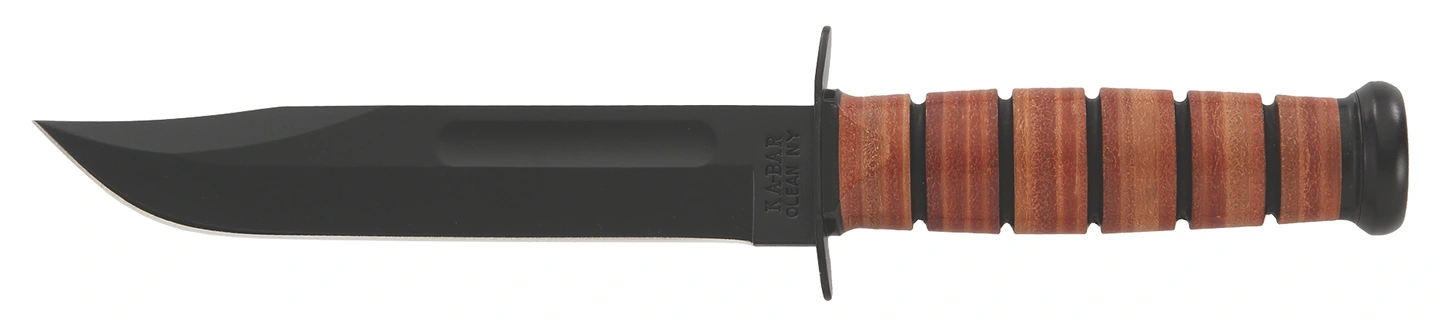
The 1217 is the familiar KA-BAR shape: a seven-inch clip-point blade, stacked-leather handle, guard and leather sheath. Choose it because that long, traditional utility format appeals to you. Its history does not automatically make it the most useful knife for your next camping trip.
At 11.875 inches overall, it has substantially more blade and handle to accommodate than the BK16. The long edge provides reach, but the size and guard are less convenient when a short blade would give you easier control. For ordinary small camp jobs, I'd choose the more manageable BK16.
The tang runs through the leather handle to the pommel, but it is narrower than the exposed full-width tang on the Beckers. Do not confuse those constructions or treat either as permission to pry. The knife is US-made; its supplied leather sheath is made in Mexico. Dry both the knife and leather after use, and avoid storing them damp.
The linked Amazon option is the 1217CP clam-pack version, with the same plain-edge knife and leather sheath. Match those pieces when comparing it with boxed, serrated or commemorative versions.
Best Thick-Bladed Option: KA-BAR Becker BK2 Campanion
| PROS | CONS |
|
|
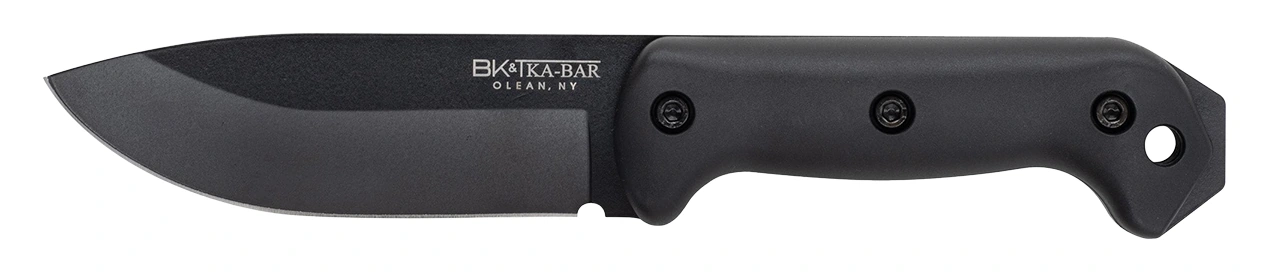
The BK2 is the choice for someone deliberately seeking a thick, substantial fixed blade. Its 5.25-inch 1095 Cro-Van blade is a quarter-inch thick, with a full-width exposed tang and removable Ultramid scales. That construction is its distinguishing feature, rather than simply being a larger BK16.
The cost of that thickness is cutting geometry and carry bulk. If your usual jobs are slicing food, opening supplies and making small controlled cuts, the BK16 is the more sensible choice. The BK2 belongs on the shortlist because some readers specifically want its substantial format, not because more steel always improves a knife.
This is the BK2 with a hard plastic sheath. The BK22 uses a different Cordura carry package, so check the item number when offers look similar. Our military survival knife guide puts the BK2 in a broader field of outdoor knives and discusses that package distinction.
Treat it as a cutting tool even when the construction looks imposing. Use an appropriate saw or splitting tool for substantial wood processing rather than relying on the knife's thickness as a guarantee. Clean and dry the blade after use, paying attention to the exposed carbon-steel edge and any moisture trapped around the scales.
Best Pocket Knife: KA-BAR Dozier D2

| PROS | CONS |
|
|
The Dozier D2 is the clear alternative when you want a KA-BAR for ordinary pocket tasks. Its three-inch hollow-ground blade, lockback and Zytel handle are a very different proposition from a large field knife. At 2.4 ounces, it gives you a compact cutting tool without adding a separate sheath to your belt.
This is the blue 4062D2 made in Taiwan, with D2 tool steel. The pocket clip and single thumb stud are reversible for setup on either side; it does not have a pair of studs simply because some listing bullets describe it that way. Choose it for the straightforward format rather than expecting a polished metal handle or an elaborate opening mechanism.
For earlier context, our Dozier review covers Advanced Knife Bro's AUS-8A sample. He reported deliberate thumb-stud opening and a stiff lockback on that knife. Those observations are tied to his sample, and its cutting performance should not be transferred to the D2 blade selected here.
D2 is not a maintenance-free stainless substitute. Clean and dry it after use, especially after moisture or food, and keep the pivot and lock clear of grit. Use controlled closing movements with fingers clear of the blade. Choose one of the fixed blades if a sheath and a fuller field-knife handle better suit your routine.
Compare Our Picks
Scroll sideways on smaller screens to compare all the details.
| Knife | Best for | Blade / steel | Carry |
|---|---|---|---|
| KA-BAR Becker BK16 | General camp cutting | 4.375 in / 1095 Cro-Van | Cordura sheath |
| KA-BAR USMC | Traditional long blade | 7.0 in / 1095 Cro-Van | Leather sheath |
| KA-BAR Becker BK2 Campanion | Thick-bladed construction | 5.25 in / 1095 Cro-Van | Hard plastic sheath |
| KA-BAR Dozier D2 | Pocket carry | 3.0 in / D2 tool steel | Reversible pocket clip |
How to Choose a KA-BAR Knife
Start with where it will live
A knife in an ordinary trouser pocket should be compared with the Dozier first. If you will wear or pack a sheath, the BK16 is the general camp starting point. Choose the USMC for its long traditional pattern or the BK2 because you have a reason to want its much thicker blade. Neither is an automatic upgrade for small cutting jobs.
Separate thickness from useful cutting
The BK2's quarter-inch blade is a distinct construction choice. The BK16 uses thinner stock and a shorter blade than the USMC, which suits more modest field tasks. Consider blade geometry, tang construction and the shape of the handle together.
Compare the complete carry setup
KA-BAR does not say whether its fixed-blade weights include the sheath, so those figures are not a knife-only comparison. Check the weight and attachment of the actual setup you will carry. The 1217's leather, BK2's hard plastic and BK16's Cordura sheaths also ask for different storage and attachment choices. The Dozier avoids a sheath, but adds a pivot and lock to keep clean.
Confirm steel and care before ordering
Match the model number as well as the handle color and photograph. The blue 4062D2 is distinct from older AUS-8A Doziers. Both its D2 blade and the fixed blades' 1095 Cro-Van need drying and rust prevention. Blade coatings leave the cutting edge exposed, and a leather sheath should never become a damp storage pouch.
Why Trust Us
I separate pocket carry from field-knife use, then compare blade geometry, tang construction and the included sheath. KnifeInformer's earlier Dozier review adds context about that design, with Advanced Knife Bro's observations kept with his AUS-8A sample. The model specifications here identify the versions being recommended.
Final Thoughts
I'd start with the BK16 for general camp cutting or the Dozier D2 for pocket carry. Choose the USMC 1217 because you want its long traditional format, or the BK2 because its thick-bladed construction answers a particular preference. The useful KA-BAR is the one whose size, carry setup and care needs fit your regular cutting jobs. For other makers worth comparing, see my guide to the best knife brands.
Frequently Asked Questions
Which KA-BAR is best for everyday carry?
Among these picks, the Dozier D2 is the pocket-carry option. It has a three-inch locking blade and a pocket clip, avoiding the separate sheath required by the fixed blades. For a sheathed knife around camp, I'd start with the BK16.
Are all KA-BAR knives made in the USA?
No. The selected USMC 1217, Becker BK2 and BK16 knives are US-made; the Dozier 4062D2 is made in Taiwan. Sheath origin can differ from knife origin as well. Check the exact model and package rather than applying one country label to the whole brand.
What is the difference between the Becker BK2 and BK22?
The BK2 selected here comes with a hard plastic sheath. The BK22 uses a Cordura sheath package for the same basic Campanion design. Compare the actual included sheath and attachment arrangement instead of treating them as two entirely different cutting roles.
Is the USMC 1217 constructed like a Becker?
No. Its narrow tang runs through the stacked-leather handle, while the BK2 and BK16 use exposed full-width tangs between removable scales. That difference is more useful to understand than a generic full-tang label. Neither construction makes a knife suitable for every task.
Is the Dozier D2 the same as the older AUS-8A Dozier?
The selected blue 4062D2 has a D2 blade; the older AUS-8A knife covered in our individual review is a different steel configuration. Do not assume a current listing, old review and similarly colored knife all describe the same version. Check the exact item number and steel.
